
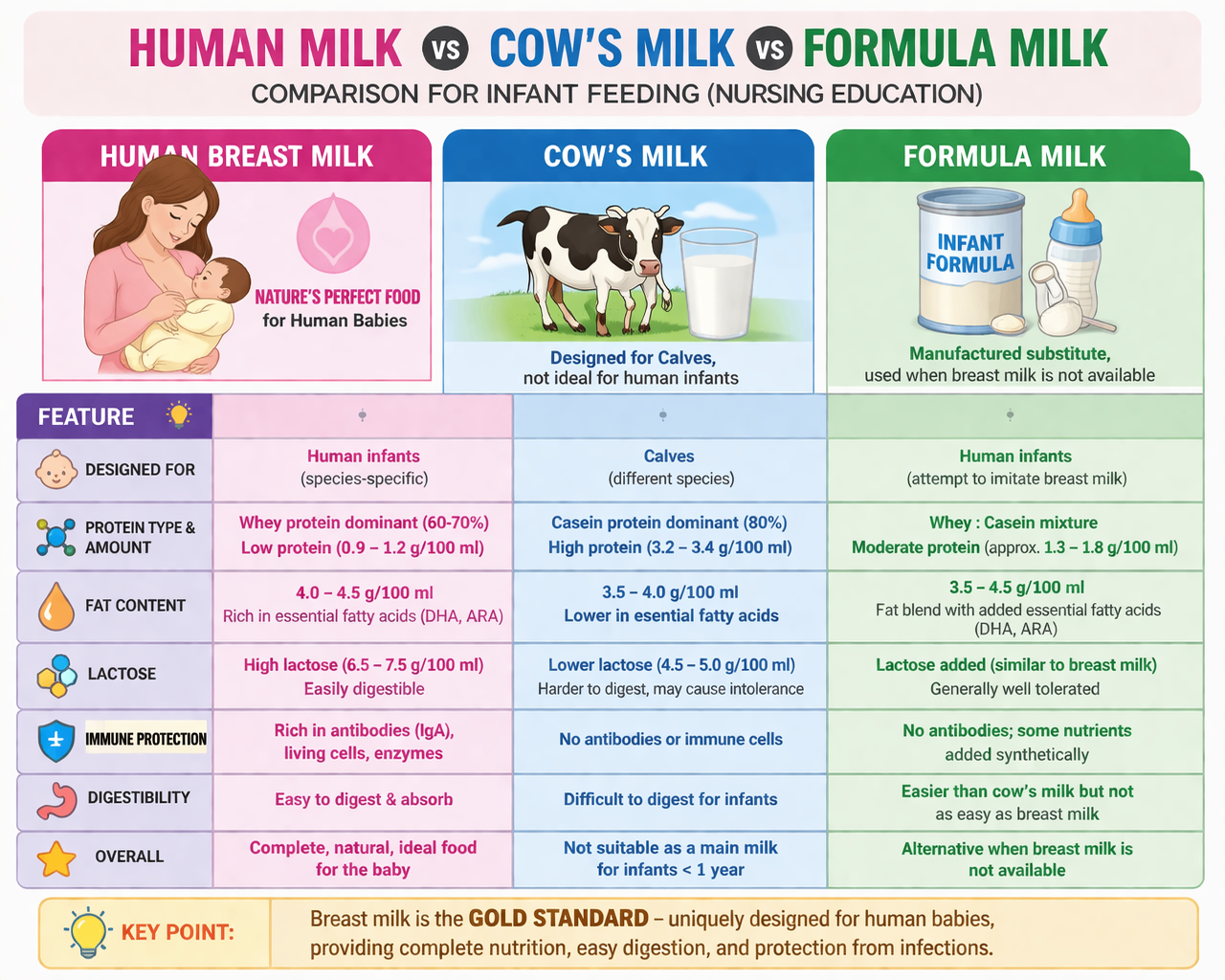
Every baby born into this world deserves the best possible start in life. And nature has already made sure of that — through mother's milk.
Breast milk is the most natural and perfect food a mother can give her newborn baby. It is not just milk. It is a complete package of nutrition, protection, and love — made fresh inside a mother's body, specifically for her own baby.
From the very first feed, breast milk gives the baby everything it needs — the right proteins, the right fats, the right sugars, vitamins, and minerals — all in the perfect amounts. Along with this, it carries powerful antibodies that protect the baby from infections, diseases, and allergies in those early, fragile months when the baby has no defense of its own.
Cow's milk is made for baby calves — not human babies. It contains proteins and minerals that are too heavy and too strong for a newborn's tiny, sensitive stomach and kidneys to handle.
Formula milk is made in factories. No matter how advanced the technology, it can never fully copy what a mother's body naturally produces. It lacks the living antibodies, the hormones, and the emotional connection that come with breastfeeding.
A baby's body, brain, and immune system are all designed to grow on human milk. It is simple — human babies need human milk.
Breastfeeding is not just feeding. It is the first and most powerful act of care, protection, and bonding between a mother and her child.
What is Human Breast Milk?
Human breast milk is the natural milk produced by a mother's body in her mammary glands (breasts) after giving birth. It is the first and most complete food nature has created exclusively for newborn human babies.
It is a Living Fluid
Unlike any other food or drink, human breast milk is not just a liquid — it is a living biological fluid that contains:
Millions of live cells, including immune cells and stem cells
Antibodies that fight infections
Hormones that regulate the baby's growth and sleep
Enzymes that help digestion
Beneficial bacteria that build the baby's gut health
What is it made of?
Component | Purpose | ||
|---|---|---|---|
Water (88%) | Keeps baby hydrated | ||
Lactose (sugar) | Provides energy for brain development | ||
Proteins | Builds muscles and organs | ||
Healthy fats | Fuels brain and nervous system growth. (DHA, Docosahexaenoic acid, an essential omega-3 fatty acid crucial for brain health, eye function, and infant development) | ||
Vitamins and minerals | Supports bones, eyes, and immunity | ||
Antibodies (IgA) | Protects from infections and allergies | ||
Growth factors | Helps the gut and organs mature |
It Changes Every Day
Human breast milk is remarkably intelligent — it automatically changes its composition:
Colostrum — thick golden milk in the first 3 days, packed with antibodies and immunity
Transitional milk — days 4 to 14, gradually increases in volume
Mature milk — from day 15 onward, full nutrition for the growing baby
It even changes within a single feed — watery milk at the start to quench thirst, and rich creamy milk at the end to satisfy hunger.
Human breast milk is nature's most perfectly designed food — a warm, living, intelligent fluid that nourishes, protects, and nurtures a human baby in a way nothing else on earth can match.
Breast Milk Secretion After Delivery
Stages of Breast Milk Production
1. Colostrum (Days 1–5) The first milk produced is colostrum — a thick, yellowish fluid secreted in small but highly concentrated amounts:
Volume: roughly 5–15 mL per feeding (about 30–100 mL/day total)
Though small in quantity, it is extremely rich in immunoglobulins (especially IgA), white blood cells, growth factors, and protein
It acts as the newborn's first "immunization," coating the gut (gastrointestinal tract) lining and protecting against pathogens
2. Transitional Milk (Days 5–14)
Volume increases rapidly to 300–500 mL/day
Fat and lactose content rise; immunoglobulin concentration decreases
The breasts begin to feel fuller as supply ramps up
3. Mature Milk (From ~2 Weeks Onwards)
A fully established supply produces approximately 750–800 mL/day on average (range: 450–1,200 mL/day)
By 1 month, output stabilizes based on infant demand (supply-and-demand regulation)
Composition shifts between foremilk (thinner, hydrating) and hindmilk (richer in fat, more calorie-dense)
Is It Sufficient for the Baby?
Yes — exclusively for the first 6 months, according to the WHO, AAP(American Academy of Pediatrics), and virtually all major health bodies. Here's why:
Nutrient Need | Breast Milk Coverage | |
|---|---|---|
Calories | ~65–70 kcal/100 mL; fully meets infant needs | |
Protein | Whey-dominant (higher ratio of whey protein than casein protein), highly bioavailable (rate and extent to which a substance is absorbed into the body's systemic circulation); sufficient | |
Fat | Rich in DHA/ARA (Arachidonic Acid), which is an essential omega-6 fatty acid found naturally in breast milk) for brain & retinal development | |
Carbohydrates | Lactose + human milk oligosaccharides (HMOs) for gut health | |
Immune factors | IgA, lactoferrin, lysozyme, macrophages — unmatched by formula.
| |
Hydration | ~88% water; no supplemental water needed |
Supplementation Needed
Vitamin D: Breast milk is low in Vitamin D; supplementation (400 IU/day) is recommended for breastfed infants
Vitamin B12: May be deficient if the mother is a vegetarian
Iron: Sufficient for the first ~4–6 months, but iron-rich foods or supplements become necessary after that
Vitamin K: Given as an injection at birth since breast milk levels are low
Beyond 6 Months
Breast milk remains highly beneficial well beyond 6 months but cannot alone meet all nutritional needs (especially iron, zinc, and energy) as the baby grows. Complementary solid foods are introduced from 6 months, while breastfeeding continues ideally up to 2 years or beyond (WHO recommendation).
In summary, the mother's body is remarkably calibrated — even the small colostrum volumes in the first days are perfectly designed for a newborn's tiny stomach (~5–7 mL capacity at birth) and immune needs, scaling up precisely as the baby grows.
Breast Milk Production After 6 Months
Does the Volume Decrease?
Not automatically — the volume does not simply drop at the 6-month mark. Production continues to be governed by the supply-and-demand principle: The more milk that is removed from the breast, the more the body produces. However, several factors cause a gradual, natural shift in volume over time.
What Actually Happens to Volume Over Time
Period | Approximate Daily Volume | What's Happening |
|---|---|---|
1–6 months | ~750–800 mL/day | Peak exclusive breastfeeding |
6–12 months | ~500–600 mL/day | Solids introduced; baby is fed less frequently |
12–18 months | ~300–500 mL/day | Solids become a major food source |
18–24 months | ~200–400 mL/day | Breastfeeding is often reduced to a few times a day |
Beyond 24 months | Highly variable | Depends entirely on how often the child is being fed |
Why Volume Gradually Reduces After 6 Months
1. Introduction of Complementary Foods
As solids are introduced from 6 months, the baby's dependence on breast milk for calories decreases
Fewer breastfeeding sessions = less stimulation = less milk produced
This is a natural and healthy transition, not a failure of supply
2. Reduced Breastfeeding Frequency
Older babies sleep longer stretches and feed less frequently
Each missed feeding sends a signal to the body to produce slightly less
3. Baby's Growing Efficiency
Older babies sucks faster and more effectively, so sessions become shorter — this can sometimes be mistaken for low supply
4. Maternal Hormonal Changes
Return of menstruation (often around 6–12 months postpartum) can cause a temporary decrease in milk production around ovulation/menstruation due to hormonal fluctuations.
Reasons:
Hormones that SUPPORT milk production:
Prolactin — the primary milk-making hormone
Oxytocin — the milk-release hormone
Hormones that SUPPRESS milk production:
Estrogen — rises during the menstrual cycle
Progesterone — rises after ovulation
A new pregnancy, if it occurs, causes the supply to drop significantly
Progesterone levels in pregnancy are 10–20 times higher than during the normal luteal phase of the menstrual cycle — this is a far more powerful suppression than the temporary monthly dip during menstruation.
Does the Quality of Milk Change?
This is a very important point — even as volume decreases, the nutritional and immunological quality of breast milk adapts remarkably:
Fat and caloric density increase to compensate for lower volume
Immunoglobulin concentration (IgA) actually rises in the second year, providing continued immune protection
Growth factors, hormones, and bioactive compounds remain present
The milk essentially becomes more concentrated and targeted as volume falls
Conclusion:
Volume ob breast milk decreases gradually and naturally after 6 months — driven by reduced nursing demand as solids are introduced — but the milk becomes richer and more immunologically potent. The baby's nutrition is increasingly shared between breast milk and complementary foods, which is exactly how nature intends the weaning process to work.
As long as the mother continues to breastfeed on demand, meaningful and beneficial milk production can continue well into the second year and beyond.
Cow's Milk: Naturally Designed for Calves
This is a profound and often overlooked biological fact. Just as human breast milk is perfectly designed for human babies, cow's milk is perfectly engineered by nature for calves — and the two are vastly different.
Why Cow's Milk is Designed for Calves
A calf at birth:
Weighs around 40–50 kg (vs a human newborn at ~3–3.5 kg)
Needs to stand and walk within hours of birth
Must grow rapidly — doubling its weight in about 47 days (vs ~180 days for a human infant)
Has a four-chambered stomach designed to digest cow's milk
Needs massive muscle and bone growth, not brain development
So cow's milk is naturally formulated to meet these specific calf needs — not human needs.
Key Compositional Differences
Component | Human Breast Milk | Cow's Milk | Implication |
|---|---|---|---|
Protein | ~1 g/100 mL (whey-dominant) | ~3.4 g/100 mL (casein-dominant) | Cow's milk has 3x more protein — far too much for human infant kidneys |
Casein ratio | 40:60 (whey:casein) | 20:80 (whey:casein) | Cow's milk casein forms tough, hard curds — difficult for human babies to digest |
Fat | Rich in DHA, ARA (brain fats) | Low in DHA | Human milk prioritizes brain growth; cow's milk prioritizes body/muscle growth |
Carbohydrates | High lactose + HMOs (gut health) | Lower lactose, no HMOs | Human milk feeds beneficial gut bacteria uniquely |
Sodium/minerals | Low and gentle | Very high | High mineral load stresses human infant kidneys |
Iron | Low but highly bioavailable (~50%) | Very low and poorly absorbed (~10%) | Cow's milk iron is largely unusable by humans |
Growth hormones | Human-specific IGF(Insulin-like Growth Factor — it is a naturally occurring hormone/protein produced mainly by the liver, and it plays a crucial role in stimulating growth, cell division, and development throughout the body.) | Bovine IGF (bovine growth hormone) | Designed to grow a large animal body rapidly |
Immune factors | IgA, lactoferrin, and lysozyme for humans | Bovine-specific immune factors | Immune protection is species-specific |
The Brain vs Body Growth Difference
Calves are born neurologically near-complete — they walk, stand, and function almost immediately. They need body growth, not much brain development.
Human babies are born neurologically immature — the brain grows to 3x its birth size in the first 2 years. They need brain-building fats (DHA, ARA, cholesterol), which human milk is rich in, and cow's milk is not.
Nature designed cow's milk to build a big body fast. Nature designed human milk to build a complex brain slowly.
What Happens When Infants Are Given Cow's Milk Too Early?
Giving cow's milk to babies under 12 months can cause:
Intestinal microbleeding — cow's milk proteins irritate the infant gut lining, causing tiny blood losses leading to iron deficiency anemia
Kidney overload — excess protein and minerals overwhelm immature infant kidneys
Allergies — bovine proteins are foreign to the human immune system
Nutritional deficiencies — lack of adequate Vitamin C, iron, and the right fatty acids for human development
This is why WHO, AAP, and all major health bodies say cow's milk should NOT be given to infants under 12 months.
After 12 Months — Is Cow's Milk Okay?
Yes, in moderation, once the baby's digestive system and kidneys have matured:
The gut can better handle bovine proteins
Kidneys can manage the higher mineral load
It becomes a useful source of calcium, Vitamin D, and protein
However, even then, it is not nutritionally equivalent to breast milk — it is simply a convenient food source for older children and adults.
Conclusion:
Cow's milk is a perfect food — but perfect for calves, not human infants. It reflects millions of years of bovine evolution to meet bovine needs. Human milk reflects millions of years of human evolution to meet human needs — especially the extraordinary demands of growing the most complex brain in the animal kingdom.
Formula milk: A manufactured alternative to breast milk
Nutrition
Made from cow’s milk or soy (or soybean), modified to resemble breast milk
Fortified with iron, vitamin D, & other nutrients
Benefits
Convenient and flexible
Allows others to feed the baby
Necessary when breastfeeding isn’t possible
Limitations
No natural antibodies
Slightly harder to digest
Requires proper preparation & hygiene
Which is Better?
Breast milk is biologically ideal for most babies.
Formula is a safe and nutritious alternative when needed.
In some cases, doctors may recommend formula ( medical issues, adoption, working mothers, etc.).
Mixed feeding (also called combination feeding) means giving your baby both breast milk and formula milk.
It can be a helpful option when exclusive breastfeeding is not possible or practical.
When
Low breast milk supply
Working mother
Medical reasons (mother or baby)
The baby is not gaining enough weight
Personal choice
Benefits
Baby still Gets Immunity, as partial breastfeeding provides antibodies and immune protection.
More Flexibility as other family members can help with feeding.
Balanced option is a useful transition method when moving from breastfeeding to formula.
Limitations:
Breast milk supply may decrease if formula replaces too many feeds
Baby may develop *“nipple confusion” (switching between breast and bottle) *Nipple confusion happens when a baby has difficulty switching between breastfeeding and artificial nipples (like bottle teats or pacifiers), leading to poor latching or ineffective feeding.
Risk of overfeeding with bottles
Tips for Successful Mixed Feeding
Breastfeed first, then offer formula if needed.
Maintain regular breastfeeding to protect milk supply.
Use slow-flow nipples to reduce nipple confusion.
Follow proper hygiene while preparing the formula.
Watch baby’s hunger and fullness cues.
Recommendation
The World Health Organization recommends exclusive breastfeeding for 6 months when possible. However, mixed feeding can be a safe and practical solution if needed.