
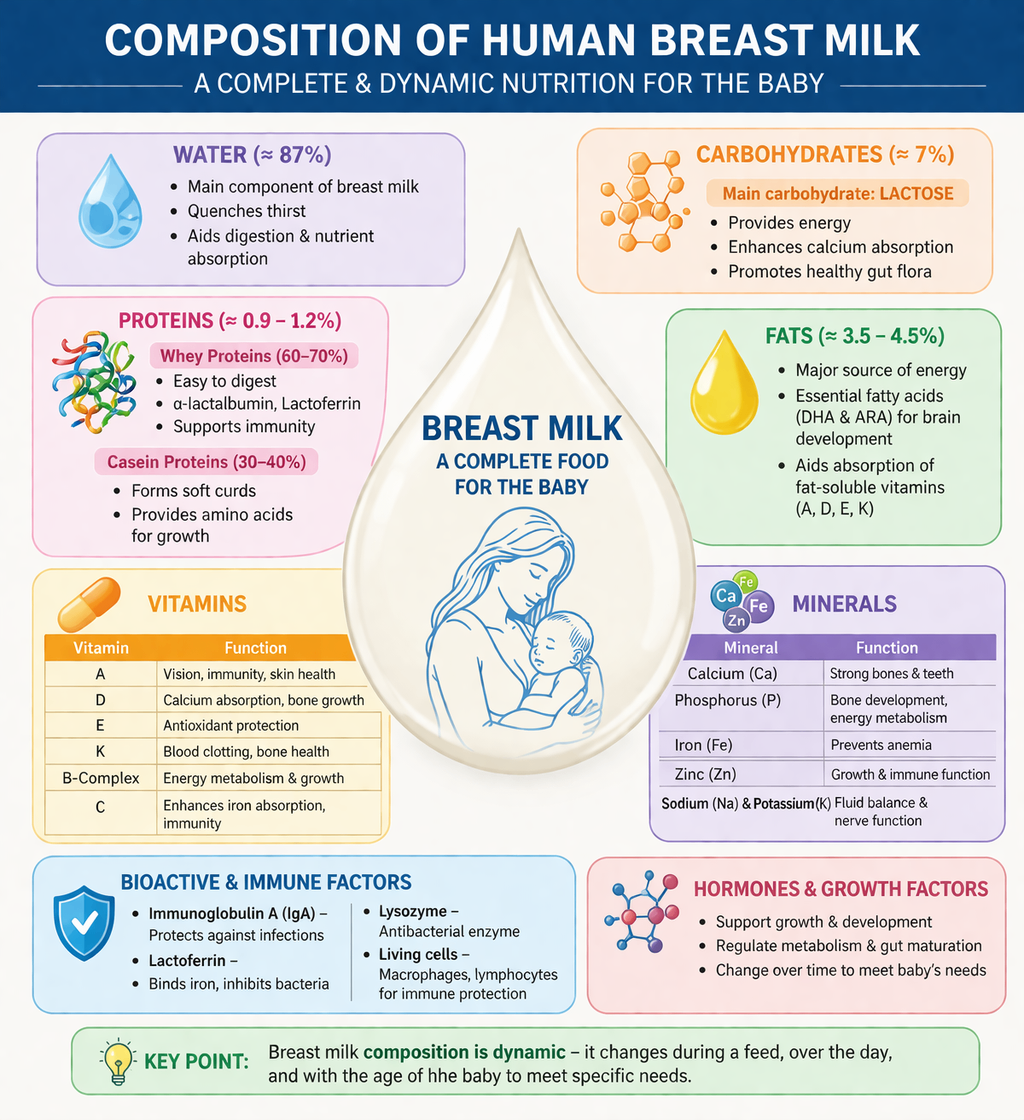
Human breast milk is a complex, dynamic, and living biological fluid that provides the ideal nutrition for infants. It is uniquely tailored to meet the changing needs of a growing baby and contains the perfect balance of nutrients required for healthy growth and development. Unlike formula milk, breast milk continuously adapts according to the infant’s age, developmental stage, health condition, and feeding requirements. Its composition can vary from day to day, throughout the course of a single feeding, and even between mothers. Each mother's milk is slightly different because it is tailored to her own baby's needs, influenced by factors such as the baby's age, health, and the mother's body, ensuring that each baby receives personalized nourishment.
Breast milk is composed of water, carbohydrates, proteins, fats, vitamins, minerals, enzymes, hormones, antibodies, and numerous bioactive substances that work together to support the infant's physical, cognitive, and immune development. In the first few days after birth, mothers produce colostrum, often called "liquid gold," which is rich in antibodies and protective factors that help safeguard newborns from infections. As lactation progresses, the milk gradually changes to mature milk, providing optimal nutrition for the infant’s growing needs.
Beyond nutrition, breast milk contains living cells, immune components, growth factors, and beneficial microorganisms that help develop a healthy digestive system, strengthen immunity, and promote brain development. These unique properties make breast milk far more than just food—it is a complete biological system designed by nature to nourish, protect, and support the infant's overall well-being. For this reason, breast milk is widely recognized as the gold standard for infant feeding and the most natural source of nourishment during the early months of life.
Composition of Breast Milk
Human breast milk is approximately 87% water and 13% solids, providing all the nutrients and protective factors needed for an infant's growth and development. Its major components include:
1. Water (87%) (no extra water needed for first 6 months)
Maintains hydration and fluid balance.
Provides all the water a healthy infant needs during the first six months of life.
2. Carbohydrates (mainly lactose)
The primary source of energy.
Helps in brain development and calcium absorption.
Supports the growth of beneficial intestinal bacteria.
Human Milk Oligosaccharides (HMOs): Feed beneficial gut bacteria, protect against infections, act as prebiotics (Prebiotics are types of dietary fiber that feed the good bacteria in the gut.)
3. Fats (~3–5%)
Main energy source (about 50% of total calories)
Includes:
Triglycerides
DHA (Docosahexaenoic acid, an essential omega-3 fatty acid) → brain & eye development
Arachidonic acid
Cholesterol (important for hormone & brain development)
Fat content increases toward the end of a feed (hindmilk).
4. Proteins (~0.8–1%)
Lower than cow’s milk (easier to digest)
Two main types:
Whey (60–70%) Lactoferrin (iron absorption, antibacterial) Immunoglobulin A (IgA) Lysozyme
Casein (30–40%) provides amino acids. It forms soft curds (easy digestion)
5. Vitamins
Provides vitamins A, D, E, K, C, and B-complex vitamins.
Supports vision, bone health, immunity, and metabolism.
Vitamin A
Vitamin D (may need supplementation depending on the mother)
Vitamin E
Vitamin K
B-complex vitamins
Vitamin C
6. Minerals
Lower than cow’s milk but better absorbed:
Important for bone formation, blood production, and overall growth.
Calcium
Phosphorus
Magnesium
Iron (high absorption rate ~50%)
Zinc
Sodium
Potassium
7. Immunological Components
Human milk is biologically active and contains:
Antibodies (especially IgA)
White blood cells
Cytokines
Growth factors
Antiviral & antibacterial agents
Provides passive immunity to the baby.
8. Hormones & Enzymes
Leptin (appetite regulation)
Adiponectin
Cortisol
Lipase (fat digestion)
Amylase
9. Hormones and Growth Factors
Support growth, appetite regulation, and organ development.
Help mature the digestive and immune systems.
10. Living Cells and Beneficial Bacteria
Includes white blood cells and probiotics.
Help fight infections and establish a healthy gut microbiome.
Together, these components make breast milk a unique, living fluid that provides complete nutrition, immune protection, and developmental support for infants.
Types of Breast Milk and How It Changes Over Time
Breast milk changes continuously to meet the growing needs of the infant. The different types of breast milk produced over time are:
1. Colostrum (First Milk)
Produced during pregnancy and in the first 2–5 days after birth.
Thick, sticky, and yellowish in color.
Rich in proteins, antibodies (especially IgA), vitamins, and immune factors.
Low in fat and sugar but highly concentrated with protective nutrients.
Helps protect newborns from infections and supports the development of the digestive system.
Often called "liquid gold" because of its immense health benefits.
2. Transitional Milk
Produced from approximately day 5 to day 14 after birth.
Represents the transition between colostrum and mature milk.
Contains increasing amounts of fat, lactose, and calories.
Supports rapid growth and increased energy needs of the infant.
The volume of milk production rises significantly during this period.
3. Mature Milk
Produced from about 2 weeks after birth onward.
Contains the ideal balance of water, carbohydrates, fats, proteins, vitamins, and minerals.
Provides complete nutrition for the growing baby.
Continues to adapt according to the infant's needs and health status.
Mature milk consists of:
Foremilk
Released at the beginning of a feeding.
Thin, watery, and lower in fat.
Rich in lactose and water.
Helps satisfy the baby's thirst.
Hindmilk
Released toward the end of a feeding.
Thicker and creamier.
Higher in fat and calories.
Provides energy and supports healthy weight gain.
Thus, breast milk is a dynamic, living fluid that changes from colostrum to transitional milk to mature milk, ensuring that the infant receives the right nutrition and protection at every stage of growth and development.
The protein content of mature human breast milk is approximately:
0.8–1.2 grams per 100 mL of milk
This equals about 0.8–1.2% protein by weight
Distribution of Proteins in Breast Milk
Whey proteins: ~60–70%
Lactoferrin
Alpha-lactalbumin
Immunoglobulins (antibodies)
Lysozyme
Casein proteins: ~30–40%
Help deliver calcium and phosphorus
Contribute to infant growth
Changes Over Time
Colostrum: Highest protein content (about 2–3%)
Transitional milk: Protein gradually decreases
Mature milk: Protein stabilizes at about 0.8–1.2%
Although breast milk contains a relatively low percentage of protein compared to many animal milks, its proteins are highly digestible and perfectly suited to support infant growth, brain development, and immune protection.
The carbohydrate content of mature human breast milk is approximately:
6.7–7.8 grams per 100 mL of milk
This equals about 7% carbohydrate by weight
Main Carbohydrate in Breast Milk
Lactose is the primary carbohydrate and accounts for most of the carbohydrate content.
Human milk also contains Human Milk Oligosaccharides (HMOs), which act as prebiotics and support the growth of beneficial gut bacteria.
Functions of Carbohydrates in Breast Milk
Provide a major source of energy for the infant.
Support brain and nervous system development.
Enhance calcium and mineral absorption.
Promote the growth of healthy intestinal bacteria.
Help protect against infections by supporting gut health.
Changes Over Time
Colostrum: Lower carbohydrate content (about 5–6%).
Transitional milk: Carbohydrate levels increase.
Mature milk: Carbohydrate content stabilizes at approximately 7%.
Thus, carbohydrates make up about 7% of breast milk, with lactose serving as the main energy source for the growing infant.
The fat content of mature human breast milk is approximately:
3.5–4.5 grams per 100 mL of milk
This equals about 3.5–4.5% fat by weight
Functions of Fat in Breast Milk
Provides about 50% of the baby's total energy needs.
Supports brain and nervous system development.
Aids in the absorption of fat-soluble vitamins (A, D, E, and K).
Supplies essential fatty acids, including DHA (Docosahexaenoic acid)and ARA (Arachidonic acid), which are important for vision and cognitive development.
Changes Over Time
Colostrum: Lower fat content (about 2–3%).
Transitional milk: Fat content gradually increases.
Mature milk usually contains 3.5–4.5% fat.
Foremilk: Lower in fat.
Hindmilk: Higher in fat and calories, providing extra energy and promoting weight gain.
Key Point
Fat is the most variable component of breast milk. Its concentration can change during a feeding, throughout the day, and from mother to mother, helping meet the infant's changing energy needs.
Average Nutritional Value of Human Breast Milk (per 100 mL)
Nutrient | Average Amount |
|---|---|
Energy | 65–70 kcal |
Water | 87 g (87%) |
Carbohydrates | 6.7–7.8 g (≈7%) |
Fat | 3.5–4.5 g (≈4%) |
Protein | 0.8–1.2 g (≈1%) |
Lactose | 6.5–7.0 g |
Calcium | 25–35 mg |
Phosphorus | 10–15 mg |
Magnesium | 3–4 mg |
Potassium | 50–60 mg |
Sodium | 15–20 mg |
Iron | 0.03–0.1 mg |
Vitamin A | 35–75 µg |
Vitamin C | 3–5 mg |
The exact amount depends on the mother's dietary vitamin C intake and nutritional status. Breastfed infants normally receive sufficient vitamin C from breast milk, provided the mother has an adequate intake of vitamin C-rich foods such as citrus fruits, guava, amla, tomatoes, and green leafy vegetables.
Difference Between Breast Milk and Cow's Milk in Respect of Their Nutritive Value (per 100 mL)
Nutrient | Human Breast Milk | Cow's Milk |
|---|---|---|
Energy | 65–70 kcal | 60–67 kcal |
Water | 87% | 87% |
Protein | 0.8–1.2 g | 3.2–3.5 g |
Fat | 3.5–4.5 g | 3.5–4.0 g |
Carbohydrate (Lactose) | 6.7–7.8 g | 4.5–5.0 g |
Calcium | 25–35 mg | 110–125 mg |
Phosphorus | 10–15 mg | 90–100 mg |
Iron | 0.03–0.1 mg | 0.02–0.05 mg |
Vitamin C | 3–10 mg | 0–2 mg |
Digestibility | Easily digested | More difficult to digest |
Antibodies & Immune Factors | Present | Absent |
Essential Fatty Acids (DHA, ARA) | Present | Very low |
Suitability for Infants | Ideal and complete food | Not recommended as the main drink before 12 months |
Key Differences
Breast milk contains less protein but is easier for infants to digest.
Breast milk contains more lactose, which supports brain growth and calcium absorption.
Cow's milk contains much higher amounts of protein, calcium, and phosphorus, which can place extra strain on an infant's immature kidneys.
Breast milk contains antibodies, enzymes, hormones, and living cells that help protect against infections, while cow's milk does not.
Breast milk is specifically designed for human infants, whereas cow's milk is designed to support the rapid growth of calves.
Conclusion
Breast milk is the most suitable source of nutrition for infants because it provides the ideal balance of nutrients along with immune protection and developmental benefits. Although cow's milk is nutritious for older children and adults, it does not provide the same biological and protective advantages as human breast milk.
Breast milk is sweeter than cow's milk.
Why?
Breast milk contains a higher amount of lactose (milk sugar) than cow's milk.
Component | Breast Milk | Cow's Milk |
|---|---|---|
Lactose | 6.7–7.8 g/100 mL | 4.5–5.0 g/100 mL |
Because lactose is the main sugar in milk, the higher lactose content makes breast milk taste noticeably sweeter.
Significance
The sweetness encourages infants to feed readily.
Lactose provides energy for rapid growth and brain development.
It also promotes the growth of beneficial bacteria in the infant's intestine.
Therefore, breast milk is naturally sweeter than cow's milk due to its higher lactose content.
Summary
Human breast milk is composed of approximately 87% water, 7% carbohydrates, 4% fat, and 1% protein, providing about 65–70 kcal of energy per 100 mL. In addition to these nutrients, it contains antibodies, enzymes, hormones, growth factors, and beneficial bacteria that support infant growth, immunity, and development.