
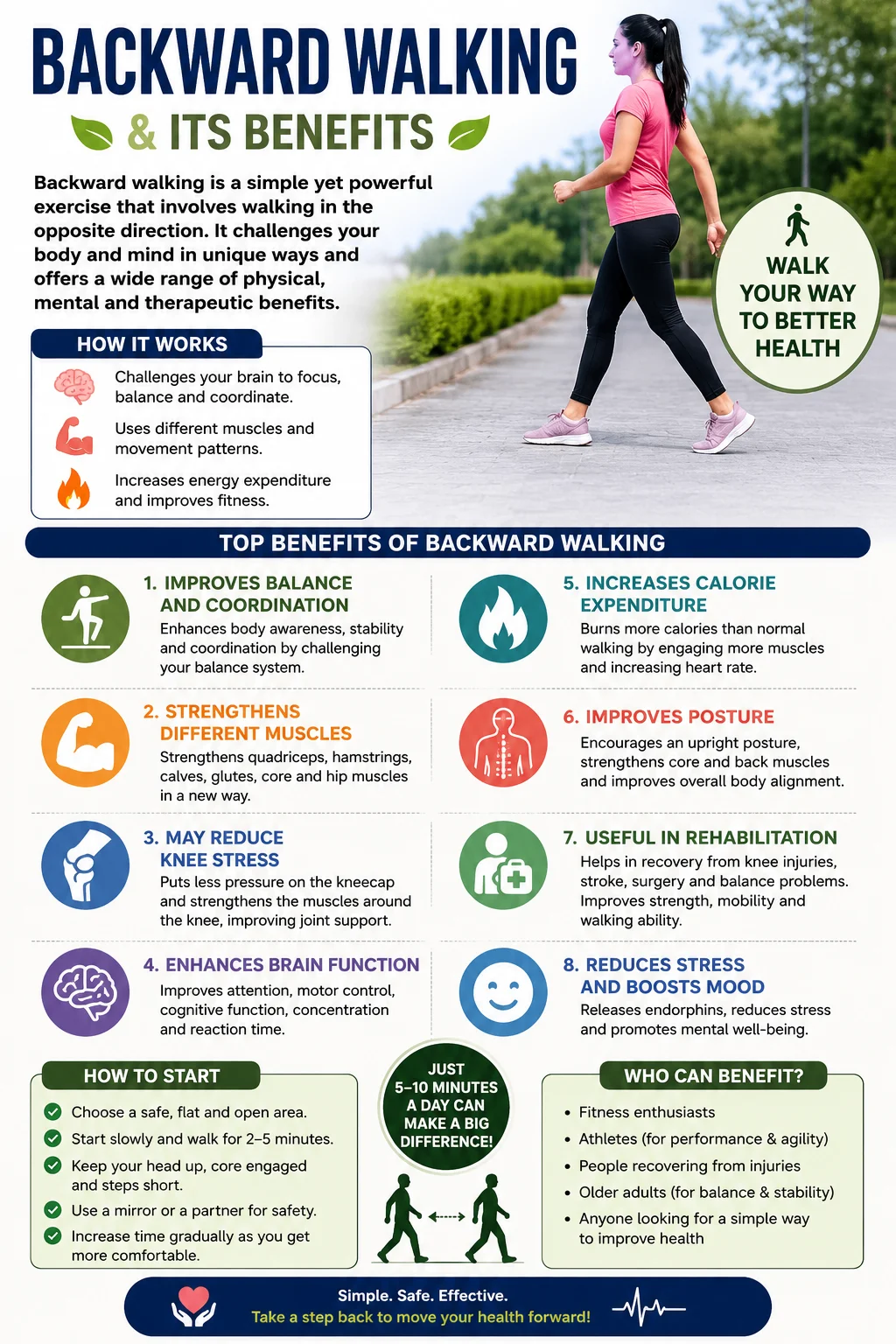
Walking is widely recognized as one of the most beneficial forms of exercise for maintaining good health, but walking backward is an often-overlooked practice that offers a unique range of physical and mental benefits. Although it may seem unusual at first, walking backward requires the body to move differently, engaging muscles, joints, and neural pathways that are not commonly activated during normal walking. This simple variation can transform an ordinary walk into a powerful exercise that challenges balance, coordination, strength, and concentration.
Walking backward requires the brain to work harder to process movement and maintain stability, making it an excellent activity for enhancing body awareness and cognitive function. At the same time, the muscles of the legs, hips, and core are engaged differently, helping to improve strength, flexibility, and overall mobility. Because of these benefits, backward walking is increasingly being incorporated into fitness programs, sports training, and physical rehabilitation therapies.
In addition to improving physical fitness, backward walking may help reduce stress on certain joints, particularly the knees, while increasing calorie expenditure and cardiovascular endurance. It encourages better posture, promotes balance, and helps develop greater control over body movements. For older adults, it can be a useful exercise for reducing the risk of falls, while athletes may use it to enhance agility, speed, and performance.
Another remarkable advantage of backward walking is its ability to break the monotony of regular exercise routines. By introducing a new movement pattern, it keeps the body challenged and the mind engaged, making physical activity more interesting and effective. Even a few minutes of backward walking each day can contribute to better muscular strength, improved coordination, enhanced mental focus, and greater overall fitness.
As a simple, cost-free, and accessible form of exercise, backward walking demonstrates that sometimes taking a step backward can actually be a step forward toward better health. With proper safety precautions and regular practice, this unique activity can become a valuable addition to a healthy lifestyle, supporting both physical vitality and mental well-being.
Health Benefits of Walking Backward
1. How Does Backward Walking Improve Balance and Coordination?
Backward walking improves balance and coordination because it forces the body and brain to work together in ways that are not required during normal forward walking. Since moving backward is less familiar, the body cannot rely on its usual automatic movement patterns. As a result, several systems become more active and efficient.
Enhances Body Awareness (Proprioception)
Proprioception is the body's ability to sense the position and movement of its muscles and joints without looking at them. When walking backward, the brain receives and processes more information from the feet, ankles, knees, and hips to determine where the body is in space. This strengthens the body's awareness and improves balance.
Activates Balance-Control Centers in the Brain
Backward walking requires continuous adjustments to maintain stability. The cerebellum (the balance and coordination center of the brain) becomes more active, helping to improve posture, movement control, and coordination over time.
Strengthens Stabilizing Muscles
While walking backward, the body relies heavily on small stabilizing muscles around the ankles, knees, hips, and core. These muscles help keep the body upright and prevent loss of balance. Stronger stabilizing muscles lead to better overall balance.
Improves Foot Placement and Movement Control
In forward walking, people often move automatically without much thought. Backward walking requires careful placement of each step, increasing coordination between the eyes, brain, and muscles. This helps develop smoother and more controlled movements.
Challenges the Vestibular System
The vestibular system, located in the inner ear, helps maintain balance and spatial orientation (Spatial orientation is the ability to perceive and understand our body's position in 3D space relative to our surroundings). Backward walking provides a unique challenge to this system, training it to respond more effectively to changes in body position and movement.
Improves Reaction Time (The time determining how quickly we can react to changes)
Since the body must constantly adjust to maintain stability while moving backward, reaction time and motor control improve. This can help prevent falls and enhance overall movement efficiency.
Example
Imagine walking on a straight line. When walking forward, it feels natural and automatic. When walking backward on the same line, we must focus more carefully on our posture, step length, and body position. This increased attention trains the brain and muscles to work together more effectively, resulting in improved balance and coordination.
Conclusion
Backward walking improves balance and coordination by enhancing body awareness, strengthening stabilizing muscles, stimulating the brain's balance centers, training the inner ear balance system, and improving movement control. Regular practice can make everyday movements steadier, safer, and more efficient.
2. How Does Backward Walking Strengthen Different Muscles?
Backward walking strengthens muscles differently from forward walking because the body uses a different movement pattern. As we move backward, muscles that are normally less active during regular walking must work harder to control movement, maintain balance, and support the body's weight.
Strengthens the Quadriceps (Front Thigh Muscles)
The quadriceps muscles at the front of the thighs are activated more during backward walking. These muscles help control the bending and straightening of the knee and play a major role in supporting body weight. Strong quadriceps improve knee stability, walking ability, and overall leg strength.
Strengthens the Calf Muscles
The calf muscles work continuously to push the body backward and maintain balance. Regular backward walking can help improve calf strength, endurance, and ankle stability.
Activates the Hamstrings Differently
The hamstrings, located at the back of the thighs, assist in controlling leg movement and stabilizing the knee joint. Although they are heavily involved in forward walking, backward walking challenges them in a different way, promoting balanced muscle development.
Strengthens the Gluteal Muscles
The gluteal muscles (buttocks) help stabilize the hips and generate movement. Backward walking increases their engagement, which can improve hip strength, posture, and lower-body power.
Improves Core Muscle Strength
To prevent losing balance while moving backward, the abdominal and lower back muscles must remain active. These core muscles help keep the spine stable and maintain an upright posture, leading to better balance and body control.
Strengthens Ankle and Foot Muscles
The small muscles around the ankles and feet work harder to stabilize the body during backward walking. Stronger ankle muscles can improve balance and reduce the risk of falls and injuries.
Enhances Hip Muscle Function
Backward walking activates the hip flexors and hip extensors differently from forward walking. This helps improve hip mobility, stability, and coordination.
Why Is This Beneficial?
Most daily activities involve moving forward, causing certain muscles to be used repeatedly while others remain underworked. Backward walking introduces a new movement pattern that challenges the muscles differently, leading to:
Better muscle balance
Increased lower-body strength
Improved joint stability
Enhanced athletic performance
Reduced risk of muscle imbalances
Conclusion
Backward walking is an excellent exercise for strengthening the quadriceps, calves, hamstrings, gluteal muscles, core, hips, and ankle stabilizers. By engaging these muscles differently from normal walking, it promotes greater strength, stability, coordination, and overall physical fitness.
3. How Does Backward Walking Reduce Knee Stress?
Backward walking may reduce stress on the knees because it changes the way forces are distributed across the knee joint and the surrounding muscles. Unlike forward walking, where the knee absorbs a significant amount of impact with each step, backward walking alters the mechanics of movement, often making it gentler on certain parts of the knee.
Reduces Pressure on the Kneecap
During forward walking, the kneecap (patella) experiences considerable compressive forces as the knee bends and straightens. In backward walking, these forces may be reduced because the movement pattern is different, placing less strain on the patellofemoral joint (the joint between the kneecap and thigh bone).
Strengthens the Quadriceps Without Excessive Joint Load
Backward walking strongly activates the quadriceps muscles at the front of the thigh. Strong quadriceps help support and stabilize the knee joint. Because the muscles work harder while the joint experiences relatively less impact, knee function may improve without excessive stress.
Produces Softer Foot Contact
When walking backward, the toes usually touch the ground before the heel. This creates a different loading pattern that can reduce the shock transmitted through the knee joint compared to the heel-first landing that occurs during forward walking.
Improves Knee Stability
Backward walking strengthens the muscles around the knee, including the quadriceps, hamstrings, and calf muscles. Stronger supporting muscles help stabilize the joint and reduce unnecessary stress on ligaments and cartilage.
Encourages Better Movement Control
Because backward walking requires greater concentration and slower, more deliberate movements, people often walk with improved posture and better control of knee alignment. This can help reduce abnormal forces acting on the knee joint.
Commonly Used in Rehabilitation
Physical therapists often include backward walking in rehabilitation programs for individuals with:
Patellofemoral pain syndrome (runner's knee)
Mild knee osteoarthritis
Knee weakness after injury
Recovery following certain knee surgeries
This is because backward walking can improve muscle strength and joint function while minimizing discomfort.
Example
Imagine walking down a hallway. During forward walking, our knee repeatedly absorbs impact as our heel strikes the ground. During backward walking, the movement is slower and more controlled, and the muscles of the thigh work harder to support the knee, helping to reduce the direct stress on the joint itself.
Conclusion
Backward walking may reduce knee stress by decreasing pressure on the kneecap, promoting softer foot contact, strengthening the quadriceps and other supporting muscles, and improving joint stability and movement control. For this reason, it is often used as a safe and effective exercise for improving knee health and supporting rehabilitation.
4. How Does Backward Walking Enhance Brain Function, Attention, Motor Control, and Cognitive Function?
Backward walking is much more than a physical exercise—it is also a powerful workout for the brain. Because humans naturally walk forward, moving backward is unfamiliar and requires greater mental effort. This increased challenge stimulates various regions of the brain, helping to improve attention, motor control, and cognitive function.
Increases Attention and Concentration
Forward walking is largely an automatic activity that requires little conscious thought. In contrast, backward walking demands continuous focus to maintain direction, balance, and safety. The brain must remain alert and attentive, which helps improve concentration and mental awareness.
Stimulates New Neural Pathways
The brain controls movement through networks of nerve cells called neural pathways. Since backward walking is not a routine activity, the brain must create and strengthen alternative movement patterns. This process enhances neuroplasticity—the brain's ability to adapt, learn, and form new connections.
Improves Motor Control
Motor control refers to the brain's ability to coordinate muscle movements smoothly and accurately. During backward walking, the brain must carefully regulate the timing, force, and direction of each step. This improves communication between the brain, spinal cord, and muscles, leading to better movement control.
Enhances Coordination Between Brain and Body
Backward walking requires constant feedback from the eyes, inner ears, muscles, and joints. The brain processes this information and adjusts body movements accordingly. This strengthens the connection between sensory input and motor responses, resulting in improved coordination.
Strengthens Executive Functions
Executive functions include planning, decision-making, problem-solving, and self-monitoring. Backward walking requires continuous adjustments and careful monitoring of movement, which engages these higher cognitive processes and helps keep the brain mentally active.
May Improve Memory and Cognitive Performance
Research suggests that novel and challenging physical activities stimulate blood flow to the brain and activate multiple brain regions. This increased brain activity may support memory, learning, and overall cognitive performance.
Example
Imagine walking forward on a familiar path—we can often do it while thinking about something else. Now imagine walking backward on the same path. Suddenly, we must pay close attention to our balance, posture, step length, and surroundings. This increased mental effort challenges the brain and helps strengthen neural connections involved in attention, coordination, and movement control.
Conclusion
Backward walking enhances brain function by increasing attention, stimulating new neural pathways, improving motor control, strengthening coordination, activating the cerebellum, enhancing spatial awareness, and supporting cognitive performance. By challenging both the body and the mind, backward walking serves as a unique exercise that promotes overall neurological and physical health.
5. How Does Backward Walking Increase Calorie Expenditure?
Backward walking increases calorie expenditure because it requires the body to work harder than normal forward walking. Since the movement is less familiar and less efficient, more muscles are activated, more energy is used, and the heart and lungs must work harder to meet the body's increased demands.
Requires More Energy
The human body is naturally adapted for forward walking, making it an efficient movement that uses relatively little energy. Backward walking is a less familiar activity, so the muscles must work harder to control movement and maintain stability. This increased effort leads to greater calorie burning.
Activates More Muscle Fibers
Backward walking engages the quadriceps, calves, hamstrings, gluteal muscles, and core muscles more intensely than regular walking. When more muscle fibers are recruited, the body consumes more energy, resulting in higher calorie expenditure.
Increases Heart Rate
Because backward walking is more physically demanding, the heart must pump more blood to deliver oxygen and nutrients to the working muscles. This increase in heart rate raises energy consumption and helps burn more calories.
Challenges: Balance and Coordination
Maintaining balance while walking backward requires constant adjustments by the muscles and nervous system. This extra effort increases overall energy use compared to normal walking.
Improves Metabolic Demand
The body's metabolism increases during backward walking because the muscles are performing unfamiliar and more challenging movements. A higher metabolic rate means more calories are burned during the activity.
Increases Oxygen Consumption
Studies have shown that backward walking often requires greater oxygen consumption than forward walking at the same speed. Since oxygen is needed to produce energy, higher oxygen use reflects greater calorie expenditure.
Encourages Greater Muscle Workload
The quadriceps, in particular, work harder during backward walking to control knee movement and support body weight. Increased muscle workload translates directly into increased energy expenditure.
Example
If two people walk the same distance at the same speed—one walking forward and the other walking backward—the person walking backward will generally use more energy because the movement is less efficient and requires greater muscular effort. As a result, more calories are burned in the same amount of time.
Benefits of Increased Calorie Expenditure
Supports weight management
Helps reduce body fat
Improves cardiovascular fitness
Enhances endurance
Increases overall physical activity benefits
Conclusion
Backward walking increases calorie expenditure because it is a more demanding activity that requires greater muscle activation, balance control, oxygen consumption, and cardiovascular effort. By making the body work harder than during normal walking, it helps burn more calories and can be an effective addition to a fitness and weight-management program.
6. How Does Backward Walking Improve Posture?
Backward walking can significantly improve posture because it encourages proper body alignment and strengthens the muscles responsible for maintaining an upright position. Unlike forward walking, which many people perform with rounded shoulders, a forward head position, or a slouched back, backward walking requires greater awareness of body position and movement.
Promotes an Upright Body Position
When walking backward, the body naturally tends to remain more upright to maintain balance and stability. This helps reduce slouching and encourages proper alignment of the head, neck, shoulders, and spine.
Strengthens Core Muscles
The abdominal and lower back muscles play a crucial role in maintaining balance during backward walking. As these core muscles become stronger, they provide better support for the spine, leading to improved posture during daily activities.
Improves Head and Neck Alignment
Many people develop poor posture from prolonged sitting, computer use, or mobile phone use, often resulting in a forward head position. Backward walking encourages individuals to keep their head aligned over their shoulders, reducing strain on the neck and upper back.
Activates Postural Muscles
Backward walking engages the muscles of the back, hips, abdomen, and shoulders that help maintain proper posture. Regular activation of these muscles improves their strength and endurance, making it easier to stand and walk upright.
Enhances Body Awareness
Backward walking requires greater concentration and awareness of body position. This increased awareness helps individuals recognize and correct poor postural habits, both during exercise and throughout the day.
Improves Balance and Spinal Stability
To avoid losing balance while walking backward, the body continuously makes small adjustments using the muscles around the spine and pelvis. These adjustments strengthen stabilizing muscles and contribute to better postural control.
Reduces Muscle Imbalances
Poor posture is often caused by weak core and back muscles combined with tight muscles in the chest and hips. Backward walking helps activate underused muscles and may contribute to a more balanced muscular system, supporting better posture.
Example
Consider someone who spends many hours sitting at a desk. They may gradually develop rounded shoulders and a forward-leaning posture. During backward walking, they must keep their chest open, head upright, and core engaged to maintain balance. Over time, this repeated practice helps train the body to adopt a more natural and upright posture.
Conclusion
Backward walking improves posture by promoting proper body alignment, strengthening core and postural muscles, enhancing body awareness, improving spinal stability, and reducing muscle imbalances. With regular practice, it can help individuals stand taller, move more efficiently, and reduce strain on the neck, shoulders, and back.
7. How Is Backward Walking Useful in Rehabilitation?
Backward walking is widely used in rehabilitation programs because it helps improve strength, balance, mobility, and coordination while placing different and often lower stresses on certain joints. Physical therapists frequently incorporate backward walking into treatment plans to assist recovery from injuries and improve functional movement.
Helps Recover from Knee Injuries
Backward walking strengthens the quadriceps muscles, which provide important support to the knee joint. At the same time, it may reduce pressure on the kneecap compared to some forward-walking activities. This makes it beneficial for people recovering from:
Patellofemoral pain syndrome (runner's knee)
Knee weakness
Mild osteoarthritis
Certain knee surgeries
Improves Balance and Prevents Falls
Many rehabilitation patients, especially older adults, experience balance problems. Backward walking challenges the body's balance systems and strengthens the muscles responsible for stability. Regular practice can improve confidence in movement and reduce the risk of falls.
Restores Muscle Strength
After an injury, surgery, or prolonged bed rest, muscles often become weak. Backward walking activates the quadriceps, hamstrings, calves, gluteal muscles, and core muscles, helping to rebuild strength and improve physical function.
Enhances Gait and Walking Ability
People recovering from stroke, neurological conditions, or lower-limb injuries may develop abnormal walking patterns. Backward walking helps retrain the nervous system and improves coordination between the brain and muscles, leading to a more efficient and stable walking pattern.
Increases Joint Mobility
The different movement pattern of backward walking encourages the joints of the ankles, knees, and hips to move through a controlled range of motion. This can help improve flexibility and reduce stiffness.
Improves Neuromuscular Control
Neuromuscular control refers to the communication between the nervous system and muscles. Because backward walking requires greater concentration and precise movement, it enhances this communication, helping patients regain better control over their movements.
Supports Recovery After Stroke
In stroke rehabilitation, backward walking may help improve:
Balance
Walking speed
Coordination
Leg strength
Confidence in movement
The increased brain activity required during backward walking can stimulate neural pathways involved in motor recovery.
Provides a Low-Impact Exercise Option
For individuals who cannot tolerate high-impact activities, backward walking offers a gentle yet effective exercise that can improve fitness, strength, and mobility without excessive strain on the joints.
Example
A person recovering from knee surgery may have weak thigh muscles and difficulty walking normally. A physical therapist may introduce backward walking exercises to strengthen the quadriceps, improve knee stability, and restore confidence in movement. Over time, this can help the individual return to normal daily activities more effectively.
Conclusion
Backward walking is a valuable rehabilitation exercise because it strengthens muscles, improves balance, restores walking ability, enhances joint mobility, promotes neuromuscular coordination, and supports recovery from injuries and neurological conditions. When performed under proper guidance, it can play an important role in helping individuals regain strength, independence, and overall physical function.
8. Safety Precautions
Begin slowly.
Practice in an open, obstacle-free area.
Avoid busy roads or uneven surfaces.
Use a treadmill with handrails if supervised.
Stop if you feel dizzy or unsteady.
9. How Much Should You Do?
Beginners can start with:
2–5 minutes of backward walking
Gradually increasing to 10–15 minutes
2–3 times per week
10. Who Should Be Careful?
People with:
Severe balance problems
Recent injuries
Vertigo or dizziness
Neurological disorders
Should consult a healthcare professional before trying backward walking.
Conclusion
Walking backward is a simple but effective exercise that can improve balance, strengthen leg muscles, enhance brain engagement, increase calorie burning, and support joint health when performed safely. It can be a valuable addition to a regular walking routine.