
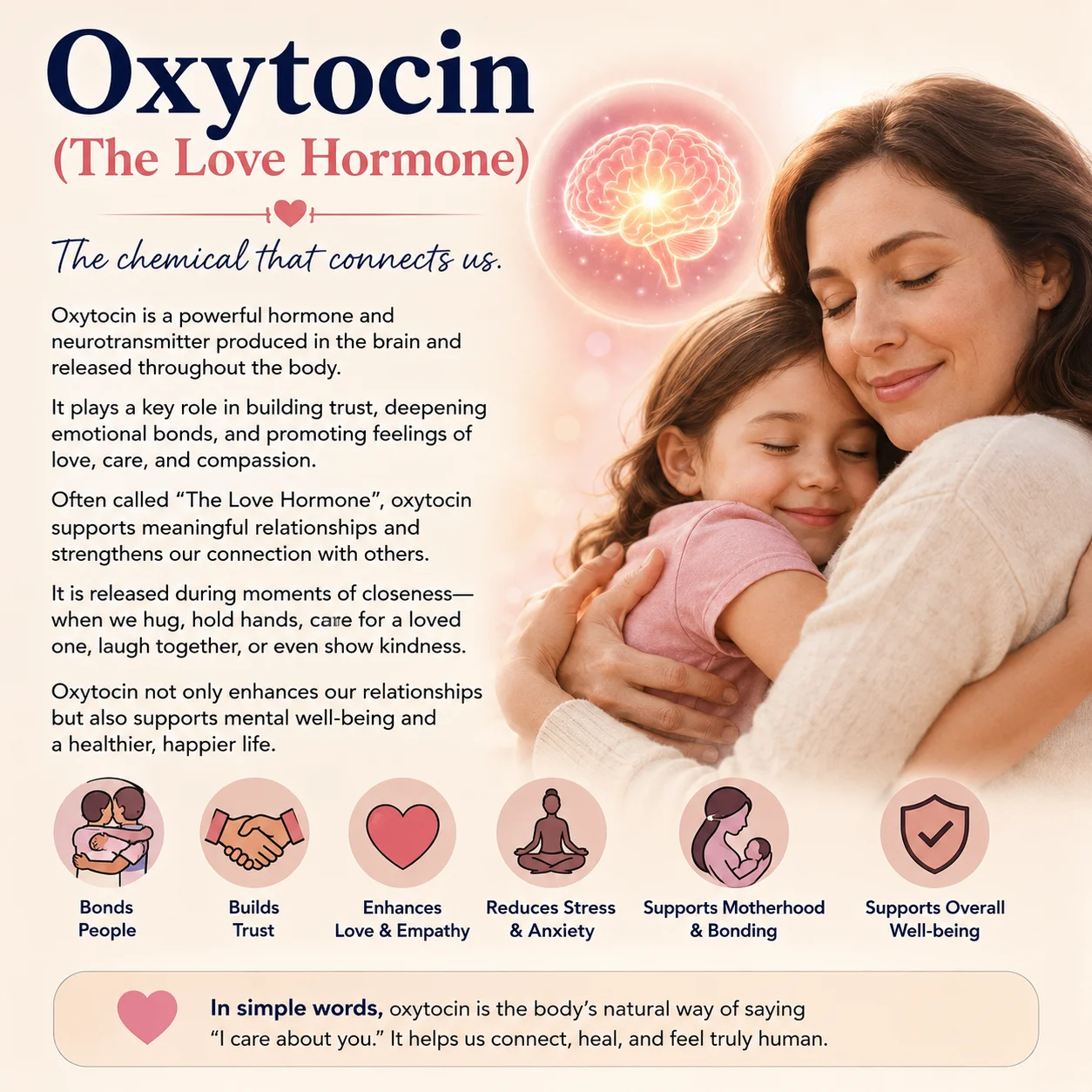
Oxytocin — The Love Hormone
Oxytocin is often called the “love hormone” or “bonding hormone” because it plays a major role in human connection, trust, affection, and emotional bonding. It is a natural hormone and neurotransmitter produced mainly in the hypothalamus of the brain and released by the pituitary gland.
Oxytocin is closely linked with feelings of:
Love and attachment
Trust and empathy
Emotional warmth
Social bonding and care
The hormone is released during positive human interactions, such as:
Hugging
Holding hands
Mother–baby bonding
Friendship and social connection
Romantic affection
Oxytocin also has important physical functions in the body. It helps during:
Childbirth (uterine contractions)
Breastfeeding (milk release)
Stress reduction and relaxation
Because oxytocin promotes emotional closeness and comfort, it is popularly known as the “love hormone.”
Where Is Oxytocin Produced?
The specialized nerve cells in the hypothalamus that produce oxytocin are called neurosecretory cells or oxytocinergic neurons.
These neurons are located mainly in two hypothalamic nuclei:
1. Paraventricular Nucleus (PVN)
A major group of oxytocin-producing neurons is found in the hypothalamus.
Functions linked with these neurons include:
Emotional bonding
Stress regulation
Social behavior
2. Supraoptic Nucleus (SON)
Another important cluster of oxytocin-producing neurons.
These neurons mainly send oxytocin to the posterior pituitary gland for release into the bloodstream.
How These Cells Work
The neuron synthesizes oxytocin in its cell body.
Oxytocin travels down the neuron’s axon.
It reaches the posterior pituitary gland.
The hormone is released into the blood when stimulated.
These neurons are unique because they function in both:
As nerve cells (neurons)
And as hormone-producing cells (neurosecretory cells)
This is why oxytocin can influence both the brain and the rest of the body.
Oxytocin is produced mainly in the hypothalamus, a small but important region of the brain that controls many body functions and emotions.
After being produced, oxytocin is transported to and stored in the posterior pituitary gland, from where it is released into the bloodstream when needed.
Posterior Pituitary Gland — Storage and Release Site of Oxytocin
The posterior pituitary does not make oxytocin itself, but it:
Stores oxytocin
It is released into the blood during specific situations
Examples of release triggers:
Hugging and affection
Childbirth
Breastfeeding
Emotional bonding
Positive social interaction
Functions of Oxytocin
Oxytocin performs important functions in both the body and the brain. It acts as a hormone as well as a neurotransmitter.
1. Promotes Emotional Bonding
Oxytocin helps create and strengthen emotional connections between people.
Examples:
Mother–baby bonding
Romantic attachment
Friendship and trust
This is why it is called the “love hormone.”
2. Builds Trust and Social Connection
Oxytocin supports:
Empathy
Social recognition
Feelings of closeness
Cooperative behavior
Positive social interaction can increase oxytocin release.
3. Reduces Stress and Anxiety
Oxytocin can help calm the nervous system and lower stress responses.
Effects may include:
Relaxation
Emotional comfort
Reduced anxiety
A simple relationship is:
Oxytocin Release→Reduced Stress and Increased Calmness
4. Important in Childbirth
Oxytocin stimulates uterine contractions during labor.
This helps:
Start labor
Strengthen contractions
Assist delivery of the baby
5. Helps in Breastfeeding
Oxytocin causes the milk ejection reflex (“let-down reflex”).
When a baby suckles:
Oxytocin is released
Milk ducts contract
Milk flows from the breast
6. Supports Maternal Behavior
Oxytocin strengthens:
Maternal attachment
Protective behavior
Caregiving responses
7. May Help Pain and Emotional Relief
Oxytocin may contribute to:
Reduced pain perception
Emotional healing
Sense of well-being
8. Supports Healthy Relationships
Higher oxytocin activity is linked with:
Affection
Compassion
Positive communication
Natural Ways to Boost Oxytocin in the Body
Oxytocin levels naturally increase during positive emotional, physical, and social experiences. Because it is strongly connected with bonding and trust, activities involving warmth, care, and connection are powerful triggers.
1. Physical Touch
Gentle and positive touch is one of the strongest natural stimulators of oxytocin.
Examples:
Hugging
Holding hands
Cuddling
Massage
Touch sends calming signals to the brain, encouraging oxytocin release.
2. Spending Time With Loved Ones
Meaningful social interaction helps increase oxytocin.
Examples:
Talking with family
Spending time with friends
Emotional support
Shared activities
A simplified idea is:
Positive Social Interaction→Oxytocin Release\text{Positive Social Interaction} \rightarrow \text{Oxytocin Release}Positive Social Interaction→Oxytocin Release
3. Eye Contact and Kind Communication
Warm eye contact and sincere communication strengthen trust and emotional closeness, which can stimulate oxytocin activity.
4. Acts of Kindness and Compassion
Helping others and receiving kindness may increase feelings of connection and emotional reward.
Examples:
Helping someone
Giving gifts
Expressing gratitude
Caring behavior
5. Mother–Baby Interaction
Oxytocin rises strongly during:
Childbirth
Breastfeeding
Skin-to-skin contact
Holding and caring for a baby
This strengthens maternal bonding.
6. Romantic Affection
Affectionate and loving interactions between partners can stimulate oxytocin release.
Examples:
Kissing
Emotional intimacy
Physical closeness
7. Pet Interaction
Spending time with pets may increase oxytocin in both humans and animals.
Examples:
Petting a dog or cat
Playing with pets
8. Meditation and Relaxation
Stress reduction may support healthier oxytocin activity.
Helpful practices:
Meditation
Deep breathing
Yoga
Mindfulness
9. Music, Singing, and Group Activities
Shared enjoyable experiences can increase social bonding and emotional connection.
Examples:
Singing together
Dancing
Group prayer
Team activities
10. Laughter
Laughing with others strengthens social bonds and may promote oxytocin release.
Medical Uses of Oxytocin
Oxytocin is used medically because of its strong effects on the uterus and milk ejection in breastfeeding. In medicine, synthetic oxytocin is commonly given as a drug to assist childbirth and related conditions.
One well-known synthetic form is Oxytocin.
1. Induction of Labor
Doctors use oxytocin to start labor when childbirth needs medical assistance.
It helps by:
Stimulating uterine contractions
Softening and opening the cervix gradually
Supporting the progression of labor
A simplified action is:
Oxytocin→Uterine Contractions→Labor Progression
2. Strengthening Weak Labor Contractions
Sometimes labor contractions become weak or irregular.
Oxytocin may be given to:
Increase contraction strength
Improve contraction rhythm
Help delivery continue normally
3. Prevention of Excessive Bleeding After Childbirth
After delivery, oxytocin helps the uterus contract firmly.
This reduces the risk of:
Postpartum hemorrhage (heavy bleeding after birth)
This is one of its most important life-saving medical uses.
4. Assisting Placenta Delivery
Oxytocin helps the uterus continue contracting after birth, which can aid in the removal of the placenta.
5. Helping Breastfeeding
Oxytocin may help stimulate the milk let-down reflex in some breastfeeding difficulties.
It causes:
Contraction of milk ducts
Release of milk from the breast
6. Research in Mental Health and Social Disorders
Scientists are studying oxytocin for possible roles in:
Anxiety disorders
Autism spectrum conditions
Social bonding difficulties
Stress-related disorders
However, many of these uses are still under research and are not standard treatment in all cases.
Important Note
Medical oxytocin must be used carefully because excessive stimulation can cause:
Very strong uterine contractions
Fetal distress
Complications during labor
Therefore, it is given under medical supervision.
Precautions Maintained During Medical Use of Oxytocin
1. Controlled Dosage
Oxytocin is usually given slowly through an intravenous (IV) infusion.
Doctors:
Start with a low dose
Increase gradually if needed
Avoid sudden large doses
This helps prevent excessively strong contractions.
A simplified principle is:
Controlled Oxytocin Dose→Safe Uterine Contractions
2. Continuous Monitoring of Uterine Contractions
Healthcare staff monitor:
Frequency of contractions
Duration
Strength
Too many or very strong contractions may reduce blood flow to the baby.
3. Monitoring the Baby’s Heart Rate
Fetal heart monitoring is very important.
Doctors watch for signs of fetal distress such as:
Abnormal heart rate
Reduced oxygen supply
Stress during labor
If problems appear, oxytocin may be reduced or stopped.
4. Monitoring the Mother’s Condition
The mother’s:
Blood pressure
Pulse
Breathing
Pain level
Fluid balance
are checked regularly.
5. Avoiding Overstimulation of the Uterus
Excessive uterine contractions can lead to:
Reduced oxygen to the baby
Uterine exhaustion
Rarely, uterine rupture
So healthcare providers ensure contractions remain safe and effective.
6. Careful Use in High-Risk Pregnancies
Extra caution is used in conditions such as:
Previous cesarean section
Multiple pregnancy (twins, triplets)
Placenta problems
Fetal distress
High blood pressure disorders
Sometimes oxytocin may not be suitable.
7. Availability of Emergency Care
Because labor conditions can change quickly:
Emergency medicines
Surgical support
Cesarean facilities
are kept ready if needed.
8. Proper Hydration and Fluid Control
Large amounts of oxytocin with excessive fluids may rarely cause a water imbalance in the body, so fluid intake is monitored carefully.
The main oxytocin medicines used medically are synthetic forms of the natural hormone oxytocin. These drugs are mainly used in obstetrics (pregnancy and childbirth care).
Common Medical Oxytocin Preparations
Oxytocin
This is the standard synthetic oxytocin used worldwide.
Common medical uses:
Induction of labor
Strengthening labor contractions
Prevention of postpartum hemorrhage
Assisting milk let-down in some cases
It is usually given:
By IV infusion
By injection
Pitocin
A commonly known brand name of synthetic oxytocin used in several countries.
Uses:
Start labor
Improve weak contractions
Control bleeding after childbirth
Syntocinon
Another medical preparation of oxytocin is widely used in hospitals.
Available forms may include:
Injection
Nasal spray (in some medical situations)
Related Oxytocin-like Medicines
Some medicines act similarly to oxytocin by stimulating uterine contractions.
Carbetocin
A longer-acting oxytocin-like drug.
Often used for:
Prevention of postpartum hemorrhage after cesarean delivery
It lasts longer than regular oxytocin.
Important Note
These medicines are powerful and are used only under trained medical supervision because improper use may cause:
Excessively strong contractions
Fetal distress
Labor complications
Simple Message: oxytocin helps us feel bonded, calm, and connected with others, especially during touch, care, and emotional closeness. It also helps during childbirth (uterine contractions), breastfeeding (milk release).