
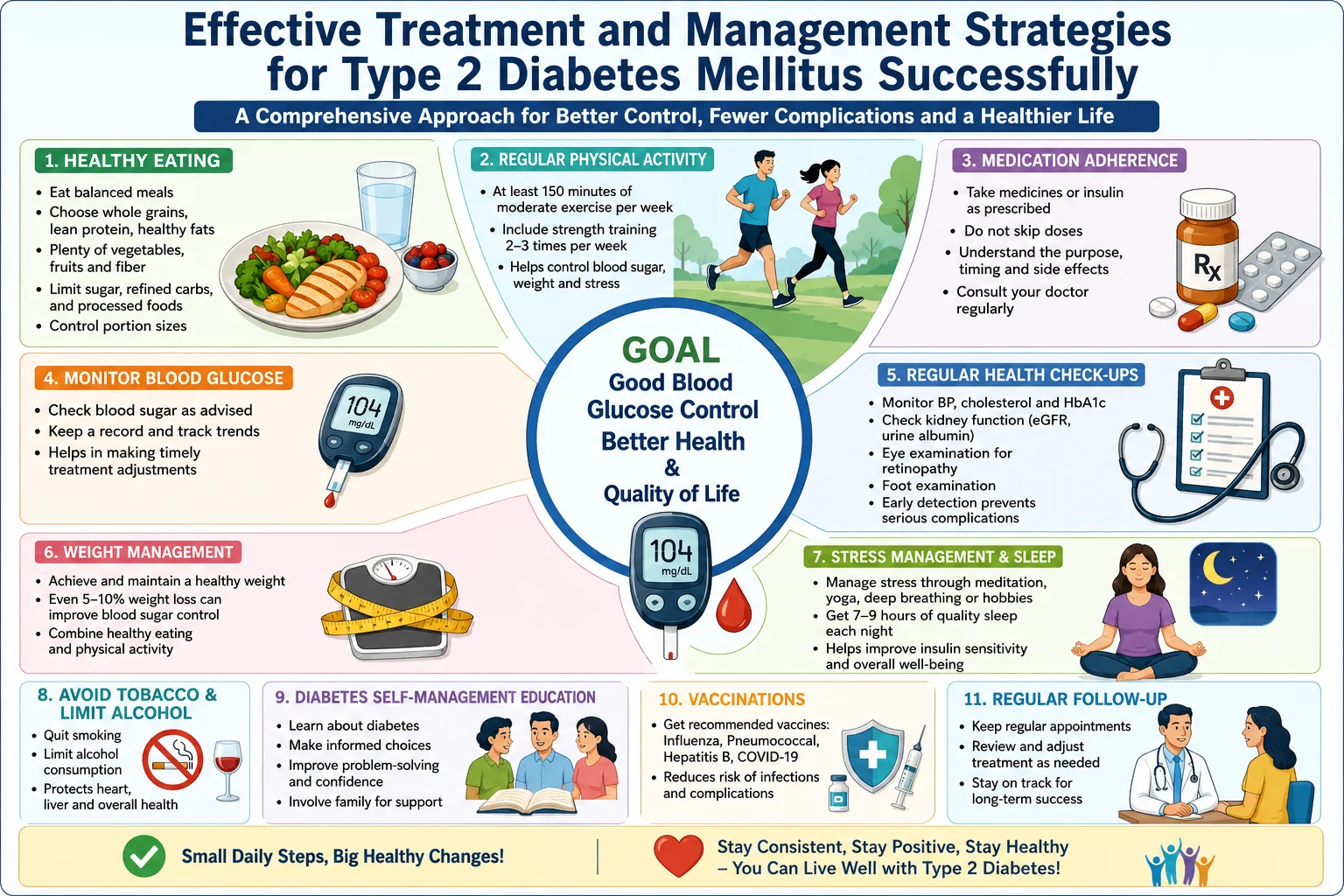
Type 2 diabetes mellitus is a chronic metabolic disorder that requires lifelong management to maintain healthy blood glucose levels and prevent complications. Although there is no permanent cure, the condition can be effectively controlled through a combination of healthy lifestyle changes, regular physical activity, balanced nutrition, weight management, blood glucose monitoring, and appropriate medications or insulin when needed. Early diagnosis, adherence to treatment, and regular follow-up with healthcare providers are essential for achieving good glycemic control and reducing the risk of complications affecting the heart, kidneys, eyes, nerves, and blood vessels. With proper treatment and consistent self-care, most people with type 2 diabetes can lead healthy, active, and productive lives.
The treatment and management of Type 2 diabetes mellitus involve a combination of lifestyle modification, medications, regular monitoring, and prevention of complications. The main components are:
1. Healthy, balanced diet tailored to individual calorie and nutritional needs.
A healthy, balanced diet means eating the right amount of calories and nutrients according to a person's age, body weight, physical activity, medical conditions, and blood glucose goals. It should include whole grains, vegetables, fruits, lean proteins, healthy fats, and high-fiber foods, while limiting refined carbohydrates, sugary foods, and unhealthy fats.
There is no single "right amount of calories" for everyone. The required calorie intake depends on a person's age, sex, body size, physical activity level, health condition, and whether they need to lose, gain, or maintain weight.
General daily calorie recommendations for adults
Person | Approximate daily calories |
|---|---|
Adult women (sedentary) | 1,600–2,000 kcal/day |
Adult women (active) | 2,000–2,400 kcal/day |
Adult men (sedentary) | 2,000–2,400 kcal/day |
Adult men (active) | 2,400–3,000 kcal/day |
For people with type 2 diabetes
There is no fixed calorie prescription. The goal is to:
Eat enough calories to maintain a healthy body weight, or
Reduce calorie intake if overweight or obese to achieve a 5–10% weight loss, which improves blood glucose control and insulin sensitivity.
Study links:
American Diabetes Association. Standards of Care in Diabetes: https://diabetesjournals.org/care
https://diabetesjournals.org/care
U.S. Dietary Guidelines for Americans: https://www.dietaryguidelines.gov
World Health Organization (WHO): https://www.who.int/news-room/fact-sheets/detail/healthy-diet
https://www.who.int/news-room/fact-sheets/detail/healthy-diet
2. Regular physical activity (at least 150 minutes of moderate-intensity exercise per week plus resistance training).
3. Weight management, aiming for a healthy body weight or a 5–10% weight loss if overweight or obese.
4. Blood glucose monitoring as recommended by a healthcare provider.
For people with type 2 diabetes mellitus, blood glucose monitoring helps determine whether treatment is effective and whether blood glucose levels are within the target range.
The main tests include:
i). Fasting Blood Glucose (FBG) / Fasting Plasma Glucose (FPG)
Measures blood glucose after at least 8 hours of fasting.
Used to monitor fasting blood glucose control.
ii). Postprandial Blood Glucose (PPBG/PPBS)
Measured 2 hours after the first bite of a meal.
Shows how well the body controls blood glucose after eating.
iii). Random Blood Glucose (RBG/RPG)
Measured at any time of the day, regardless of meals.
Useful when symptoms of high or low blood glucose occur.
iv). HbA1c (Glycated Hemoglobin) Test
Measures the average blood glucose over the previous 2–3 months.
Usually checked every 3–6 months to assess long-term blood glucose control.
v). Self-Monitoring of Blood Glucose (SMBG)
Uses a glucometer and a small drop of blood from the fingertip.
Performed at home as recommended by the healthcare provider, such as before meals, after meals, at bedtime, or whenever symptoms occur.
vi). Continuous Glucose Monitoring (CGM) (for selected patients)
Continuous Glucose Monitoring (CGM) is a system that continuously measures glucose levels in the fluid just beneath the skin (interstitial fluid) using a small sensor inserted under the skin, usually on the upper arm or abdomen. The sensor sends glucose readings every 1–5 minutes to a receiver or smartphone, allowing people to see their glucose levels throughout the day and night without repeated finger-prick tests.
CGM is especially useful for selected patients, including:
People who use insulin, especially multiple daily injections or an insulin pump.
People with frequent hypoglycemia (low blood glucose) or hypoglycemia unawareness.
People whose blood glucose is difficult to control despite treatment.
Some pregnant women with diabetes, as advised by their healthcare provider.
How does it help?
Shows real-time glucose levels 24 hours a day.
Displays trends, showing whether glucose is rising, falling, or stable.
Warns the user when glucose becomes too high or too low.
Helps healthcare providers adjust diet, exercise, and medications more accurately.
Reduces the need for frequent finger-prick tests (although some CGM systems may still require occasional confirmation).
Major study links:
American Diabetes Association. Standards of Care in Diabetes: https://diabetesjournals.org/care
National Institute of Diabetes and Digestive and Kidney Diseases (NIDDK): https://www.niddk.nih.gov/health-information/diabetes/overview/managing-diabetes
https://www.niddk.nih.gov/health-information/diabetes/overview/managing-diabetes
Centers for Disease Control and Prevention (CDC): https://www.cdc.gov/diabetes/technology/index.html
5. Oral antidiabetic medications, such as metformin (usually the first-line medication), and other drugs when needed.
Metformin is the first-line oral medication for most people with type 2 diabetes mellitus, unless there are contraindications (such as advanced kidney disease).
Aspect | Metformin |
|---|---|
Drug class | Biguanide |
Main use | First-line treatment for type 2 diabetes mellitus; also used in some people with prediabetes at very high risk |
Mechanism of action | • Decreases glucose production by the liver (its main effect). |
Usual adult dose | Start: 500 mg once daily with the evening meal (or 500 mg twice daily with meals). |
Common side effects | Nausea, diarrhea, abdominal discomfort, bloating, loss of appetite, metallic taste in the mouth. These usually improve after a few weeks. |
Rare but serious side effect | #Lactic acidosis (very rare but potentially life-threatening), mainly in people with severe kidney failure or certain other serious illnesses. |
Patient education | • Take with meals to reduce stomach upset. |
#Lactic acidosis is a rare emergency in which too much lactic acid accumulates in the blood, making it too acidic. It requires immediate medical treatment. may occur if the drug accumulates because of severe kidney failure, severe dehydration, severe infection, liver failure, or conditions causing low oxygen levels (such as shock or severe heart failure).
Symptoms of Lactic acidosis: Extreme weakness or tiredness, Rapid or difficult breathing, Nausea or vomiting, Abdominal pain, Dizziness, Confusion
https://medlineplus.gov/druginfo/meds/a696005.html
#During major surgery or after receiving iodinated contrast dye (used in some CT scans and angiography), kidney function may temporarily worsen in some people. Because metformin is removed from the body by the kidneys, reduced kidney function can cause the drug to accumulate, increasing the rare risk of lactic acidosis.Therefore, healthcare providers may temporarily stop metformin before or at the time of the procedure and restart it after confirming that kidney function is normal, usually within 48 hours if appropriate.
https://www.acr.org/clinical-resources/clinical-tools-and-reference/contrast-manual
Normally, vitamin B₁₂ binds to a protein called intrinsic factor in the stomach. This vitamin B₁₂–intrinsic factor complex travels to the ileum, where it attaches to special receptors on the intestinal cells. This attachment requires calcium.
Metformin is thought to interfere with this calcium-dependent process, so the vitamin B₁₂–intrinsic factor complex cannot attach to the receptors as efficiently. As a result, less vitamin B₁₂ is absorbed into the bloodstream. Periodic blood tests help detect deficiency early so it can be treated before complications develop (vitamin B₁₂ supplements can be prescribed.). Vitamin B₁₂ deficiency can cause: Anemia, Tingling or numbness in the hands and feet, Weakness and fatigue.
https://ods.od.nih.gov/factsheets/VitaminB12-HealthProfessional/
https://www.bmj.com/content/340/bmj.c2181
Major study links:
American Diabetes Association. Standards of Care in Diabetes: https://diabetesjournals.org/care
National Institute of Diabetes and Digestive and Kidney Diseases (NIDDK): https://www.niddk.nih.gov/health-information/diabetes/overview/managing-diabetes
https://www.niddk.nih.gov/health-information/diabetes/overview/managing-diabetes
British National Formulary (BNF): https://bnf.nice.org.uk
MedlinePlus – Metformin: https://medlineplus.gov/druginfo/meds/a696005.html
6. Injectable medications, including GLP-1 receptor agonists and insulin, for people who do not achieve adequate blood glucose control with oral medications or have specific clinical indications.
The two main types of injectable medications used for type 2 diabetes mellitus are GLP-1 receptor agonists and insulin. Below is a concise overview suitable for study purposes.
i). GLP-1 Receptor Agonists: GLP-1 stands for Glucagon-Like Peptide-1.
It is a natural hormone (incretin hormone) produced by L cells of the small intestine, mainly in the ileum and colon, after eating.
Examples: Semaglutide, Liraglutide, Dulaglutide, Exenatide, Lixisenatide
Use
Type 2 diabetes not adequately controlled with diet, exercise, and oral medications (especially metformin).
Particularly useful in people with obesity or established cardiovascular disease, as some agents also promote weight loss and reduce cardiovascular risk.
Mechanism of action
GLP-1 receptor agonists imitate the action of the natural GLP-1 hormone, helping the body release more insulin, reduce glucagon, slow stomach emptying, and lower blood glucose levels.
They:
Increase insulin release only when blood glucose is high.
Reduce glucagon secretion, lowering glucose production by the liver.
Slow stomach emptying, so glucose enters the bloodstream more gradually.
Increase satiety, helping people eat less and lose weight.
Usual doses (examples)
Drug | Typical starting dose |
|---|---|
Semaglutide | 0.25 mg once weekly for 4 weeks, then 0.5 mg once weekly; may increase to 1 mg or 2 mg if needed. |
Liraglutide | 0.6 mg once daily for 1 week, then 1.2 mg daily; may increase to 1.8 mg daily. |
Dulaglutide | 0.75 mg once weekly; may increase to 1.5 mg weekly or higher depending on the product. |
Dose adjustments should always be made by a healthcare provider.
Common side effects:
are nausea, vomiting, diarrhea, constipation, abdominal pain, decreased appetite. These side effects often improve after a few weeks.
Rare but serious side effects
are pancreatitis, gallbladder disease, kidney injury (usually related to severe dehydration)
Contraindications
Personal or family history of medullary thyroid carcinoma (MTC)
Multiple Endocrine Neoplasia syndrome type 2 (MEN2)
Previous serious allergic reaction to the medication
Use cautiously in people with a history of pancreatitis
Patient education
Inject on the same day each week (for weekly preparations).
Eat smaller meals to reduce nausea.
Drink plenty of fluids if vomiting or diarrhea occurs.
Learn the correct injection technique.
Continue a healthy diet and regular exercise.
Seek medical attention for severe, persistent abdominal pain, which may indicate pancreatitis.
ii). Insulin
Use
Insulin is used when:
Blood glucose remains high despite oral medications and/or GLP-1 receptor agonists.
HbA1c remains above target.
Blood glucose is very high at diagnosis.
During pregnancy, severe illness, surgery, or hospitalization.
The pancreas no longer produces enough insulin.
Mechanism of action
Injected insulin replaces or supplements the body's own insulin, allowing glucose to move from the bloodstream into muscle, fat, and liver cells, thereby lowering blood glucose.
Common insulin types and examples
Type | Examples | Onset | Duration |
|---|---|---|---|
Rapid-acting | Lispro, Aspart, Glulisine | 10–20 min | 3–5 h |
Short-acting | Regular insulin | 30–60 min | 6–8 h |
Intermediate-acting | #NPH insulin | 1–2 h | 12–18 h |
Long-acting | Glargine, Detemir, Degludec | 1–2 h | 24–42 h |
#NPH insulin stands for Neutral Protamine Hagedorn insulin.
Neutral: The insulin solution has a neutral pH.
Protamine: A protein added to insulin to slow its absorption from the injection site.
Hagedorn: Named after Hans Christian Hagedorn, the Danish scientist who helped develop this insulin.
Onset: insulin begins to work
Peak action: The time when the insulin has its strongest blood glucose-lowering effect.
Duration: The total length of time the insulin continues to lower blood glucose before its effect wears off.
Typical dose
Usually starts at 10 units once daily of a long-acting insulin or
0.1–0.2 units/kg/day.
The dose is then adjusted based on blood glucose readings.
Common side effects
Hypoglycemia (low blood glucose) (most common)
Weight gain
Injection-site pain or redness
Rare side effects
Allergic reactions
Lipodystrophy (fat tissue changes at injection sites)
Contraindications
There are no absolute contraindications when insulin is required.
Insulin should not be given during hypoglycemia until the low blood glucose has been corrected.
Patient education
Learn the correct injection technique.
Rotate injection sites (abdomen, thigh, upper arm, buttocks) to prevent lipodystrophy.
Monitor blood glucose regularly.
Never skip meals after taking mealtime insulin.
Recognize symptoms of hypoglycemia (sweating, shakiness, hunger, confusion).
Carry a fast-acting carbohydrate (such as glucose tablets or fruit juice) in case hypoglycemia occurs.
Store unopened insulin in the refrigerator (2–8°C). Once opened, many insulin products can be kept at room temperature for about 28 days, depending on the specific product label.
Do not use insulin that has expired or appears abnormal.
Therefore,
GLP-1 receptor agonists help the body produce more insulin only when blood glucose is high, reduce liver glucose production, slow digestion, and promote weight loss.
Insulin replaces the body's missing insulin and is used when blood glucose cannot be adequately controlled with other treatments or in specific clinical situations.
Major study links
American Diabetes Association. Standards of Care in Diabetes: https://diabetesjournals.org/care
https://diabetesjournals.org/care
National Institute of Diabetes and Digestive and Kidney Diseases (NIDDK): https://www.niddk.nih.gov/health-information/diabetes/overview/managing-diabetes
https://www.niddk.nih.gov/health-information/diabetes/overview/managing-diabetes
National Institute for Health and Care Excellence (NICE): https://www.nice.org.uk/guidance/ng28
https://www.nice.org.uk/guidance/ng28
MedlinePlus – Insulin: https://medlineplus.gov/insulin.html
MedlinePlus – Semaglutide: https://medlineplus.gov/druginfo/meds/a618008.html
https://medlineplus.gov/druginfo/meds/a618008.html
7. Regular HbA1c testing (typically every 3–6 months) to assess long-term blood glucose control.
8. Control of blood pressure and cholesterol to reduce the risk of cardiovascular disease.
People with type 2 diabetes have a higher risk of heart disease and stroke. Keeping blood pressure and cholesterol within the target range helps protect blood vessels, reduces plaque buildup in the arteries, improves blood flow, and lowers the risk of cardiovascular complications.
ACE inhibitors ( Lisinopril, Enalapril, Ramipril), ARBs (Angiotensin II receptor blockers): Losartan, Valsartan, Telmisartan
Calcium channel blockers (e.g., Amlodipine)
Thiazide diuretics (e.g., Hydrochlorothiazide, Chlorthalidone)
These medicines lower blood pressure, reducing strain on the heart and preventing damage to the heart, kidneys, brain, and blood vessels. ACE inhibitors and ARBs also help protect the kidneys, which is especially important in diabetes.
Patient education
Take medicines exactly as prescribed, even if you feel well.
Continue a healthy diet, regular exercise, and weight management.
Do not stop medicines without consulting your healthcare provider.
Have your blood pressure and cholesterol checked regularly.
Report side effects such as persistent cough (with some ACE inhibitors), dizziness, or unexplained muscle pain (with statins).
9. Smoking cessation and limiting alcohol consumption.
Stopping smoking improves insulin sensitivity, protects blood vessels, and lowers the risk of heart disease and other diabetes-related complications. Limiting alcohol helps prevent blood glucose fluctuations, supports weight management, and reduces the risk of liver disease and other health problems.
10. Routine screening for diabetes-related complications, including:
i). Eye examination (diabetic retinopathy screening) – Detects damage to the retina early to help prevent vision loss.
ii). Kidney function tests (urine albumin and blood creatinine/eGFR) – Detect early kidney damage before symptoms develop. eGFR stands for estimated Glomerular Filtration Rate.
It is a blood test-based estimate of how well the kidneys are filtering waste products from the blood. It is calculated using the blood creatinine level, along with a person's age and sex (and, depending on the equation used, other factors).
iii). Foot examination – Checks for poor circulation, loss of sensation, ulcers, and infections to help prevent foot complications and amputations.
iv). Nerve function assessment – Detects diabetic neuropathy early to reduce the risk of injuries, ulcers, and chronic pain.
v). Blood pressure measurement – Detects hypertension, reducing the risk of heart disease, stroke, and kidney damage.
vi). Blood cholesterol (lipid profile) – Detects abnormal cholesterol levels to lower the risk of cardiovascular disease.
11. Regular follow-up with healthcare providers to adjust treatment and monitor progress.
Regular follow-up visits help healthcare providers review blood glucose levels, HbA1c, blood pressure, cholesterol, and any complications, then adjust medications, diet, or exercise plans if needed to achieve better diabetes control.
12. Diabetes self-management education, i
Components of diabetes self-management education
i). Healthy eating – Choosing balanced meals, controlling portion sizes, and limiting added sugars.
ii). Regular physical activity – Learning how exercise helps control blood glucose and how much activity is recommended.
iii). Taking medications correctly – Understanding the purpose, dose, timing, and possible side effects of diabetes medicines or insulin.
iii). Blood glucose monitoring – Learning how and when to check blood glucose and interpret the results.
iv). Recognizing hypoglycemia and hyperglycemia – Identifying the signs, symptoms, and appropriate treatment of low and high blood glucose.
v). Foot care – Inspecting the feet daily, maintaining foot hygiene, and knowing when to seek medical attention.
vi). Preventing complications – Understanding the importance of eye examinations, kidney tests, blood pressure control, cholesterol management, and vaccinations.
vii). Healthy lifestyle habits – Maintaining a healthy weight, stopping smoking, limiting alcohol, getting adequate sleep, and managing stress.
viii). Sick-day management – Knowing how to manage diabetes during illness, including medication use, hydration, and blood glucose monitoring.
ix). Regular follow-up – Keeping medical appointments and having HbA1c and other recommended tests performed on schedule.
Major study links:
American Diabetes Association. Standards of Care in Diabetes: https://diabetesjournals.org/care
Association of Diabetes Care & Education Specialists (ADCES): https://www.diabeteseducator.org
Centers for Disease Control and Prevention (CDC): https://www.cdc.gov/diabetes/managing/index.html
https://www.cdc.gov/diabetes/living-with/
13. Stress management and adequate sleep to support good metabolic control.
Managing stress through meditation, yoga, deep breathing, or regular physical activity, and getting 7–9 hours of good-quality sleep each night, helps improve insulin sensitivity, lowers stress hormone levels, and supports better blood glucose control.
14. Vaccinations (such as influenza, pneumococcal, hepatitis B, and COVID-19 vaccines as recommended) to reduce the risk of infections.
Vaccinations (such as influenza, pneumococcal, hepatitis B, and COVID-19 vaccines) to reduce the risk of infections
People with type 2 diabetes are more likely to develop infections because high blood glucose weakens the immune system and makes it harder for the body to fight germs. Infections can also cause blood glucose levels to rise, making diabetes more difficult to control.
Vaccinations help by preventing serious infections, reducing the risk of hospitalization, diabetes-related complications, and severe illness.
Examples of recommended vaccines:
Influenza vaccine – Protects against seasonal flu.
Pneumococcal vaccine – Protects against pneumonia and other pneumococcal infections.
Hepatitis B vaccine – Protects against hepatitis B virus infection.
COVID-19 vaccine – Protects against severe COVID-19 illness.
These measures work together to maintain blood glucose within the target range, reduce symptoms, prevent complications, and improve quality of life.
Major study links:
American Diabetes Association (ADA). Standards of Care in Diabetes: https://diabetesjournals.org/care
https://diabetesjournals.org/care
National Institute of Diabetes and Digestive and Kidney Diseases (NIDDK): https://www.niddk.nih.gov/health-information/diabetes/overview/managing-diabetes
https://www.niddk.nih.gov/health-information/diabetes/overview/managing-diabetes
World Health Organization (WHO): https://www.who.int/news-room/fact-sheets/detail/diabetes
https://www.who.int/news-room/fact-sheets/detail/diabetes
My question: During pregnancy, the preferred medication
During pregnancy, the preferred medication for treating diabetes mellitus is insulin because it does not cross the placenta in clinically significant amounts and is considered safe for the developing baby.
i). Insulin (First-line treatment)
Why is insulin preferred?
Does not cross the placenta, so it does not directly affect the fetus.
Provides effective blood glucose control, reducing the risk of complications such as miscarriage, congenital anomalies (when diabetes is present before pregnancy), excessive fetal growth (macrosomia), stillbirth, and neonatal hypoglycemia.
The dose can be adjusted as insulin requirements change during pregnancy.
ii). Oral medications
Metformin crosses the placenta. It is used in some pregnancies (particularly in gestational diabetes or selected women with type 2 diabetes) when the benefits outweigh the risks, but insulin remains the preferred treatment when tighter glucose control is needed.
Glyburide (Glibenclamide) may be used in selected cases, but it is less preferred than insulin because it is associated with a higher risk of neonatal hypoglycemia and macrosomia compared with insulin in some studies.
Major guideline links:
American Diabetes Association (ADA). Standards of Care in Diabetes: https://diabetesjournals.org/care
National Institute for Health and Care Excellence (NICE): https://www.nice.org.uk/guidance/ng3
https://www.nice.org.uk/guidance/ng3
World Health Organization (WHO): https://www.who.int/publications/i/item/9789240079502