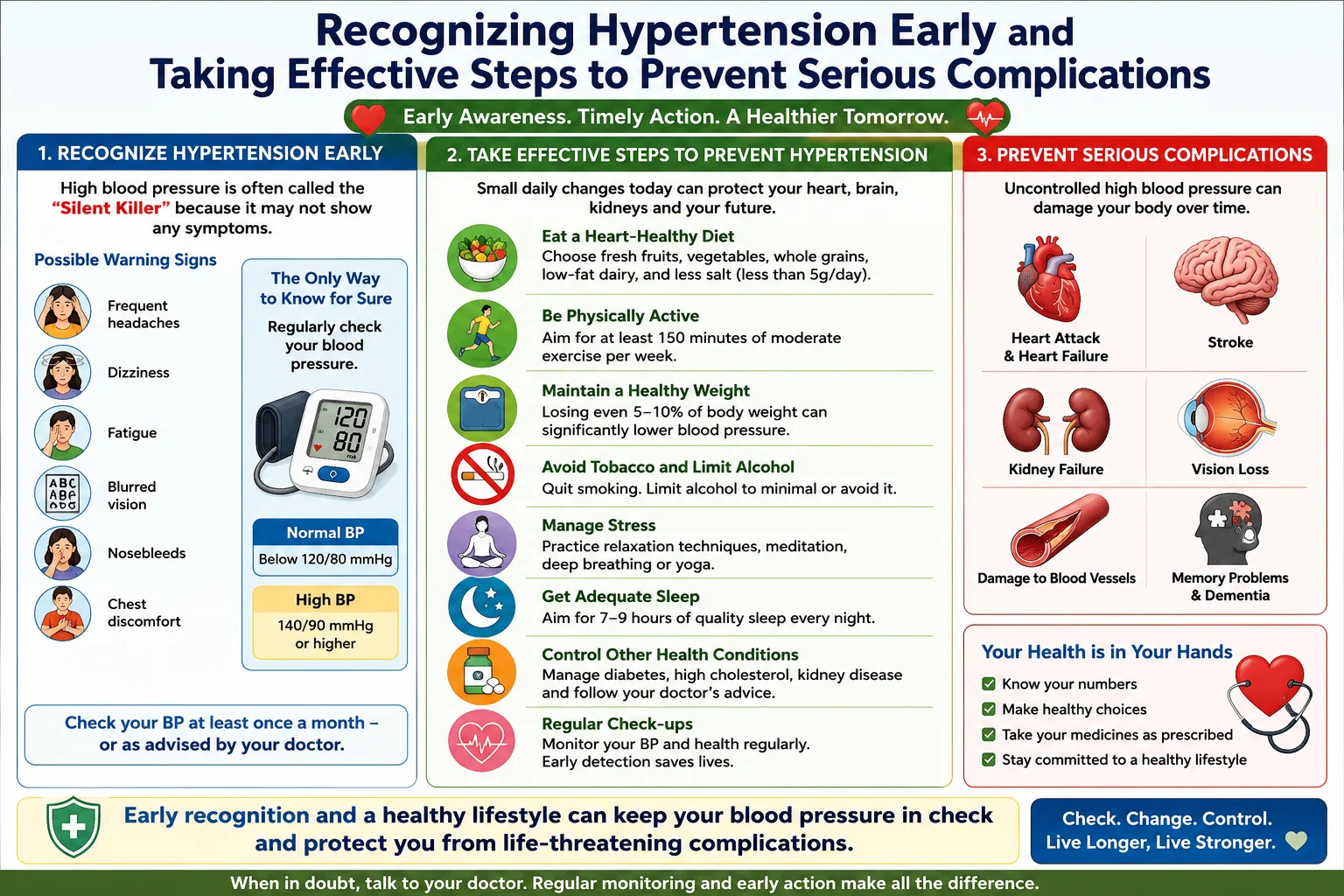
Hypertension is often called the “silent killer” because it usually develops without noticeable symptoms, allowing damage to the heart, brain, kidneys, and blood vessels to occur unnoticed over time. Recognizing the warning signs when they occur, undergoing regular blood pressure screening, and identifying personal risk factors are essential for early detection. Equally important are healthy lifestyle choices, such as eating a balanced diet, reducing salt intake, staying physically active, maintaining a healthy weight, avoiding tobacco, limiting alcohol, managing stress, and following medical advice. Early recognition and timely preventive measures can significantly reduce the risk of serious complications and promote long-term cardiovascular health.
Way to recognize High Blood pressure:
The most reliable way to recognize that your blood pressure has increased is to measure it with a validated blood pressure monitor, because hypertension usually causes no symptoms.
However, if blood pressure becomes very high or remains uncontrolled for a long time, some people may experience:
Persistent headache (especially in the morning)
Dizziness
Blurred vision
Chest pain
Shortness of breath
Palpitations (rapid or pounding heartbeat)
Nosebleeds (occasionally)
Fatigue or confusion (in severe cases)
Important: These symptoms are not specific to hypertension and may not occur even when blood pressure is dangerously high.
Therefore,
You cannot reliably tell if your blood pressure is high based on symptoms alone. The only accurate way is to check it regularly with a blood pressure monitor. Symptoms such as headache, dizziness, blurred vision, chest pain, or shortness of breath usually occur only in severe or uncontrolled hypertension.
The clinical manifestations of hypertension:
Most people with hypertension have no symptoms until complications develop, which is why it is often called the "silent killer."
1. Often no symptoms (silent disease), especially in the early stages.
Most people with hypertension have no warning signs or symptoms. The only reliable way to detect it is by measuring blood pressure regularly.
https://www.cdc.gov/high-blood-pressure/about/index.html
2. Persistent Headache (especially in severe or uncontrolled hypertension).
May occur in severe or very high blood pressure, but is uncommon in mild hypertension.
https://www.who.int/news-room/fact-sheets/detail/hypertension
3. Dizziness or lightheadedness.
Can occur when blood pressure is very high or during a hypertensive emergency.
4. Blurred vision or vision changes.
Results from damage to the #retinal blood vessels (hypertensive retinopathy) in severe or long-standing hypertension.
https://www.who.int/news-room/fact-sheets/detail/hypertension?utm_
#The retinal blood vessels are the tiny arteries and veins located in the retina, the light-sensitive layer at the back of the eye. They supply oxygen and nutrients to the retina, allowing it to function properly and transmit visual signals to the brain.
5. Chest pain (#angina).
May occur if hypertension has led to #coronary artery disease or during a hypertensive emergency.
The #coronary arteries are the blood vessels located on the surface of the heart. They arise from the aorta (the body's main artery) just above the aortic valve and supply oxygen-rich blood and nutrients to the heart muscle (myocardium).
The heart pumps blood to the entire body, so the heart muscle needs a constant supply of oxygen and energy. When the coronary arteries become narrowed, less blood reaches the heart muscle. As a result, the heart muscle does not receive enough oxygen, especially during physical activity or stress, causing chest pain or discomfort called #angina pectoris.
6. Shortness of breath.
May develop due to heart failure or severe uncontrolled hypertension
7. Palpitations (awareness of heartbeat).
Can occur when severe hypertension affects the heart or causes abnormal heart rhythms.
8. Nosebleeds (epistaxis) (occasionally, particularly with severe hypertension).
In severe or uncontrolled hypertension, the small blood vessels inside the nose can become stretched and fragile because of the high pressure. These vessels may rupture (break), leading to a nosebleed (epistaxis). Nosebleeds are not a common symptom of routine hypertension. They are more likely to occur with severely elevated blood pressure or if another condition (such as nasal dryness, trauma, or blood-thinning medications) is also present.
9. Fatigue or weakness.
May be present in severe hypertension because of reduced blood flow to the brain or heart.
10. Confusion or difficulty concentrating (in severe hypertension).
In severe hypertension, very high blood pressure can reduce normal blood flow to the brain and cause brain swelling (hypertensive encephalopathy). This interferes with normal brain function, leading to confusion, difficulty concentrating, or altered mental status.
11. Blood in the urine (hematuria) due to kidney involvement.
Long-standing or severe hypertension damages the tiny blood vessels (glomeruli) in the kidneys. This damage allows red blood cells to leak into the urine, causing blood in the urine (hematuria).
12. Swelling of the legs or feet (edema), particularly if heart or kidney damage develops.
Long-standing hypertension can damage the heart and kidneys, both of which play important roles in maintaining the body's fluid balance.
Heart damage (heart failure): When high blood pressure weakens the heart, it cannot pump blood efficiently. Blood backs up in the veins, increasing pressure in the blood vessels. This causes fluid to leak into the surrounding tissues, leading to swelling (edema), especially in the legs and feet due to gravity.
Kidney damage (chronic kidney disease): High blood pressure damages the kidneys' filtering units (glomeruli), reducing their ability to remove excess sodium and water. The retained fluid accumulates in the body, causing swelling of the legs and feet.
https://www.who.int/health-topics/hypertension/high-blood-pressure---check-it?utm_.com#tab=tab_1
13. Signs of target organ damage, including:
Heart: Left ventricular hypertrophy, heart failure, coronary artery disease.
Brain: Stroke, transient ischemic attack (TIA), vascular dementia.
Kidneys: Chronic kidney disease.
Eyes: Hypertensive retinopathy (blurred vision or vision loss).
Conclusion:
Most people with hypertension have no symptoms, especially in the early and moderate stages. Many of the clinical manifestations—such as headache, dizziness, blurred vision, chest pain, shortness of breath, confusion, and nosebleeds—are more likely to occur in severe, uncontrolled, or long-standing hypertension, or when complications have developed.
Preventive Measures of Hypertension
1. Maintain a healthy body weight.
For preventing hypertension, the goal is to maintain a healthy body weight, usually defined by a Body Mass Index (BMI) of 18.5–24.9 kg/m² for most adults. However, for South Asians (including Indians), health risks begin at a lower BMI, so a BMI of about 18.5–22.9 kg/m² is generally recommended.
Additionally, keeping your waist circumference below:
90 cm (35 inches) in men
80 cm (31.5 inches) in women
helps reduce the risk of hypertension and cardiovascular disease.
2. Eat a balanced diet rich in fruits, vegetables, whole grains, legumes, and low-fat dairy (e.g., the DASH die
The DASH diet stands for Dietary Approaches to Stop Hypertension. It is a balanced diet.
It is a heart-healthy eating plan specifically designed to lower blood pressure and reduce the risk of heart disease and stroke.
Main features of the DASH diet
Eat more: Fruits, Vegetables, Whole grains, Low-fat or fat-free dairy products, Beans, lentils, nuts, and seeds, Lean protein such as fish, skinless poultry, and legumes
Limit: Salt (sodium), Saturated and trans fats, Red and processed meats, Sugary drinks and sweets, Highly processed foods
Why does it help?
The DASH diet is rich in potassium, calcium, magnesium, and fiber, which help relax blood vessels, balance sodium, and lower blood pressure.
Major study:
Appel LJ, Moore TJ, Obarzanek E, et al. A Clinical Trial of the Effects of Dietary Patterns on Blood Pressure. New England Journal of Medicine. 1997;336:1117–1124.
https://www.nejm.org/doi/full/10.1056/NEJM199704173361601https://www.nejm.org/doi/full/10.1056/NEJM199704173361601
Guideline:
National Heart, Lung, and Blood Institute (NHLBI): DASH Eating Plan
https://www.nhlbi.nih.gov/education/dash-eating-plan3. Reduce salt (sodium) intake to help lower blood pressure.
Reduce salt (sodium) intake: Limit sodium intake to less than 2 g/day (about 5 g or one teaspoon of salt per day) to help lower blood pressure.
https://www.who.int/news-room/fact-sheets/detail/sodium-reduction?utm_source=chatgpt.com
4. Increase potassium-rich foods (unless contraindicated because of kidney disease).
Increase potassium-rich foods: Aim for at least 3,510 mg of potassium per day from foods (unless you have kidney disease or another condition requiring potassium restriction). Potassium helps balance sodium, relax blood vessels, and lower blood pressure. People with kidney disease may not be able to remove excess potassium efficiently. As a result, potassium can build up in the blood (hyperkalemia), which can cause dangerous heart rhythm abnormalities (arrhythmias) and even cardiac arrest.
Eat potassium-rich foods such as bananas, oranges, spinach, beans, potatoes, tomatoes, and yogurt. Potassium helps remove excess sodium and relax blood vessels, helping to lower blood pressure.
The 3,510 mg of potassium per day is not measured by weighing potassium itself. Instead, it is estimated from the potassium content of the foods you eat using food nutrition labels or food composition tables.
For example:
1 medium banana > Potassium ~420 mg (Approx)
1 medium baked potato > Potassium ~900 mg (Approx)
1 cup cooked spinach > Potassium ~840 mg (Approx)
1 cup cooked lentils > Potassium ~730 mg (Approx)
1 cup plain yogurt > Potassium ~570 mg (Approx)
1 medium orange > Potassium ~240 mg (Approx)
The 3,510 mg refers to the total potassium naturally present in the foods you eat each day. It is estimated from the potassium content of different foods, not measured directly
Reference:
World Health Organization. Guideline: Potassium Intake for Adults and Children.
https://www.who.int/publications/i/item/9789241504829
WHO Fact Sheet on Hypertension:
https://www.who.int/news-room/fact-sheets/detail/hypertensionhttps://www.who.int/news-room/fact-sheets/detail/hypertension
5. Exercise regularly:
Exercise regularly (at least 150 minutes of moderate-intensity aerobic activity per week): Regular exercise strengthens the heart, improves blood vessel function, helps maintain a healthy weight, and reduces blood pressure.
https://www.who.int/publications/i/item/9789240015128
6. Limit alcohol consumption or avoid it.
Limit alcohol consumption or avoid it: Excess alcohol activates the sympathetic nervous system, increases stress hormone levels, narrowing blood vessels, and damages heart and blood vessels, all of which can raise blood pressure.
7. Avoid smoking and all tobacco products.
Smoking and tobacco cause blood vessels to narrow, temporarily raise blood pressure, damage the blood vessel lining (endothelium), and accelerate atherosclerosis, increasing the risk of hypertension and cardiovascular disease.
https://www.cdc.gov/tobacco/about/cigarettes-and-cardiovascular-disease.html
8. Manage stress through relaxation techniques, meditation, yoga, or deep breathing.
Manage stress through relaxation techniques, meditation, yoga, or deep breathing: These practices reduce sympathetic nervous system activity and lower stress hormone levels (adrenaline, noradrenaline, and cortisol), helping blood vessels relax and lowering blood pressure.
https://www.apa.org/topics/stress/body
9. Get adequate sleep (about 7–9 hours per night for most adults).
Get adequate sleep (about 7–9 hours per night for most adults): Adequate sleep helps regulate the sympathetic nervous system, lowers stress hormone levels, and allows blood pressure to fall normally during sleep. Poor or insufficient sleep increases the risk of hypertension.
https://link.springer.com/article/10.5664/jcsm.4950
10. Control diabetes, high cholesterol, and kidney disease with appropriate treatment.
Control diabetes, high cholesterol, and kidney disease with appropriate treatment: These conditions damage blood vessels and impair blood pressure regulation. Proper treatment helps protect the heart, kidneys, and blood vessels, reducing the risk of hypertension and its complications.
https://diabetesjournals.org/care/issue
11. Take prescribed medications as directed:
Avoid overusing medicines that can raise blood pressure (such as some NSAIDs and decongestants): These medicines can cause sodium and water retention, narrow blood vessels, or stimulate the sympathetic nervous system, leading to increased blood pressure.
12. Monitor blood pressure regularly, especially if you have risk factors or a family history of hypertension.
13. Attend regular health check-ups for early detection and management.
14. Stay physically active throughout the day and avoid prolonged sitting.
15. Follow your healthcare provider's advice if you are at increased risk of developing hypertension.
These measures help prevent hypertension and reduce the risk of serious complications such as heart attack, stroke, heart failure, chronic kidney disease, and hypertensive retinopathy.