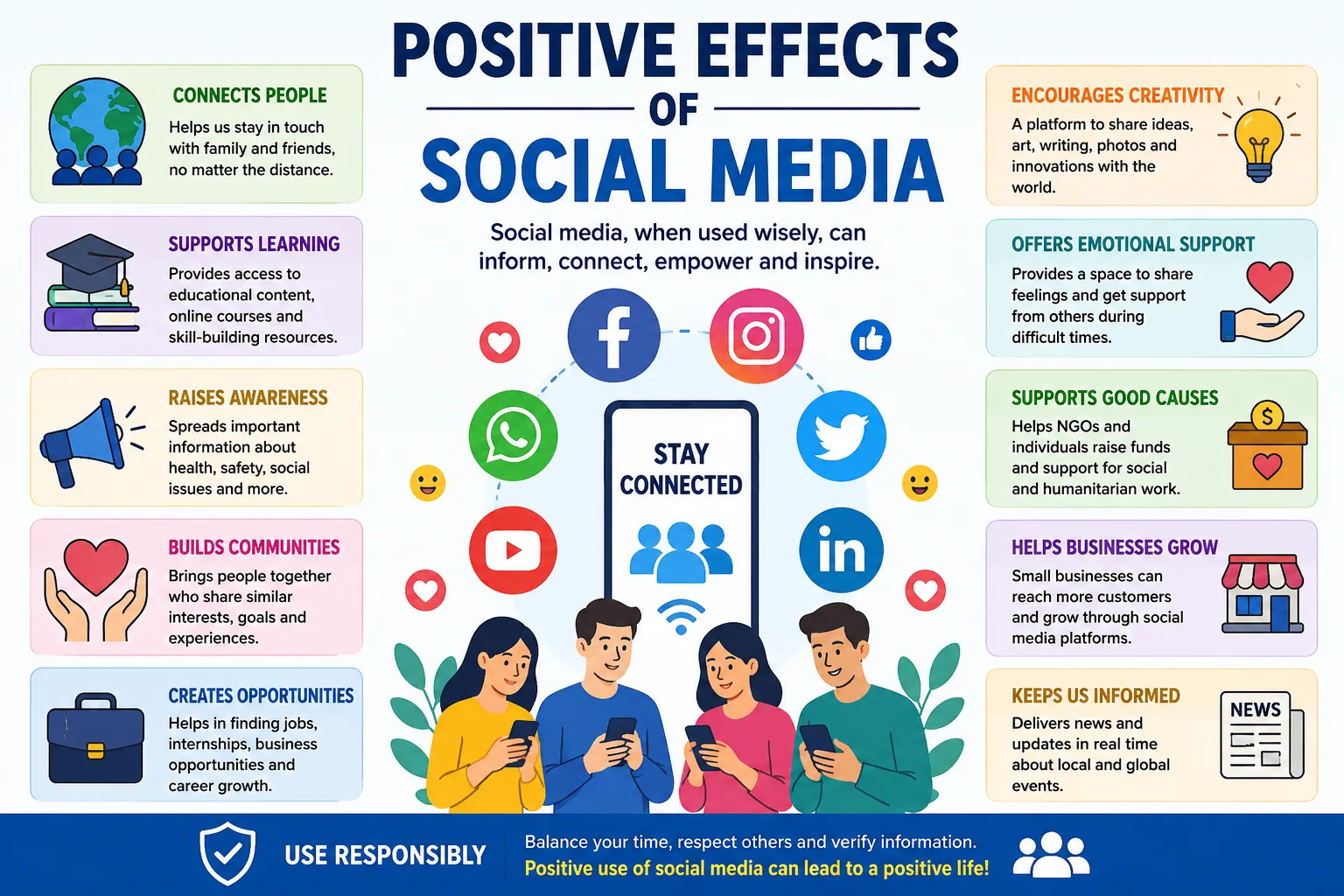
Social media has become an inseparable part of modern society, transforming the way people communicate, learn, work, and build relationships. It connects individuals, families, and communities across geographical boundaries within seconds, making the exchange of ideas, information, and experiences easier than ever before. From promoting education, public health awareness, and social support to strengthening community engagement during emergencies, social media has created countless opportunities that enrich everyday life.
However, the rapid growth of social media has also introduced significant social challenges. Excessive use, misinformation, cyberbullying, social polarization, reduced face-to-face interaction, privacy concerns, and unhealthy dependence on online validation can negatively affect individuals, families, and communities. These influences extend beyond personal well-being and can shape public opinion, cultural values, social relationships, and even community harmony.
Understanding both the positive and negative effects of social media is essential for using these powerful platforms responsibly. By recognizing their benefits while remaining aware of their potential risks, individuals and societies can promote healthy digital habits, strengthen social relationships, and create a safer, more informed, and more connected community for present and future generations.
The positive effects of social media on society include:
1. Improves Communication and Global Connectivity
Social media enables people to communicate instantly through text messages, voice calls, video calls, and shared posts, regardless of geographical distance. It helps families, friends, colleagues, students, and organizations stay connected, exchange information in real time, and collaborate efficiently. It also allows people from different countries and cultures to interact, share ideas, and build relationships, promoting global connectivity and understanding.
Example:
A nurse working abroad can use WhatsApp or Facebook Messenger to video call family members in India every day, share photos and important updates instantly, and maintain close family relationships despite living thousands of kilometers away.
Study link:
Pew Research Center – Social Media and the Cost of Caring
https://www.pewresearch.org/internet/2015/01/15/social-media-and-the-cost-of-caring/
https://www.protidinersangbad.com/todays-newspaper/editor-choice/428398
2. Promotes Education and Knowledge Sharing
Social media provides quick and easy access to educational resources, online lectures, scientific articles, expert opinions, and health information. Students, teachers, researchers, and professionals can share knowledge, discuss ideas, participate in webinars, join educational groups, and learn new skills from experts around the world. It also encourages collaborative learning by allowing users to ask questions and exchange experiences in real time.
Example:
i). A nursing student joins a Facebook or Telegram study group where teachers and classmates share lecture notes, clinical guidelines, educational videos, and previous examination questions. This helps the student understand difficult topics, stay updated, and prepare more effectively for examinations.
ii). When the nationwide COVID-19 lockdown began in Kolkata on 23 March 2020, I was unable to attend my institution, the College of Nursing, because all educational activities had shifted online. Our Principal instructed the faculty to continue teaching through virtual classes to ensure that students' education was not interrupted.
During this period, I conducted online classes in Obstetrical Nursing for Fourth-Year Generic B.Sc. Nursing students and First-Year Post Basic B.Sc. Nursing students. I also taught Anatomy to First-Year Generic B.Sc. Nursing students. The Generic B.Sc. students attended the classes from their hostel, while the Post Basic B.Sc. students participated from their homes.
Despite the challenges of remote teaching, I made every effort to provide effective learning experiences. In addition to delivering theoretical lectures, I demonstrated important practical topics such as the mechanism of labour, fetal skull, pelvis, and various bones using teaching models and visual aids during the online sessions. I also conducted online examinations to assess the students' understanding and ensure continuity of the academic program.
This experience strengthened my confidence in online teaching and demonstrated that, with dedication, adaptability, and the effective use of technology, quality nursing education can be successfully delivered even during unprecedented circumstances.
Study link:
UNESCO – Digital Learning and Education
https://www.unesco.org/en/education/digital-learning
3. Raises Public Awareness About Social and Health Issues
Social media enables government agencies, healthcare organizations, educational institutions, and community groups to quickly share accurate information with large numbers of people. It helps spread awareness about disease prevention, vaccination, healthy lifestyles, disaster preparedness, environmental protection, blood donation, and social issues. During emergencies, social media also provides timely updates, helping people make informed decisions and respond appropriately.
Example:
During the COVID-19 pandemic, the Ministry of Health and the World Health Organization used social media to educate the public about hand hygiene, mask use, vaccination, physical distancing, and recognizing symptoms. These messages reached millions of people within a short time and increased public awareness.
Study link:
World Health Organization – Digital Health
https://www.who.int/health-topics/digital-health
4. Strengthens Community Engagement and Social Support
Social media connects people with local communities, support groups, volunteer organizations, and non-governmental organizations (NGOs) that share common interests or needs. It allows community members to exchange information, organize events, provide emotional support, raise funds, and coordinate help during emergencies. This strengthens social bonds and encourages people to work together for the welfare of their communities.
Example:
After severe flooding in a town, local residents create a Facebook or WhatsApp group to share information about safe shelters, food distribution, blood donation, and rescue services. Volunteers use the group to coordinate relief efforts, while affected families receive timely assistance and emotional support.
Study link:
National Institutes of Health (NCBI) – Online Social Support and Health
https://pmc.ncbi.nlm.nih.gov/articles/PMC4183915/
This review explains how online communities and social networking platforms can provide emotional, informational, and practical support, strengthening community engagement and social connectedness.
5. Encourages Civic Participation and Social Activism
Social media enables people to learn about public issues, express their opinions, participate in discussions, organize community activities, and support social causes. It helps governments, non-governmental organizations (NGOs), and citizens communicate directly, making it easier to promote awareness campaigns, volunteer activities, environmental protection, blood donation drives, and disaster relief efforts. Social media also encourages people to participate in lawful civic activities such as public consultations, voter education, and community development programs.
Example:
A local community organization uses Facebook and WhatsApp to organize a neighborhood clean-up campaign. Within a few days, hundreds of residents receive the invitation, volunteer to participate, and work together to clean public parks and streets, improving the local environment.
Study link:
Pew Research Center – Social Media and Political Engagement
https://www.pewresearch.org/internet/2012/09/19/social-media-and-political-engagement
This report describes how social media can increase civic participation by helping people access information, discuss public issues, and become involved in community and civic activities.
6. Supports Business Growth and Employment Opportunities
Social media allows businesses to promote their products and services, reach customers worldwide, advertise at a relatively low cost, and receive customer feedback instantly. Small businesses, entrepreneurs, and self-employed individuals can use social media to increase sales and build their brands. It also creates employment opportunities in areas such as digital marketing, content creation, graphic design, online customer service, e-commerce, and social media management.
Example:
i). A woman starts a homemade bakery and creates an Instagram and Facebook page to showcase her cakes. Customers place orders through social media, and as demand increases, she hires two assistants and expands her business, creating new employment opportunities.
ii). I know a music teacher who is also a talented singer. She runs a music school from her home, where many students attend regular singing lessons. Before the COVID-19 pandemic, all of her classes were conducted in person.
During the COVID-19 outbreak, however, her students were unable to come to her house because of lockdown restrictions and concerns about infection. To continue teaching without interrupting her students' learning, she began conducting online music classes. What started as a temporary solution soon became a valuable opportunity.
As word spread about her online teaching, students from different parts of India and even from abroad began enrolling in her classes. She continued to expand her online music school while maintaining the quality of her teaching. Today, she is still successfully conducting online classes and has also started organizing online music examinations for her students.
The use of social media and digital communication platforms has enabled her to reach a much wider audience than before. As a result, her music school has grown significantly, her professional opportunities have increased, and both she and her students have benefited. She is happy because her passion has become a thriving profession, and her students are equally happy because they can continue learning music from anywhere in the world.
Study link:
World Bank – Digital Development
https://www.worldbank.org/en/topic/digitaldevelopment
The World Bank highlights how digital technologies, including social media, support entrepreneurship, business growth, innovation, and job creation by improving market access and communication.
7. Facilitates Emergency Communication During Disasters
During natural disasters and public emergencies, social media enables government agencies, disaster management authorities, emergency services, and community organizations to quickly share warnings, evacuation instructions, weather updates, road closures, shelter locations, and rescue information. It also allows affected people to report their location, request assistance, and inform family members that they are safe, improving the speed and coordination of emergency response.
Example:
During a severe cyclone, the local disaster management authority posts evacuation alerts and the locations of nearby relief shelters on Facebook, X (formerly Twitter), and WhatsApp. Residents receive these updates immediately, move to safer places, and volunteers use the same platforms to coordinate rescue operations and distribute food and medical supplies.
Study link:
World Health Organization – Infodemic Management and Risk Communication
https://www.who.int/teams/risk-communication/infodemic-management
The WHO explains that digital platforms and social media can rapidly disseminate reliable information during public health emergencies and disasters, helping authorities communicate with the public and support emergency response.
8. Promotes Cultural Exchange and Global Understanding
Social media allows people from different countries, cultures, religions, and languages to communicate and share their traditions, festivals, food, music, art, customs, and daily lives. By interacting with people from diverse backgrounds, users gain a better understanding of different cultures, reduce stereotypes and prejudices, and develop greater respect, tolerance, and appreciation for cultural diversity. This promotes global friendship and mutual understanding.
Example:
A nursing student in India joins an international Facebook group with students from Japan, Brazil, Nigeria, and Canada. Members share how festivals, healthcare practices, and nursing education differ in their countries. Through these discussions, the student gains a broader understanding of different cultures and learns to respect cultural diversity in patient care.
Study link:
UNESCO – Culture and Digital Technologies
https://www.unesco.org/en/culture
UNESCO highlights how digital technologies and social media help preserve cultural heritage, encourage intercultural dialogue, and promote mutual understanding among people from different societies.
9. Provides Entertainment and Creative Expression
Social media provides a platform where people can watch entertainment, share creative talents, and express their ideas through videos, music, photography, painting, writing, dance, storytelling, and other forms of art. It allows creators to reach a global audience, receive feedback, inspire others, and even turn their hobbies into careers. These opportunities encourage creativity, cultural expression, and personal development.
Example:
i). A young woman who enjoys singing uploads short music videos to YouTube and Instagram. Her performances attract thousands of viewers, helping her gain confidence, improve her skills through audience feedback, and eventually receive invitations to perform at local cultural events.
ii). Writing poems and stories has always been one of my greatest passions. I regularly share my writings in my WhatsApp groups and on Facebook, where my friends and followers read them with interest. Their encouraging comments and positive feedback give me immense happiness and inspire me to continue writing with greater enthusiasm.
Creative writing has become a meaningful part of my life. It not only allows me to express my thoughts and emotions but also helps me overcome feelings of loneliness and keeps me mentally active and cheerful. The appreciation I receive from readers motivates me to improve my writing and explore new ideas.
Inspired by this positive experience, I have recently started my own blog, "Health Spectrum," with the aim of sharing reliable health information for the benefit of the general public as well as nursing and healthcare students. Through this platform, I hope to promote health awareness and make educational information more accessible.
The advancement of social media and digital communication has made all of this possible. These platforms have enabled me to connect with readers from different places, share my creativity, receive valuable feedback, and contribute to society through health education. I consider social media not only a means of communication but also a powerful tool for learning, creativity, and public service.
Study link:
UNESCO – Creativity and Creative Economy
https://www.unesco.org/en/creativity
UNESCO highlights how digital platforms and social media support creativity, artistic expression, cultural participation, and the growth of creative industries.
10. Enhances Professional Networking and Career Development
Social media enables professionals, students, researchers, and employers to build professional networks, exchange knowledge, discover job opportunities, and collaborate with experts worldwide. Platforms such as LinkedIn, ResearchGate, and professional Facebook groups help users share achievements, attend webinars, learn new skills, follow industry trends, and connect with mentors or potential employers. These activities support career growth and lifelong professional development.
Example:
A newly graduated nurse creates a LinkedIn profile highlighting her qualifications and clinical skills. She connects with hospital recruiters, joins nursing professional groups, attends online webinars, and learns about job vacancies. Within a few months, she is invited for interviews and secures a nursing position.
Study link:
OECD – Digital Economy and Digital Skills
https://www.oecd.org/digital/
The OECD explains that digital technologies and online professional platforms improve access to employment opportunities, professional networking, skill development, and career advancement.
11. Supports Fundraising and Humanitarian Assistance
Social media enables individuals, charities, non-governmental organizations (NGOs), and humanitarian agencies to quickly reach large audiences and raise funds for medical treatment, disaster relief, education, food distribution, and other charitable causes. It also helps recruit volunteers, coordinate relief efforts, share information about urgent needs, and encourage people to donate money, blood, clothes, food, or other essential supplies.
Example:
After a devastating earthquake, a humanitarian organization launches a fundraising campaign on Facebook and Instagram. Within a few days, thousands of people donate money, while volunteers use social media to organize the distribution of food, clean water, medicines, and temporary shelters to affected families.
Study link:
International Federation of Red Cross and Red Crescent Societies (IFRC) – Digital Humanitarian Action
https://www.ifrc.org
The IFRC explains how digital platforms and social media help mobilize donations, coordinate volunteers, and deliver humanitarian assistance more effectively during emergencies and disasters.
Encourages Collaboration and Innovation
Social media enables students, researchers, healthcare professionals, educators, businesses, and organizations to communicate, exchange ideas, share research findings, and work together regardless of location. Through online groups, professional communities, webinars, and discussion forums, people can solve problems collectively, develop new ideas, improve products and services, and accelerate scientific and technological innovation.Example:
Researchers from India, the United Kingdom, and Australia join an online professional group to discuss antibiotic resistance. They share research findings, exchange clinical experiences, and collaborate on a joint research project. Their teamwork leads to the publication of a scientific paper and recommendations for improving infection control practices.Study link:
OECD – Digital Transformation and Innovation
https://www.oecd.org/digital/The OECD highlights that digital platforms facilitate knowledge sharing, collaboration, innovation, research partnerships, and the development of new ideas across countries and sectors.
Continuation in next Blog https://www.healthspectrumindia.com/settings/posts/e9f698c3-17e6-4405-9820-b6876b56f783