
Social media has become an integral part of everyday life, connecting billions of people across the world and transforming the way individuals communicate, learn, work, and share experiences. While these platforms offer valuable opportunities for education, social support, creativity, and global connectivity, excessive or unhealthy use can also influence mental health in significant ways. The impact of social media varies across different age groups, as children, adolescents, adults, and older adults face unique psychological, emotional, and social challenges. Understanding both the positive and negative effects of social media is essential for promoting healthy digital habits, protecting mental well-being, and fostering a balanced relationship with technology in today's increasingly connected world.
Social media:
It refers to internet-based websites and mobile applications that enable people to create, share, and exchange information, ideas, photos, videos, and messages, while interacting with others in real time or asynchronously.
Examples: Facebook, Instagram, X (formerly Twitter), WhatsApp, YouTube, Snapchat, TikTok, LinkedIn, Reddit, and Pinterest.
History of Social Media
The history of social media began with the rapid expansion of the internet during the 1990s. Early online communication occurred through email, chat rooms, bulletin board systems (BBS), and internet forums, allowing people to exchange messages and ideas electronically. In 1997, #SixDegrees.com became the first recognizable social networking website, enabling users to create personal profiles and connect with friends.
#SixDegrees.com: SixDegrees.com was the world's first recognizable social networking website, launched in 1997. It allowed users to create personal profiles, build friend lists, and connect with other users online, laying the foundation for modern social media platforms.
During the early 2000s, social media evolved rapidly with the launch of platforms such as Friendster (2002), LinkedIn (2003) for professional networking, MySpace (2003) for personal networking and entertainment, and Facebook (2004), which revolutionized global online communication. This was followed by YouTube (2005) for video sharing, Twitter (2006) for microblogging, WhatsApp (2009) for instant messaging, Instagram (2010) for photo sharing, Snapchat (2011) for disappearing messages, and TikTok (2016) for short-form videos.
Today, social media has become an essential part of modern life, connecting billions of people worldwide. It is widely used for communication, education, business, entertainment, healthcare, news sharing, and social networking, profoundly influencing the way people interact and access information.
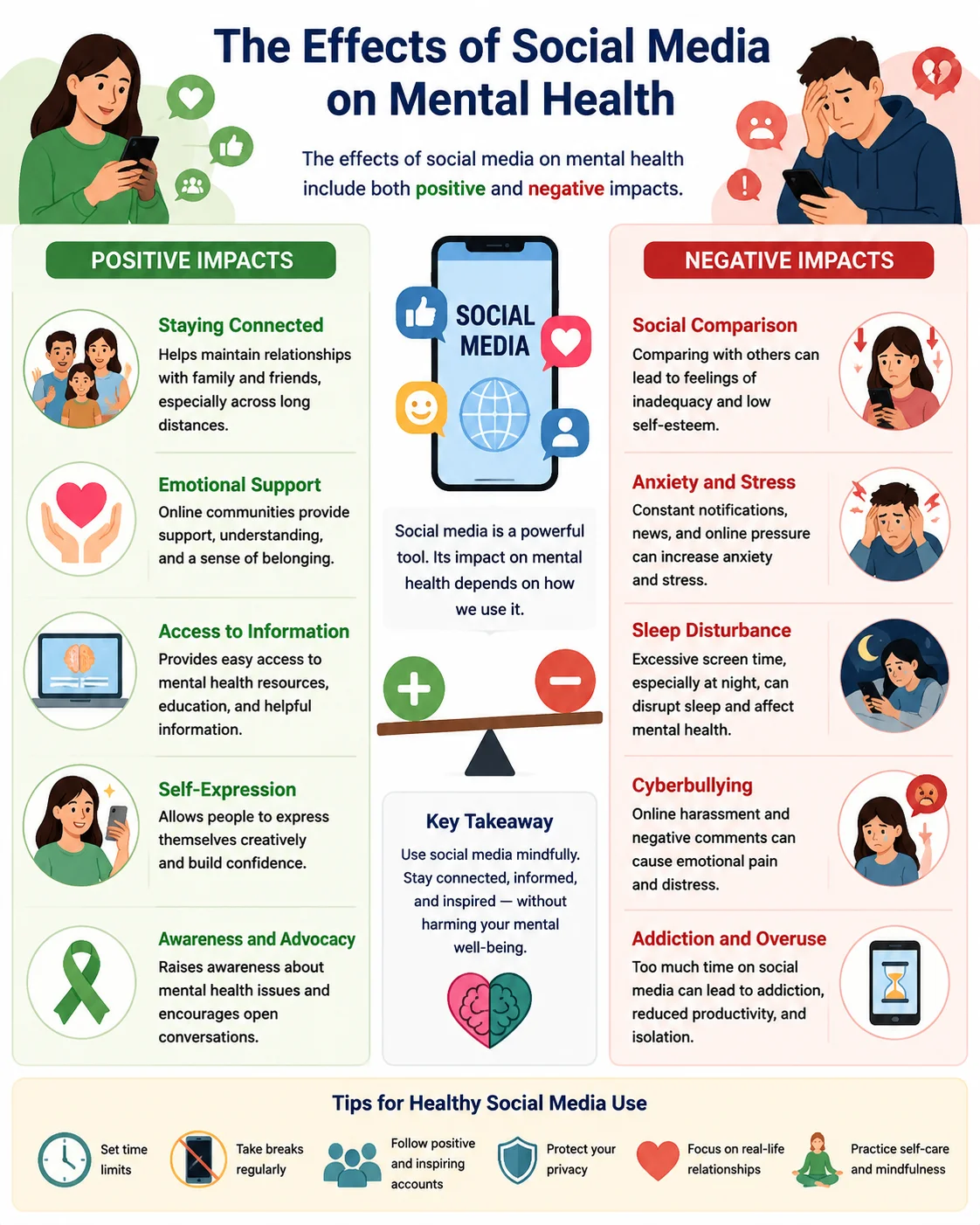
The effects of social media on mental health include both positive and negative impacts.
Positive effects
1. Enhances social connection and communication.
2. Provides emotional support through online communities.
3. Increases access to health information and mental health resources.
4. Encourages self-expression and creativity.
5. Promotes learning, skill development, and professional networking.
6. Helps maintain relationships with family and friends across distances.
7. Raises awareness about mental health and reduces stigma.
8. Offers opportunities for peer support during illness or difficult life events.
Negative effects
1. Anxiety and excessive worry.
Social media exposes people to constant notifications, disturbing news, unrealistic lifestyles, and pressure to gain likes or approval. Frequent comparison with others and the fear of missing out (#FOMO) can make people feel anxious, insecure, and worried about their own lives.
#FOMO (Fear of Missing Out) is the anxious feeling that other people are having rewarding, enjoyable, or important experiences without you. It often leads people to check social media repeatedly so they do not miss updates, events, or conversations.
Example:
A college student repeatedly checks Instagram and sees friends posting photos from parties, vacations, and achievements. She begins to worry that she is missing out or not doing well enough. She constantly checks her phone for likes and messages, feels restless when there are no notifications, and becomes increasingly anxious and unable to concentrate on her studies.
Study link:
Primack BA, et al. Social Media Use and Perceived Social Isolation Among Young Adults. American Journal of Preventive Medicine (2017).
https://pmc.ncbi.nlm.nih.gov/articles/PMC5313634/
This study found that higher social media use was associated with greater perceived social isolation, a factor linked to anxiety and poor mental well-being.
2. Depression and low mood.
Spending excessive time on social media can lead to constant comparison with others, exposure to negative content, cyberbullying, and feelings of loneliness or rejection. Seeing only the "perfect" moments of others' lives may make people feel that their own lives are less successful or less enjoyable, leading to sadness, hopelessness, and a persistently low mood.
Example:
A young woman spends several hours each day on social media viewing photos of friends with successful careers, happy relationships, and luxury vacations. She starts believing that her own life is inadequate, feels discouraged about herself, loses interest in activities she once enjoyed, and gradually develops symptoms of depression and persistent low mood.
Study link:
Lin LY, et al. Association between Social Media Use and Depression among U.S. Young Adults. Depression and Anxiety (2016).
https://pmc.ncbi.nlm.nih.gov/articles/PMC4853817/https://
This study found that greater social media use was associated with an increased likelihood of depression among young adults.
3. Low self-esteem and poor body image due to social comparison.
Social media often displays edited, filtered, or idealized images of people's appearance and lifestyles. Repeatedly comparing oneself with these unrealistic images can make individuals feel less attractive, overweight, or unsuccessful, leading to low self-esteem, poor body image, and dissatisfaction with their own appearance.
Example:
A 19-year-old girl spends hours on Instagram following fitness influencers and fashion models. After repeatedly comparing her body with their edited photos, she begins to believe that she is unattractive and overweight, even though she has a healthy body weight. She loses confidence, avoids social gatherings, and becomes unhappy with her appearance.
Study link:
Fardouly J, Vartanian LR. Social Media and Body Image Concerns: Current Research and Future Directions. Current Opinion in Psychology (2016).
https://www.sciencedirect.com/science/article/pii/S2352250X15001505
This review discusses how appearance-focused social media and social comparison contribute to body dissatisfaction and lower self-esteem, particularly among adolescents and young adults.
4. Fear of Missing Out (FOMO).
5. Social media addiction and excessive screen time.
Social media platforms are designed to keep users engaged through endless scrolling, notifications, likes, and personalized content. Repeated use activates the brain's reward system, making it difficult to stop checking social media. As screen time increases, it can interfere with sleep, study, work, physical activity, face-to-face relationships, and emotional well-being, leading to stress, poor concentration, and reduced productivity.
Example:
A university student plans to use social media for 15 minutes before studying. However, continuous scrolling through Instagram and short videos keeps him online for more than three hours. He delays his assignments, sleeps late, feels tired the next day, and finds it difficult to concentrate in class. Over time, he becomes dependent on checking his phone every few minutes.
Study link:
Kuss DJ, Griffiths MD. Online Social Networking and Addiction—A Review of the Psychological Literature. International Journal of Environmental Research and Public Health (2011).
https://pmc.ncbi.nlm.nih.gov/articles/PMC3194102/
This review describes how excessive social media use can become addictive and negatively affect sleep, academic performance, work productivity, and mental health.
6. Sleep disturbances and insomnia.
Using social media late at night keeps the brain mentally active and exposes the eyes to blue light from phone or computer screens. Blue light suppresses melatonin, the hormone that helps regulate sleep, making it harder to fall asleep. In addition, exciting or emotionally upsetting content can keep the mind alert, leading to poor sleep quality and insomnia.
Example:
A young man lies in bed intending to sleep at 10:30 p.m., but starts watching short videos on social media. He continues scrolling until 1:00 a.m. because each video leads to another. As a result, he falls asleep very late, wakes up tired the next morning, feels sleepy during the day, and has difficulty concentrating at work.
Study link:
Levenson JC, Shensa A, Sidani JE, et al. The Association Between Social Media Use and Sleep Disturbance Among Young Adults. Preventive Medicine (2016).
https://pmc.ncbi.nlm.nih.gov/articles/PMC4853817/
This study found that frequent social media use was associated with increased sleep disturbances among young adults.
7. Cyberbullying and online harassment.
Cyberbullying involves sending threatening, insulting, humiliating, or false messages or posts through social media or other online platforms. Victims may experience fear, embarrassment, anxiety, depression, low self-esteem, and, in severe cases, suicidal thoughts. Because online content can spread rapidly and remain visible for a long time, its emotional impact can be greater than traditional bullying.
Example:
A 15-year-old student posts a photo on social media. Some classmates begin posting insulting comments about her appearance and repeatedly send hurtful messages in a group chat. She becomes afraid to open social media, loses confidence, avoids school, feels depressed, and withdraws from family and friends.
Study link:
Cyberbullying Among Adolescents and Children: A Comprehensive Review of the Global Situation, Risk Factors, and Preventive Measures (NCBI/PMC)
https://pmc.ncbi.nlm.nih.gov/articles/PMC8006937/
This review reports that cyberbullying is associated with increased risks of anxiety, depression, low self-esteem, self-harm, and suicidal ideation among children and adolescents.
8. Loneliness and social isolation despite being online.
Although social media connects people virtually, excessive online interaction may replace meaningful face-to-face relationships. People may have hundreds of online friends but still lack genuine emotional support and real-life companionship, leading to feelings of loneliness and social isolation.
Example:
A 28-year-old man spends several hours each day chatting on social media and following hundreds of online friends. However, he rarely meets people in person or participates in social activities. Despite being constantly connected online, he feels lonely, has no close friend to confide in, and becomes socially isolated.
Study link:
Primack BA, et al. Social Media Use and Perceived Social Isolation Among Young Adults. American Journal of Preventive Medicine (2017).
https://pmc.ncbi.nlm.nih.gov/articles/PMC5313634/
This study found that greater social media use was associated with higher levels of perceived social isolation, even though users were frequently connected online.
9. Reduced attention span and decreased academic or work performance.
Frequent social media use causes constant interruptions from notifications, messages, and short-form videos, making it difficult to maintain attention on one task for long periods. Repeated switching between studying or working and checking social media reduces concentration, memory, productivity, and overall performance.
Example:
A college student sits down to study for an examination but checks social media every few minutes whenever a notification appears. As a result, studying takes much longer than planned, important concepts are not remembered, and the student's examination performance declines.
Study link:
Rosen LD, Carrier LM, Cheever NA. Facebook and Texting Made Me Do It: Media-Induced Task-Switching While Studying. Computers in Human Behavior (2013).
https://www.sciencedirect.com/science/article/pii/S0747563212003654
This study found that frequent interruptions from social media and texting while studying reduced concentration and negatively affected academic performance.
10. Increased stress from constant notifications and information overload.
Constant notifications, messages, emails, and an endless stream of new posts keep the brain in a state of continuous alertness. Trying to process large amounts of information throughout the day can cause mental fatigue, difficulty relaxing, irritability, and increased stress.
Example:
An office employee receives frequent notifications from WhatsApp, Facebook, Instagram, and work-related apps throughout the day. Every few minutes, he stops working to check his phone. By the end of the day, he feels mentally exhausted, overwhelmed by the constant flow of information, and stressed because he cannot complete his work efficiently.
Study link:
Reinecke L, Aufenanger S, Beutel ME, et al. Digital Stress Over the Life Span: The Effects of Communication Load and Internet Multitasking on Perceived Stress and Psychological Health. Frontiers in Psychology (2017).
https://www.frontiersin.org/articles/10.3389/fpsyg.2017.00985/full
This study discusses how continuous digital communication, frequent notifications, and information overload contribute to increased stress and reduced psychological well-being.
11. Exposure to harmful or misleading content.
Social media can expose users to false information, violent or disturbing content, hate speech, unrealistic beauty standards, and harmful health advice. Repeated exposure to such content may increase fear, anxiety, confusion, emotional distress, and unhealthy behaviors, especially among children, adolescents, and vulnerable adults.
Example:
A young woman watches several social media videos claiming that a strict "detox diet" can help people lose 10 kg in one month. Believing the misleading information, she follows the diet without consulting a healthcare professional. She becomes weak, develops nutritional deficiencies, and feels anxious when she does not achieve the expected results.
Study link:
https://www.who.int/health-topics/infodemic?utm_source=chatgpt.com#tab=tab_1
The WHO explains that health misinformation on digital platforms can confuse people, promote harmful behaviors, and negatively affect both physical and mental well-being
12. Increased risk of eating disorders and unhealthy weight-control behaviors in vulnerable individuals.
Social media often promotes unrealistic body ideals, extreme dieting, and rapid weight-loss trends. People who are vulnerable—especially adolescents and young adults with low self-esteem or body dissatisfaction—may compare themselves with these images and begin unhealthy behaviors such as skipping meals, excessive dieting, self-induced vomiting, misuse of laxatives, or compulsive exercise.
Example:
A 17-year-old girl follows several fitness influencers on social media who constantly post edited photos of very thin bodies and promote "quick weight-loss" diets. Wanting to look like them, she starts skipping meals and eating very little. Over time, she becomes undernourished, loses excessive weight, and develops an eating disorder.
Study link:
Holland G, Tiggemann M. A Systematic Review of the Impact of the Use of Social Networking Sites on Body Image and Disordered Eating Outcomes. Body Image (2016).
https://www.sciencedirect.com/science/article/pii/S174014451630062X
This systematic review found that frequent use of appearance-focused social media is associated with greater body dissatisfaction and a higher risk of disordered eating behaviors, particularly among adolescents and young adults.
13. Reduced face-to-face social interaction and interpersonal skills.
Spending excessive time on social media can reduce opportunities for in-person conversations and social activities. Over time, some individuals may become less confident in communicating face-to-face, making eye contact, expressing emotions, resolving conflicts, and building meaningful relationships.
Example:
A 22-year-old man spends most of his free time chatting online and scrolling through social media. Although he communicates frequently through messages, he rarely meets friends in person. When attending a family gathering or job interview, he feels uncomfortable starting conversations, avoids eye contact, and finds it difficult to interact confidently with others.
Study link:
Uhls YT, Michikyan M, Morris J, et al. Five Days at Outdoor Education Camp Without Screens Improves Preteen Skills With Nonverbal Emotion Cues. Computers in Human Behavior (2014).
https://www.sciencedirect.com/science/article/pii/S0747563214003227
This study showed that reducing screen media use and increasing face-to-face interaction improved children's ability to recognize emotions and enhanced interpersonal communication skills.
14. Emotional dependence on likes, comments, and online validation.
Some people begin to measure their self-worth by the number of likes, comments, shares, or followers they receive on social media. When posts receive little attention, they may feel disappointed, rejected, or anxious, becoming emotionally dependent on online approval for happiness and self-confidence.
Example:
A 20-year-old student uploads a photo on Instagram and repeatedly checks her phone to see how many likes and comments it receives. When the post gets fewer likes than expected, she feels upset, believes that people do not like her, loses confidence, and deletes the post. Her mood becomes dependent on online reactions rather than her real-life achievements and relationships.
Study link:
Nesi J, Prinstein MJ. Using Social Media for Social Comparison and Feedback-Seeking: Gender and Popularity Moderate Associations with Depressive Symptoms. Journal of Abnormal Child Psychology (2015).
https://pmc.ncbi.nlm.nih.gov/articles/PMC4652535/
This study found that frequent social comparison and seeking validation through social media were associated with greater depressive symptoms and poorer emotional well-being, particularly among adolescents.
Major reviews and research articles
U.S. Surgeon General Advisory on Social Media and Youth Mental Health (2023) Official PDF
https://www.hhs.gov/sites/default/files/sg-youth-mental-health-social-media-advisory.pdf
National Center for Biotechnology Information (NCBI) – Social Media Use and Mental Health Review article
https://pmc.ncbi.nlm.nih.gov/articles/PMC7364393/
NCBI – Social Media and Depression/Anxiety in Young Adults Research article
https://pmc.ncbi.nlm.nih.gov/articles/PMC4183915/
NCBI – Positive and Negative Effects of Social Media on Mental Health Systematic review
https://pmc.ncbi.nlm.nih.gov/articles/PMC5422656/
Cyberbullying and psychological effects
CDC – Cyberbullying and Mental Health CDC Fact Sheet
https://www.cdc.gov/youth-violence/about/about-bullying.html
Sleep disturbance and screen time
Sleep Foundation – Social Media and Sleep Evidence-based summary
https://www.sleepfoundation.org/how-sleep-works/how-social-media-affects-sleep
Body image and social comparison
NCBI – Social Media and Body Image Concerns Research review
https://pmc.ncbi.nlm.nih.gov/articles/PMC6214874/
WHO mental health information
World Health Organization – Mental Health WHO overview
https://www.who.int/health-topics/mental-health#tab=tab_1
These are widely used academic or public-health sources and are appropriate for nursing assignments, presentations, or health-education materials.