
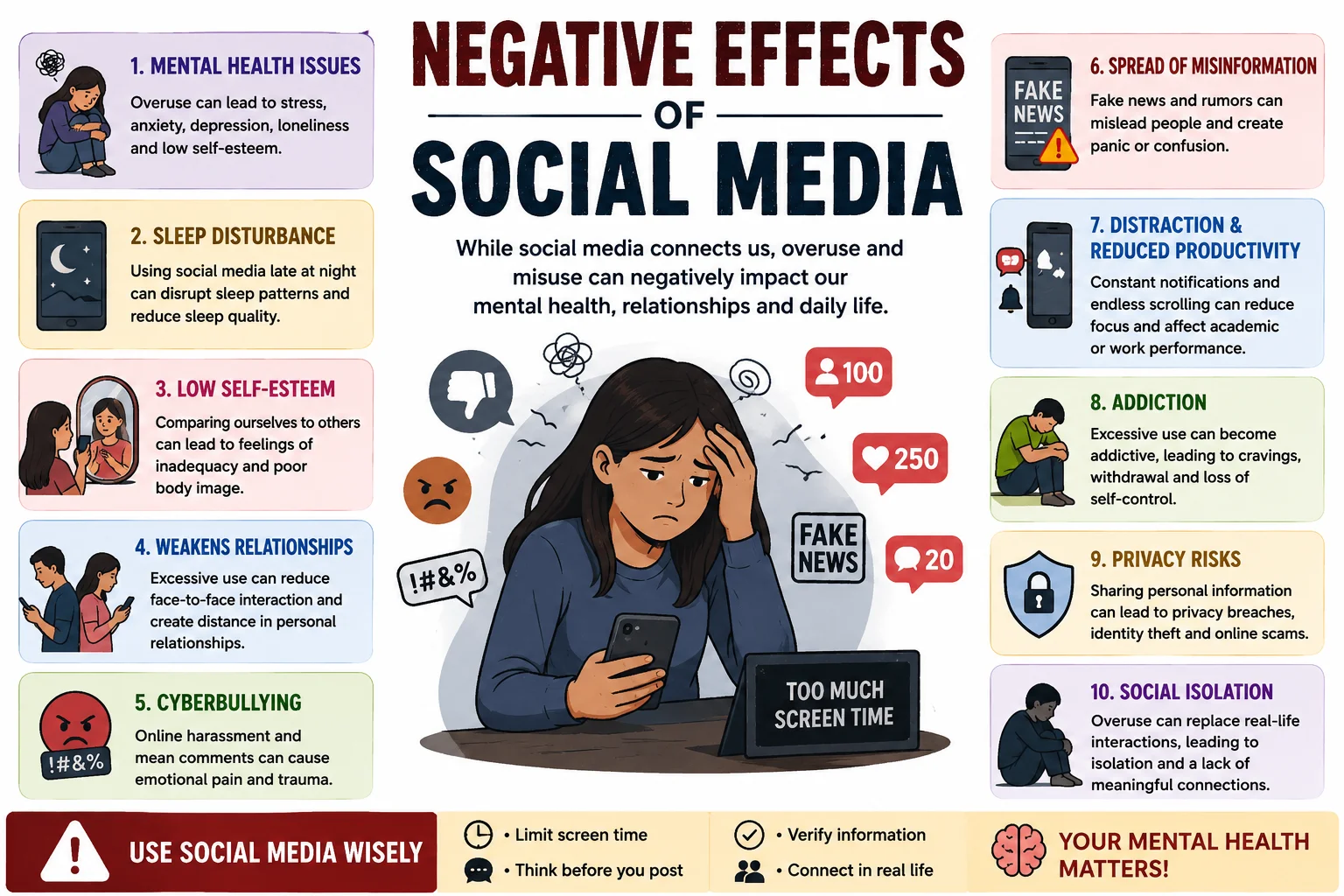
In the previous part of this blog, we explored how social media has positively transformed society by improving communication, promoting education, strengthening communities, supporting businesses, encouraging creativity, and connecting people across the world. When used wisely, these platforms have become powerful tools for learning, collaboration, and social development.
However, like every powerful technology, social media also has a darker side. Excessive or irresponsible use can negatively influence individuals, families, and communities. Problems such as misinformation, cyberbullying, online fraud, privacy violations, social polarization, reduced face-to-face interaction, unhealthy lifestyle habits, and excessive dependence on digital platforms have become growing concerns in modern society. These issues not only affect personal relationships but can also influence public opinion, social harmony, community well-being, and even democratic processes.
Understanding these negative effects is just as important as appreciating the benefits. By recognizing the potential risks and learning how to use social media responsibly, individuals, families, educators, and communities can minimize its harmful consequences while continuing to enjoy its many advantages. In this section, I will explore the major negative effects of social media on society and discuss why responsible and balanced use is essential for building a healthier and more informed community.
Major negative effects of social media on society:
1. Spreads Misinformation and Fake News
Misinformation
Misinformation is false or inaccurate information that is shared without the intention to deceive. The person sharing it often believes it is true.
Example:
A person forwards a WhatsApp message claiming that drinking hot water every hour can completely prevent COVID-19 because they think it is helpful. However, there is no scientific evidence to support this claim.
Fake News
Fake news is false or fabricated information that is deliberately created and shared to mislead, manipulate, or attract attention. It is often designed to influence public opinion, create panic, damage reputations, or earn money through clicks and advertisements.
Example:
A social media post falsely claims that a well-known politician has been arrested or that a particular vaccine has been banned, even though no such event has occurred. The post is intentionally created to mislead people and quickly spreads across social media.
Difference between misinformation and fake news
Misinformation | Fake News |
|---|---|
False information shared unintentionally. | False information created and shared intentionally. |
The sender usually believes it is true. | The creator knows it is false. |
Often spreads through friends, family, or social media forwarding. | Often created to manipulate opinions, create panic, or generate profit. |
Study link
World Health Organization – Infodemic
https://www.who.int/health-topics/infodemic
The WHO explains how misinformation and false information spread rapidly through digital platforms and can affect public health, decision-making, and society.
2. Increases Social Polarization and Public Conflicts
Social media algorithms often show users content that matches their existing beliefs, opinions, and interests. As a result, people may repeatedly see only one side of an issue while being exposed to fewer opposing viewpoints. This can create "echo chambers," where individuals become more convinced that their own opinions are correct and become less willing to understand or respect different perspectives.
At the same time, emotionally charged posts, misinformation, hate speech, and inflammatory comments can spread rapidly, increasing arguments, mistrust, hostility, and divisions between different social, political, religious, or cultural groups. This polarization can weaken social harmony and sometimes contribute to public conflicts.
i). Example:
During an election, false or misleading posts about political parties spread widely on social media. Supporters of different parties repeatedly share and believe information that favors their own side while rejecting opposing views. Heated online arguments gradually lead to hostility, public protests, and conflicts between groups in the community.
Study link:
Pew Research Center – The Political Environment on Social Media
https://www.pewresearch.org/internet/2020/10/15/the-political-environment-on-social-media/
This report discusses how social media can reinforce political divisions, strengthen like-minded groups, and contribute to social and political polarization.
ii). Example: The viral bus incident and subsequent suicide I are referring to actually happened in Kerala.
The Incident: On January 16, 2026, a 42-year-old man named Deepak U was filmed on a crowded private bus in Kerala by a social media influencer, Shimjitha Musthafa, who accused him of intentionally brushing his elbow against her and alleged sexual harassment.
https://www.bbc.com/news/articles/cwy88wpx5qxo
The Backlash & Suicide: The video went viral on Instagram with millions of views. Two days later, on January 18, 2026, Deepak was found dead by suicide at his home, with his family stating he was deeply traumatized by the public shaming and online trial.
https://www.facebook.com/reel/2025388785523428
Police Action: Following widespread public outrage and a complaint from the man's family, the Kerala Police registered a case for abetment to suicide and arrested the woman on January 21, 2026.
This is an example of social polarisation between males and females leading to social conflicts, when it becomes viral through social media.
3. Promotes Cyberbullying and Online Harassment
Social media allows people to communicate instantly, but it can also be misused to harass, threaten, insult, spread rumors, share embarrassing photos or videos, or post hateful comments. Because users can remain anonymous or hide behind fake accounts, some individuals feel more confident engaging in abusive behavior online than they would in person. Harmful content can spread rapidly and remain accessible for a long time, increasing its emotional impact on the victim.
Cyberbullying and online harassment can damage a person's self-esteem, reputation, mental health, academic or work performance, and social relationships. Victims may experience anxiety, depression, social withdrawal, and fear of participating in online or offline activities.
i). Example:
A 15-year-old school student uploads a photo after participating in a cultural program. A few classmates begin posting insulting comments about the student's appearance, create edited images to make fun of the student, and spread false rumors through a class WhatsApp group. Some students repeatedly send abusive messages, while others share and "like" the hurtful posts instead of stopping them. Within a few days, the offensive content reaches many students in the school.
As a result, the student feels deeply embarrassed, becomes afraid to attend school, avoids using social media, loses self-confidence, and gradually withdraws from friends and extracurricular activities. The emotional distress also affects the student's concentration and academic performance.
Study link:
National Institutes of Health (NCBI) – Cyberbullying Among Adolescents and Children: A Comprehensive Review of the Global Situation, Risk Factors, and Preventive Measures
https://pmc.ncbi.nlm.nih.gov/articles/PMC11373784/
This review reports that cyberbullying is associated with increased risks of anxiety, depression, low self-esteem, self-harm, and poor social well-being, particularly among children and adolescents.
ii). Example:
A school teacher in Karaya, Kolkata, faced months of targeted cyberstalking and online harassment from a former student, who created multiple fake social media accounts to send abusive messages to her, her family, and her colleagues.
Case Details
The Victim: A school teacher residing in the Karaya area of southeast Kolkata.
The Accused: Identified as Krishnendu Banerjee, a former student from 2013.
The Harassment: For six months, the individual bombarded the teacher with derogatory texts across Instagram and LinkedIn, escalating from personal attacks to messaging her relatives and co-workers.
The Action: When blocked, the individual continuously switched to newly created accounts, prompting a formal written police complaint.
4. Reduces Face-to-Face Social Interaction and Communication Skills
When people spend excessive time on social media, they often replace in-person conversations with texting, messaging, and online interactions. As a result, they have fewer opportunities to practice important interpersonal skills such as maintaining eye contact, interpreting facial expressions and body language, listening actively, expressing emotions, resolving conflicts, and communicating confidently in real-life situations. Over time, this may weaken communication skills and reduce the quality of personal relationships.
Example:
A college student spends several hours each day chatting with friends through social media but rarely meets them in person. When asked to give a classroom presentation or participate in a group discussion, the student feels nervous, avoids eye contact, speaks very little, and finds it difficult to express ideas confidently. Although the student is active online, real-life communication skills gradually become weaker.
Study link:
Uhls YT, Michikyan M, Morris J, et al. Five Days at Outdoor Education Camp Without Screens Improves Preteen Skills With Nonverbal Emotion Cues. Computers in Human Behavior (2014).
https://www.sciencedirect.com/science/article/pii/S0747563214003227
This study found that reducing screen media use and increasing face-to-face interaction improved children's ability to recognize nonverbal emotional cues and enhanced interpersonal communication skills.
5. Weakens Family Relationships and Quality Time Together
Excessive use of social media can reduce the amount of meaningful face-to-face interaction among family members. Instead of talking, eating together, or participating in shared activities, individuals may spend their time scrolling through social media or chatting online. Over time, this can decrease communication, emotional bonding, mutual understanding, and the quality of family relationships. Family members may feel ignored, neglected, or emotionally disconnected despite living in the same home.
Example:
Every evening, a family sits together for dinner, but each member is busy using a smartphone. The father is reading Facebook posts, the mother is watching Instagram videos, the son is playing online games, and the daughter is chatting with friends. Although they are sitting at the same table, they hardly talk to one another. Gradually, family conversations become less frequent, emotional bonding weakens, and misunderstandings increase because they spend little quality time together.
Study link:
McDaniel BT, Coyne SM. "Technoference": The Interference of Technology in Couple Relationships and Implications for Women's Personal and Relational Well-Being. Psychology of Popular Media Culture (2016).
https://pmc.ncbi.nlm.nih.gov/articles/PMC4998676/
This study shows that frequent interruptions from smartphones and social media can reduce the quality of family interactions and relationships by interfering with meaningful communication and shared time.
6. Encourages Social Media Addiction and Excessive Screen Time
Social media addiction is a condition in which a person feels a strong, difficult-to-control urge to use social media repeatedly, even when it interferes with daily life, work, studies, sleep, or relationships. The person may constantly check notifications, scroll through posts for long periods, and feel anxious or restless when unable to access social media.
Excessive screen time
Excessive screen time means spending more time than necessary using digital devices such as smartphones, tablets, or computers, particularly for social media, entertainment, or non-essential activities. It often reduces the time available for physical activity, sleep, face-to-face interaction, study, or work.
Example:
A university student plans to check Instagram for only 10 minutes before studying. However, after continuously watching short videos and scrolling through posts, three hours pass. The student postpones studying, sleeps late, feels tired the next day, and gradually notices declining academic performance and reduced interaction with family members.
Study link:
Andreassen CS. Online Social Network Site Addiction: A Comprehensive Review. Current Addiction Reports (2015).
https://link.springer.com/article/10.1007/s40429-015-0056-9
This review describes social media addiction, its characteristics, risk factors, and its effects on daily functioning, health, and well-being.
7. Threatens Privacy and Increases the Risk of Identity Theft
Social media users often share personal information such as their full name, date of birth, phone number, email address, home location, workplace, school, travel plans, family photographs, and daily activities. If privacy settings are weak or users share too much information publicly, cybercriminals can collect these details to impersonate the person, steal their identity, hack online accounts, commit financial fraud, or access confidential information. Even seemingly harmless posts can reveal enough information for criminals to answer security questions or guess passwords.
Example:
A woman frequently posts her birthday, home address, workplace, family photos, and vacation updates on social media. A cybercriminal collects this information, creates a fake profile using her name and photographs, and sends messages to her friends asking for money, pretending that she has an emergency. Some friends believe the message and transfer money before realizing that the account is fake.
Study link:
National Cybersecurity Alliance – Social Media Privacy and Security
https://staysafeonline.org
This resource explains how oversharing personal information on social media increases the risk of privacy breaches, identity theft, account hacking, and online fraud, and provides practical guidance for protecting personal information.
8. Facilitates Online Fraud and Financial Scams
Fraudsters can misuse social media to create fake profiles, impersonate trusted individuals or organizations, advertise fraudulent products, send phishing links, promote fake investment schemes, and conduct online shopping scams. Because these scams often appear to come from legitimate businesses, celebrities, friends, or family members, many people are deceived into sharing personal information, bank account details, passwords, or making financial payments. Once the money is transferred or sensitive information is shared, it is often difficult to recover the loss.
i). Example:
A man sees a Facebook advertisement offering a smartphone at an unusually low price. The seller asks him to pay the full amount in advance through an online payment app. After making the payment, the seller deletes the account, and the buyer never receives the phone. Later, he realizes that the advertisement and seller's profile were fraudulent.
Study link:
Federal Trade Commission (FTC) – Social Media: A Golden Goose for Scammers
https://consumer.ftc.gov/articles/social-media-golden-goose-scammers
The FTC reports that scammers increasingly use social media platforms to promote fake investment opportunities, fraudulent online stores, romance scams, and phishing schemes, causing significant financial losses to users.
ii). Example:
A major ongoing wave of cyber scams across the greater Kolkata and New Town urban area involves high-profile digital arrest and online investment frauds facilitated via social media, messaging apps, and VoIP calls. Residents in New Town and nearby localities have lost lakhs to crores of rupees after fraudsters initiated contact through social platforms, fake profile links, and intimidating video calls.
. https://www.facebook.com/reel/1455307996158427
9. Exposes People to Harmful or Misleading Content
Social media allows anyone to create and share content with millions of people within seconds. Because not all posts are reviewed for accuracy or safety before they are published, users may be exposed to false health advice, violent or disturbing videos, hate speech, extremist messages, gambling promotions, pornography, self-harm content, dangerous challenges, or misleading advertisements. Repeated exposure to such content can influence beliefs, attitudes, and behaviors, especially among children and adolescents, who may have difficulty distinguishing reliable information from misinformation.
i). Example:
A teenager watches a series of social media videos claiming that an "all-natural herbal drink" can cure diabetes without medication. Believing these videos, the teenager encourages a family member with diabetes to stop taking prescribed medicines. As a result, the person's blood glucose becomes dangerously high, requiring urgent medical treatment.
Study link:
World Health Organization – Infodemic
https://www.who.int/health-topics/infodemic
The WHO explains that harmful and misleading online content can spread rapidly through social media, affecting health decisions, public behavior, and overall societal well-being.
ii). Example (Personal Observation):
One practical example that, in my opinion, demonstrates the negative effects of social media occurred after the 2026 election results, when the BJP formed the government with a large majority. Before the election, there were public assurances that there would be no violence against supporters of the defeated parties.
However, soon after the results, numerous videos showing alleged incidents of violence began circulating widely on social media. Later, I came across reports and discussions suggesting that some of these videos were not related to the current events but were old videos or videos from different places that had been recirculated and presented as if they were recent. This created confusion among many people and led to strong emotional reactions before the authenticity of the videos could be verified.
This experience reminded me that social media can rapidly spread misleading or out-of-context content, making it difficult for the public to distinguish between verified information and misinformation. Such content has the potential to influence public opinion, increase fear, deepen political divisions, and create unnecessary tension in society. Therefore, it is essential to verify information through reliable news sources and official statements before believing or sharing it with others.
10. Promotes Hate Speech and Online Violence
Social media allows messages to spread rapidly to large audiences. Some users misuse these platforms to post hate speech, abusive language, threats, discriminatory comments, and content that targets people based on their race, religion, ethnicity, nationality, gender, or other characteristics. Because harmful posts can be shared, commented on, and amplified within minutes, they may encourage hostility, intimidate individuals or groups, and increase tensions in society. In some cases, repeated exposure to inflammatory content can contribute to harassment, public unrest, or even real-world violence.
i). Example:
After a false rumor about a religious community is posted on social media, hundreds of users begin sharing hateful messages and abusive comments without verifying the information. The rumor spreads rapidly, increasing mistrust and anger between different communities. Some individuals organize online campaigns to threaten members of the targeted group, and the hostility eventually leads to confrontations in the local community.
Study link:
United Nations – United Nations Strategy and Plan of Action on Hate Speech
https://www.un.org/en/hate-speech
The United Nations explains that online hate speech can spread rapidly through social media, fuel discrimination and hostility, and in some situations contribute to violence if left unchecked.
ii). Example:
The spreading of online misinformation and hate speech on social networks like Facebook and YouTube frequently instigates real-world communal and caste violence in India, such as the 2018 Bhima Koregaon clashes and nationwide anti-minority mobilization events documented by groups like India Hate Lab.
Case Study: Bhima Koregaon Violence (2018)
Trigger: Misinformation, provocative messages, and inflammatory digital content spread rapidly across social media platforms regarding a historical commemorative event.
Impact: The online escalation incited intense caste-related riots and physical violence on January 1, 2018, in the Maharashtra village of Bhima Koregaon, leading to tragic loss of life and statewide protests.
iii). Example:
Multiple first information reports (FIRs) have been lodged against Bengali actor Sreelekha Mitra across West Bengal on Sunday (July 26, 2026) for allegedly carrying a poster with an objectionable cartoon of Prime Minister Narendra Modi at the massive students’ rally in Kolkata on Friday (July 24, 2026) demanding Union Education Minister Dharmendra Pradhan’s resignation.
This is a current event of negative effect of social media that promotes hate speech and online violence by showing the cartoon of our country supreme.
11. Creates Unrealistic Social Expectations and Materialistic Values
A 19-year-old college student follows several social media influencers who regularly post photographs of expensive branded clothes, luxury cars, foreign vacations, and costly restaurants. After seeing these posts every day, the student begins to believe that owning expensive products and living a luxurious lifestyle are the standards of success and happiness.
To keep up with these expectations, the student repeatedly asks parents for costly mobile phones and branded clothing, even though the family cannot comfortably afford them. The student also feels embarrassed when comparing personal life with the glamorous lifestyles shown online and becomes dissatisfied with what he or she already has.
Over time, the student starts valuing material possessions, appearance, and online status more than education, personal growth, family relationships, and real-life achievements. This illustrates how social media can create unrealistic social expectations and encourage materialistic values that may negatively affect self-esteem, financial decisions, and overall well-being.
Study link:
American Psychological Association (APA) – Health Advisory on Social Media Use in Adolescence
https://www.apa.org/topics/social-media-internet/health-advisory-adolescent-social-media-use
The APA explains that repeated exposure to idealized lifestyles and appearance-focused content on social media can influence young people's values, increase social comparison, and contribute to unrealistic expectations about success, wealth, and happiness.
12. Negatively Influences Children and Adolescents
A 14-year-old boy spends several hours each day watching social media videos. Many of the videos feature dangerous stunts, risky online challenges, abusive language, and pranks performed by popular influencers. Wanting to gain attention and become popular among his friends, he attempts to imitate these activities and uploads his own videos online.
As time passes, he spends less time studying, playing outdoor games, and interacting with his family. His academic performance declines, he becomes more irritable, and he constantly checks his phone to see how many views, likes, and comments his videos receive. His self-esteem gradually becomes dependent on online approval rather than real-life achievements.
This example shows how excessive exposure to inappropriate or unrealistic social media content can negatively influence the behavior, values, emotional well-being, education, and healthy development of children and adolescents.
Study link:
American Psychological Association (APA) – Health Advisory on Social Media Use in Adolescence
https://www.apa.org/topics/social-media-internet/health-advisory-adolescent-social-media-use
The APA explains that adolescents are particularly vulnerable to the effects of social media because their brains and social skills are still developing. Excessive or inappropriate social media use may affect emotional health, behavior, learning, and overall development.
13. Reduces Productivity at Work and Academic Performance
Example:
An employee repeatedly checks social media during office hours and fails to complete assigned work on time. Similarly, a student spends hours scrolling through social media instead of studying, resulting in poor examination performance.
14. Increases Social Comparison and Dissatisfaction
Example:
A young woman sees her friends frequently posting luxury vacations and expensive purchases on social media. She begins to feel that her own life is less successful, even though those posts show only selected highlights.
https://pmc.ncbi.nlm.nih.gov/articles/PMC3477910/
15. Encourages Emotional Dependence on Online Validation
Example:
A teenager becomes upset and loses confidence because a photo receives very few likes compared with friends' posts.
https://www.apa.org/topics/social-media-internet/health-advisory-adolescent-social-media-use
16. Contributes to Sleep Disturbances and Unhealthy Lifestyle Habits
17. Weakens Critical Thinking Through Information Overload
Example:
After reading dozens of conflicting posts about a health issue, a person becomes confused and shares unverified information without checking reliable sources.
https://www.who.int/health-topics/infodemic#tab=tab_1
18. Can Be Misused to Organize Illegal or Harmful Activities
Example:
A false rumor is spread through social media claiming that a particular community has committed a serious crime. The rumor quickly goes viral, and some people use private messaging groups to gather at a specific location to damage property and attack innocent people before the police confirm that the information is false.
https://www.unodc.org/unodc/en/cybercrime/convention/home.html
19. Reduces Trust in Reliable Information Sources
Example:
After repeatedly seeing false social media posts claiming that vaccines are unsafe, some people stop trusting official health advice from doctors and public health authorities.
https://www.who.int/health-topics/infodemic#tab=tab_1
20. Contributes to Social Isolation Despite Constant Online Connectivity
Example:
A young man spends hours chatting with friends online every day but rarely meets them in person. Despite having hundreds of online contacts, he often feels lonely and lacks real emotional support.
https://pmc.ncbi.nlm.nih.gov/articles/PMC7364393/
These headings cover the major societal problems associated with social media and will provide a comprehensive continuation to my previous blog on its positive effects.