
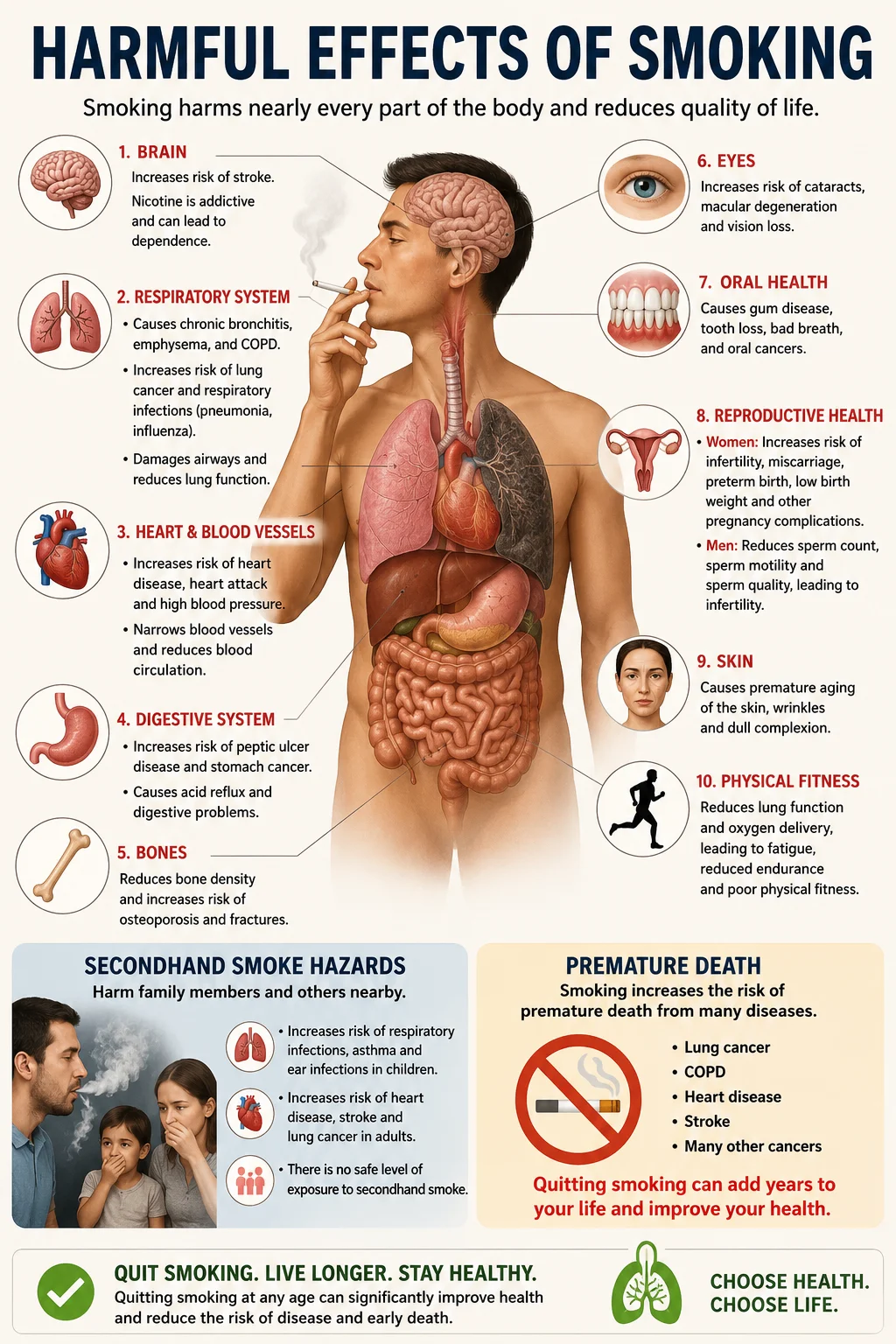
Smoking is one of the leading preventable causes of disease and death worldwide. It exposes the body to thousands of harmful chemicals that damage vital organs and interfere with normal bodily functions. Regular smoking increases the risk of numerous health problems, including lung diseases, heart disease, stroke, and various types of cancer. Beyond affecting smokers themselves, tobacco smoke also poses serious health risks to people exposed to secondhand smoke. Despite widespread awareness of its dangers, smoking remains a major public health challenge, contributing significantly to illness, disability, and premature mortality. Understanding the harmful effects of smoking is essential for promoting healthier lifestyles and preventing tobacco-related diseases.
Harmful Effects of Smoking
Smoking has serious adverse effects on nearly every organ of the body. The toxic chemicals present in tobacco smoke damage tissues, reduce oxygen supply, and increase the risk of many diseases. Smoking is a major cause of preventable illness and premature death worldwide.
Major harmful effects of smoking include:
1. Lung diseases such as chronic bronchitis, emphysema, and chronic obstructive pulmonary disease (COPD).
Smoking causes lung diseases because tobacco smoke contains thousands of harmful chemicals that irritate and inflame the airways. Repeated exposure damages the tiny air sacs (alveoli) in the lungs, increases mucus production, and destroys the cilia that normally clear dust and germs. Over time, these changes lead to chronic bronchitis (persistent airway inflammation), emphysema (destruction of alveoli), and chronic obstructive pulmonary disease (COPD), resulting in airflow limitation and breathing difficulties.
Study link:
Global Initiative for Chronic Obstructive Lung Disease COPD and Smoking
https://goldcopd.org/2024-gold-report/?utm_source=chatgpt.com
Research article:
Cigarette Smoking and the Pathogenesis of COPD NIH Study
https://pmc.ncbi.nlm.nih.gov/articles/PMC2692120/?utm_source=chatgpt.com
This review explains how cigarette smoke induces chronic airway inflammation, oxidative stress, and lung tissue destruction that contribute to COPD.
2. Lung cancer and other cancers, including cancers of the mouth, throat, esophagus, pancreas, bladder, and kidney.
Smoking causes cancer because tobacco smoke contains more than 70 known carcinogens that can damage DNA and interfere with normal cell repair mechanisms. Over time, this genetic damage leads to uncontrolled cell growth and the development of cancer. Harmful chemicals from tobacco smoke enter the bloodstream and reach many organs, which is why smoking increases the risk of cancers of the lung, mouth, throat, esophagus, pancreas, bladder, and kidney.
Study link:
U.S. Surgeon General Report: Smoking and Cancer
ww.ncbi.nlm.nih.gov/books/NBK294316/?utm_source=chatgpt.com
Research article:
Tobacco Smoking and Cancer: A Meta-Analysis Review
https://pmc.ncbi.nlm.nih.gov/articles/PMC6745239/?utm_source=chatgpt.com
This review describes how tobacco carcinogens cause DNA mutations, chronic inflammation, and cellular changes that promote the development of multiple cancers.
3. Heart disease due to narrowing and damage of blood vessels.
Smoking causes heart disease because the chemicals in tobacco smoke damage the inner lining of blood vessels (endothelium), promote inflammation, increase blood clot formation, and accelerate the buildup of fatty deposits (atherosclerosis). These changes narrow and stiffen the arteries, reducing blood flow to the heart. Smoking also raises blood pressure and heart rate, increasing the workload on the heart and the risk of coronary heart disease, heart attack, and other cardiovascular diseases.
Study link:
Centers for Disease Control and Prevention: Smoking and Heart Disease
https://www.cdc.gov/tobacco/about/cigarettes-and-cardiovascular-disease.html?utm_source=chatgpt.com
Research article:
Cardiovascular Toxicity of Cigarette Smoking and Secondhand Smoke NIH Review
https://pmc.ncbi.nlm.nih.gov/articles/PMC2040350/?utm_source=chatgpt.com
This review explains how smoking causes endothelial dysfunction, atherosclerosis, thrombosis, and other cardiovascular changes that lead to heart disease.
4. Stroke caused by impaired blood flow to the brain.
Smoking increases the risk of stroke by damaging blood vessels, promoting the buildup of fatty plaques (atherosclerosis), and making the blood more likely to clot. These changes can narrow or block arteries supplying the brain, reducing blood flow and oxygen delivery. Smoking also raises blood pressure, which further increases the risk of both ischemic stroke (blocked blood vessel) and hemorrhagic stroke (bleeding in the brain).
Study link:
Centers for Disease Control and Prevention: Smoking and Stroke
https://www.cdc.gov/stroke/prevention/index.html
Research article:
Smoking and Risk of Stroke: Systematic Review and Meta-Analysis
https://pmc.ncbi.nlm.nih.gov/articles/PMC6708836/
This review found that smoking significantly increases stroke risk through vascular damage, atherosclerosis, and enhanced blood clotting.
5. Reduced immunity makes the body more susceptible to infections.
Smoking causes reduced immunity because tobacco smoke impairs the function of immune cells such as macrophages, neutrophils, and lymphocytes. It also damages the respiratory tract's natural defense mechanisms, making it harder for the body to fight bacteria, viruses, and other pathogens. As a result, smokers are more susceptible to infections, particularly respiratory infections.
Study link:
The Effects of Smoking on the Immune System: NIH Review
https://pmc.ncbi.nlm.nih.gov/articles/PMC5352117/
Therefore, Smoking weakens both innate and adaptive immune responses, increases inflammation, and reduces the body's ability to combat infections effectively.
6. Respiratory infections such as pneumonia and influenza.
Smoking increases the risk of respiratory infections such as pneumonia and influenza because tobacco smoke damages the cilia (tiny hair-like structures) that help clear germs from the airways. It also weakens immune defenses in the lungs, increases inflammation, and impairs the function of immune cells that fight infections. As a result, viruses and bacteria can more easily infect the respiratory tract and lungs.
Therefore, Smoking weakens the lungs' natural defense mechanisms, making pneumonia, influenza, and other respiratory infections more likely and often more severe.
Study link:
Smoking and Increased Risk of Respiratory Infections NIH Review
https://pmc.ncbi.nlm.nih.gov/articles/PMC7398598/?utm_source=chatgpt.com
This review summarizes evidence that smoking impairs respiratory immune defenses and increases susceptibility to influenza, pneumonia, and other respiratory infections.
7. Poor oral health, including gum disease, tooth loss, and bad breath.
Smoking causes poor oral health because tobacco smoke reduces blood flow to the gums, weakens the immune response, and promotes the growth of harmful bacteria in the mouth. These effects increase the risk of gum disease (periodontitis), delay healing of oral tissues, contribute to tooth loss, and cause bad breath (halitosis) due to the accumulation of tobacco residues and bacterial activity.
Therefore, Smoking damages the gums and supporting tissues of the teeth, making oral infections more common and increasing the likelihood of tooth loss and bad breath.
Study link:
Tobacco Smoking and Periodontal Disease NIH Review
https://pubmed.ncbi.nlm.nih.gov/35950749/
This review explains how smoking adversely affects periodontal tissues, impairs healing, and significantly increases the risk of gum disease and tooth loss.
8. Reproductive problems such as infertility and pregnancy complications.
Smoking causes reproductive problems because the toxic chemicals in tobacco smoke damage reproductive organs and interfere with hormone function. In women, smoking can reduce fertility by affecting egg quality, ovarian function, and implantation. During pregnancy, smoking reduces oxygen supply to the fetus and increases the risk of miscarriage, preterm birth, low birth weight, stillbirth, and other complications. In men, smoking can reduce sperm count, sperm motility, and sperm quality.
https://pmc.ncbi.nlm.nih.gov/articles/PMC4639396/?utm_source=chatgpt.com
Therefore, Smoking impairs reproductive function and increases the risk of infertility and adverse pregnancy outcomes by damaging reproductive tissues and reducing oxygen delivery to the developing fetus.
Study link:
The Effects of Cigarette Smoking on Female Fertility and Pregnancy: NIH Review
https://www.ncbi.nlm.nih.gov/books/NBK44697/
This review discusses the impact of smoking on fertility, pregnancy, fetal development, and reproductive health.
9. Premature aging of the skin leading to wrinkles and dull complexion.
Smoking causes premature aging of the skin because tobacco smoke reduces blood flow to the skin, decreases oxygen and nutrient delivery, and increases oxidative stress. It also damages collagen and elastin, the proteins responsible for maintaining skin strength and elasticity. As a result, smokers are more likely to develop wrinkles, sagging skin, and a dull complexion at an earlier age.
Therefore, Smoking accelerates skin aging by damaging collagen and reducing blood supply, leading to wrinkles and loss of skin vitality.
Study link:
Tobacco Smoking and Skin Aging NIH Review
https://pmc.ncbi.nlm.nih.gov/articles/PMC8330869/?utm_source=chatgpt.com
This review explains how smoking promotes oxidative stress and collagen degradation, contributing to premature skin aging and wrinkle formation.
10. Reduced physical fitness due to decreased lung function and oxygen delivery.
Smoking causes reduced physical fitness because it damages the lungs and decreases their ability to take in oxygen efficiently. Carbon monoxide from cigarette smoke binds to hemoglobin more strongly than oxygen, reducing the amount of oxygen delivered to muscles and other tissues. In addition, smoking impairs heart and lung function, leading to decreased endurance, increased fatigue, and poorer exercise performance.
In short: Smoking reduces lung capacity and oxygen delivery to the body, making physical activity more difficult and lowering overall fitness.
Study link:
Cigarette Smoking and Cardiorespiratory Fitness NIH Study
https://pubmed.ncbi.nlm.nih.gov/39809238/
This study found that smoking is associated with reduced cardiorespiratory fitness and exercise capacity due to impaired lung function and oxygen transport.
11. Secondhand smoke hazards that harm family members and others nearby.
Smoking causes secondhand smoke hazards because the smoke released from burning tobacco and exhaled by smokers contains many toxic chemicals and carcinogens. When non-smokers inhale this smoke, they are exposed to the same harmful substances that smokers inhale. This exposure can damage the heart, lungs, and blood vessels, increasing the risk of respiratory infections, asthma, heart disease, lung cancer, and stroke.
Therefore, Secondhand smoke exposes nearby people to harmful chemicals, increasing their risk of serious diseases even if they do not smoke themselves.
Study link:
Health Effects of Secondhand Smoke NIH Review
https://pmc.ncbi.nlm.nih.gov/articles/PMC4538886/
This review summarizes evidence that secondhand smoke causes significant health problems in children and adults, including respiratory and cardiovascular diseases.
12. Increased risk of premature death from multiple smoking-related diseases.
Smoking increases the risk of premature death because it contributes to many life-threatening diseases, including lung cancer, chronic obstructive pulmonary disease (COPD), heart disease, stroke, and other cancers. The cumulative damage caused by tobacco smoke to multiple organs and body systems significantly shortens life expectancy and increases mortality risk.
Therefore, Smoking damages vital organs and causes several major diseases that can lead to early death.
Study link:
21st Century Hazards of Smoking and Benefits of Cessation NIH Study
https://pubmed.ncbi.nlm.nih.gov/23343063/
This landmark study found that smokers have a substantially higher risk of premature death from smoking-related diseases, while quitting smoking markedly reduces this risk.
Smoking cessation can significantly improve health and reduce the risk of these harmful effects at any age.