
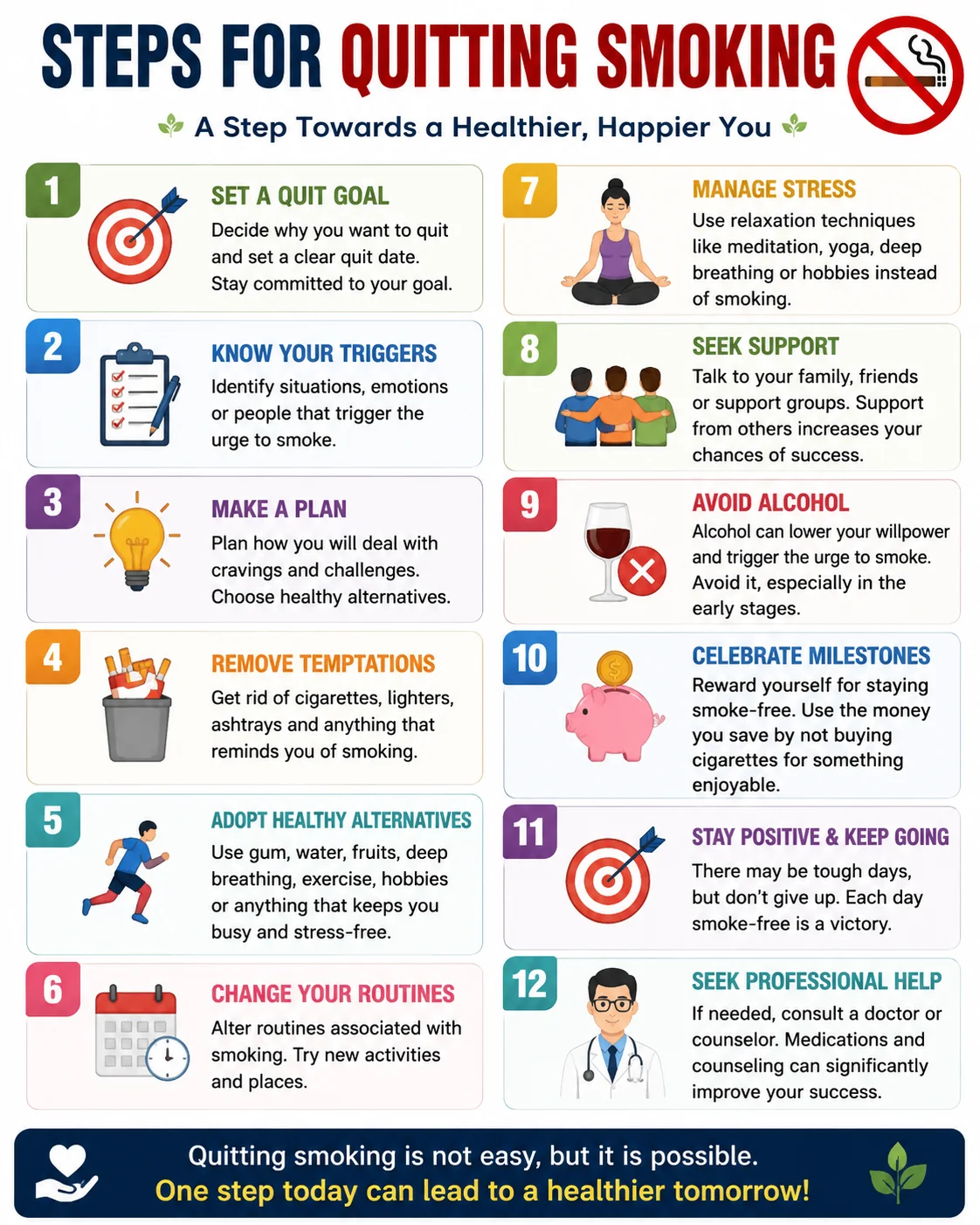
Quitting smoking is one of the most important steps a person can take to improve health and enhance quality of life. Although smoking can become a strong habit due to nicotine addiction, overcoming it is possible with determination, support, and the right strategies. The benefits of quitting begin almost immediately, with improvements in breathing, circulation, and overall well-being. Over time, the risks of heart disease, lung disease, cancer, and other smoking-related illnesses decrease significantly. By understanding the challenges of smoking cessation and adopting healthy alternatives, individuals can break free from tobacco dependence and move toward a healthier and more fulfilling future.
Steps for Quitting Smoking
1. Make a Firm Decision to Quit
Commit yourself to quitting and identify the reasons why you want to stop smoking.
Making a firm commitment to quit smoking helps strengthen motivation and increases the likelihood of success. Writing down personal reasons for quitting—such as improving health, protecting family members from secondhand smoke, saving money, or reducing the risk of disease—can help maintain focus during cravings and withdrawal. Individuals who have strong personal motivation and clear goals are more likely to remain smoke-free.
Study link:
Motivation to Stop Smoking and Smoking Cessation Success NIH Study
https://www.ncbi.nlm.nih.gov/books/NBK555596/
This study found that stronger motivation and commitment to quitting are associated with higher rates of successful smoking cessation.
Commitments for Quitting Smoking
To successfully quit smoking, a person should make the following commitments:
i). Commit to a Smoke-Free Life
Decide firmly that smoking is no longer a part of your lifestyle.
ii). Commit to a Quit Date
Set a specific date and stick to it.
iii). Commit to Avoiding Triggers
Stay away from situations, places, or habits that encourage smoking.
iv). Commit to Managing Cravings
Use healthy alternatives such as deep breathing, drinking water, or chewing sugar-free gum.
v). Commit to Healthy Living
Engage in regular exercise, eat a balanced diet, and get adequate sleep.
vi). Commit to Seeking Support
Accept help from family, friends, healthcare professionals, or support groups.
vii). Commit to Learning from Relapses
If a slip occurs, view it as a learning experience rather than a failure.
viii). Commit to Protecting Your Health
Remember the health benefits of quitting and the risks of continued smoking.
ix). Commit to Staying Positive
Focus on progress and celebrate small achievements along the way.
x). Commit to Long-Term Abstinence
Remain vigilant even after quitting, as cravings may occasionally return.
Therefore, quitting smoking requires a strong personal commitment to change behavior, overcome cravings, maintain healthy habits, and remain smoke-free for life.
2. Set a Quit Date
Choose a specific date to stop smoking and prepare for it.
Setting a quit date is a widely recommended smoking cessation strategy because it helps smokers prepare mentally and practically for quitting. Research has shown that planning a quit attempt and setting a target quit date can improve readiness and increase the likelihood of a successful quit attempt.
Therefore, A quit date provides a clear goal, allows preparation for withdrawal symptoms, and helps organize support and cessation aids before quitting.
Study link:
Clinical Practice Guideline: Treating Tobacco Use and Dependence
This evidence-based guideline recommends that smokers set a quit date and prepare for it as a key step in successful smoking cessation.
3. Identify Smoking Triggers
Recognize situations, emotions, or activities that make you want to smoke.
Common Smoking Triggers
Smoking triggers are situations, feelings, or activities that make a person want to smoke. Identifying these triggers is an important step in quitting.
i). Emotional Triggers
Stress, Anxiety, Anger, Sadness, Boredom, Loneliness
ii). Social Triggers
Being around friends who smoke, Parties and social gatherings, seeing others smoke, Peer pressure
iii). Daily Routine Triggers
After waking up, After meals, During work breaks, While driving, Watching television, Drinking tea or coffee
iv). Substance-Related Triggers
Drinking alcohol, Consuming caffeine, Using other tobacco products
v). Environmental Triggers
Smelling cigarette smoke, Visiting places where smoking is common, seeing cigarettes or lighters
vi). Physical Triggers
Nicotine withdrawal symptoms, Strong cravings for nicotine
Smoking triggers are emotional states, social situations, daily habits, substances, and environments that create the urge to smoke. Recognizing and avoiding these triggers can greatly improve the chances of successfully quitting smoking.
4. Avoid Triggers When Possible
Stay away from places, people, or habits that encourage smoking, especially during the early stages.
Avoiding smoking triggers helps reduce cravings and prevents relapse. Once a person identifies situations, people, places, or emotions associated with smoking, they can take steps to avoid or manage them. For example, avoiding smoking areas, limiting alcohol consumption, changing daily routines, staying away from friends who smoke during the early quitting period, and using healthy alternatives such as walking, chewing sugar-free gum, or deep breathing can help reduce the urge to smoke.
Study link:
Coping With Smoking Urges and Triggers During Smoking Cessation NIH Study
https://pmc.ncbi.nlm.nih.gov/articles/PMC4562427/
This study discusses how identifying and avoiding smoking cues and triggers can improve smoking cessation success and reduce the risk of relapse.
5. Seek Support from Family and Friends
Inform loved ones about your decision and ask for encouragement and support.
Telling family members, friends, and colleagues about your decision to quit smoking can provide emotional support, encouragement, and accountability. Loved ones can help by offering motivation during cravings, avoiding smoking around you, celebrating your progress, and encouraging you to stay committed to your quit plan. Social support can reduce stress and increase confidence, making it easier to remain smoke-free. Support from family and friends strengthens motivation, helps manage cravings, and improves the chances of successfully quitting smoking.
Study link:
Partner Support and Smoking Cessation NIH Study
https://pubmed.ncbi.nlm.nih.gov/30101972/
This study found that positive social support from partners, family, and friends can significantly improve smoking cessation outcomes and long-term abstinence
6. Use Nicotine Replacement Therapy if Needed
Nicotine patches, gum, lozenges, or other approved therapies can help manage cravings.
Nicotine replacement therapy (NRT) provides the body with a controlled amount of nicotine without the harmful chemicals found in tobacco smoke. This helps reduce withdrawal symptoms such as irritability, anxiety, restlessness, and strong cravings that occur when a person stops smoking. By gradually lowering nicotine dependence, NRT makes quitting more comfortable and increases the likelihood of long-term success.
Study link:
Nicotine Replacement Therapy for Smoking Cessation Cochrane Review
https://www.cochranelibrary.com/cdsr/doi/10.1002/14651858.CD000146.pub5/full
This systematic review found that nicotine replacement therapies such as patches, gum, and lozenges significantly increase the chances of successfully quitting smoking by reducing cravings and withdrawal symptoms.
How Nicotine Replacement Therapies Are Applied
i). Nicotine Patch
Applied directly to a clean, dry hairless area of skin such as the upper arm, chest, or back.
Usually worn for 16–24 hours depending on the product.
The patch is replaced daily, and the application site should be rotated to avoid skin irritation.
ii). Nicotine Gum
Chewed slowly until a peppery or tingling taste appears.
Then "parked" between the cheek and gum to allow nicotine absorption.
Repeated chewing and parking is continued for about 30 minutes.
Food and drinks should be avoided for about 15 minutes before and during use.
iii). Nicotine Lozenge
Placed in the mouth and allowed to dissolve slowly.
Moved occasionally from one side of the mouth to the other.
Should not be chewed or swallowed.
Usually dissolves within 20–30 minutes.
iv). Nicotine Inhaler
A cartridge containing nicotine is inserted into a mouthpiece.
The user takes frequent puffs to release nicotine vapor into the mouth and throat.
Used when cravings occur.
v). Nicotine Nasal Spray
Sprayed into each nostril according to the prescribed dose.
Provides rapid nicotine delivery and is generally available by prescription in many countries.
vi). Other Approved Therapies
Varenicline (Champix/Chantix): Taken as tablets; reduces cravings and blocks the rewarding effects of nicotine.
Bupropion (Zyban): Taken as tablets; helps reduce withdrawal symptoms and cravings.
Therefore, Patches provide steady nicotine throughout the day, while gum, lozenges, inhalers, and sprays provide quicker relief when cravings occur. Prescription medications such as varenicline and bupropion work differently by reducing cravings and withdrawal symptoms.
Physiology Behind Nicotine Replacement Therapy (NRT)
Nicotine replacement therapy works by supplying small controlled doses of nicotine to the body without exposing the user to the harmful chemicals found in cigarette smoke.
How Smoking Causes Addiction
When a person smokes, nicotine rapidly enters the bloodstream and reaches the brain within seconds.
Nicotine binds to nicotinic acetylcholine receptors (nAChRs) in the brain.
This stimulates the release of dopamine, a neurotransmitter associated with pleasure and reward.
Repeated nicotine exposure causes dependence, and the brain begins to crave nicotine regularly.
What Happens When Smoking Stops
Nicotine levels fall rapidly.
Dopamine release decreases.
Withdrawal symptoms develop, including:
Cravings
Irritability
Anxiety
Restlessness
Difficulty concentrating
How NRT Works
Nicotine patches, gum, lozenges, inhalers, and sprays provide nicotine at lower and slower rates than cigarettes.
The nicotine binds to the same nicotinic acetylcholine receptors, partially satisfying the brain's need for nicotine.
This reduces withdrawal symptoms and cravings.
Because NRT does not contain tar, carbon monoxide, and thousands of toxic chemicals found in tobacco smoke, it is much safer than smoking.
Long-Term Effect
The dose of nicotine is gradually reduced over weeks to months.
The brain slowly adapts to lower nicotine levels.
Dependence decreases, making it easier to quit permanently.
Therefore, NRT works by stimulating nicotine receptors in the brain enough to reduce cravings and withdrawal symptoms while avoiding the harmful substances present in cigarettes. Over time, the nicotine dose is reduced, allowing the brain to become nicotine-free.
Study link:
Nicotine Replacement Therapy Mechanisms and Effectiveness NIH Review
https://pmc.ncbi.nlm.nih.gov/articles/PMC5003586/?utm_source=chatgpt.com
This review explains how NRT acts on nicotinic acetylcholine receptors to reduce withdrawal symptoms and support smoking cessation.
7. Stay Physically Active
Regular exercise helps reduce cravings, stress, and withdrawal symptoms.
Regular physical activity can help people quit smoking by reducing nicotine cravings, relieving stress, and improving mood. Exercise stimulates the release of endorphins and other neurotransmitters such as dopamine, which can help counteract the decrease in dopamine levels that occurs after quitting smoking. Exercise also reduces anxiety, improves concentration, and provides a healthy distraction from smoking urges.
Therefore, Exercise helps manage withdrawal symptoms and cravings by improving mood, reducing stress, and activating the brain's natural reward pathways.
Study link:
Exercise for Smoking Cessation Cochrane Review
https://www.cochranelibrary.com/cdsr/doi/10.1002/14651858.CD002295.pub6/full
This review found that exercise can temporarily reduce cigarette cravings and withdrawal symptoms and may support smoking cessation efforts when combined with other treatments.
8, Adopt Healthy Alternatives
Adopt Healthy Alternatives to Quit Smoking
Healthy alternatives help replace the habit of smoking and reduce cravings without using tobacco.
i). Drink Water
Action: Sipping water keeps the mouth busy, reduces dry mouth, and may help lessen nicotine cravings.
ii). Chew Sugar-Free Gum
Action: Keeps the mouth occupied and provides an alternative oral activity instead of smoking.
iii). Eat Healthy Snacks
Examples: Carrot sticks, cucumber slices, fruits, nuts, or roasted chickpeas.
Action: Replaces the hand-to-mouth action of smoking and helps control cravings.
iv). Practice Deep Breathing
Action: Taking slow deep breaths mimics the inhalation pattern of smoking while reducing stress and anxiety.
v). Engage in Physical Activity
Examples: Walking, jogging, cycling, or stretching.
Action: Distracts from cravings and releases endorphins that improve mood.
vi). Keep Hands Busy
Examples: Stress balls (Hold the ball in your palm and squeeze tightly, a physical outlet of stress and nervous energy), pens, knitting, puzzles, or hobbies.
Action: Replaces the physical habit of holding a cigarette.
vii). Practice Relaxation Techniques
Examples: Meditation, yoga, mindfulness, or prayer.
Action: Reduces stress, a common trigger for smoking.
viii). Call a Friend or Family Member
Action: Social support can encourage and distract from cravings.
ix). Change Daily Routines
Changing daily habits linked to smoking helps reduce the urge to smoke.
Examples:
If you usually smoke after tea or coffee, drink water or take a short walk instead.
If you smoke during work breaks, spend the break chatting with a friend or stretching.
This helps your brain stop associating certain activities with cigarettes
x). Pursue a Hobby
Examples: Reading, gardening, music, painting, or cooking.
Action: Keeps the mind engaged and reduces the focus on smoking.
9. Manage Stress Effectively
Use relaxation techniques such as meditation, yoga, or hobbies instead of smoking.
Many people smoke to cope with stress, anxiety, boredom, or negative emotions. Relaxation techniques provide a healthier way to manage these feelings without using cigarettes.
Meditation calms the mind and reduces stress.
Yoga combines physical activity with controlled breathing, helping to reduce anxiety and cravings.
Hobbies such as reading, gardening, painting, or music keep the mind occupied and distract from smoking urges.
These activities can also increase the release of natural mood-enhancing chemicals in the brain, helping people feel better without nicotine.
https://drjud.com/assets/pdfs/C2Q-FactSheet_for-clinicians.pdf
This study found that mindfulness-based practices can reduce stress, improve self-control, help manage cravings, and increase smoking cessation success.
https://pubmed.ncbi.nlm.nih.gov/41239976/
This review suggests that yoga may help reduce stress, withdrawal symptoms, and cigarette cravings, supporting smoking cessation efforts.
10. Avoid Alcohol and Other Smoking Triggers
Alcohol and certain social situations can increase the urge to smoke.
Alcohol is a common smoking trigger because it can weaken self-control and increase the urge to smoke. Many smokers develop a strong association between drinking alcohol and smoking cigarettes, so consuming alcohol can automatically trigger cravings.
How Alcohol Triggers Smoking
Reduces self-control: Alcohol impairs judgment, making it harder to resist smoking urges.
Strengthens learned habits: Many people smoke while drinking, so the brain links alcohol consumption with smoking.
Increases nicotine cravings: Alcohol can enhance the rewarding effects of nicotine, making cigarettes seem more satisfying.
Social situations: Drinking often occurs in social settings where others may be smoking, increasing temptation.
https://pmc.ncbi.nlm.nih.gov/articles/PMC5588903/
11. Reward Your Progress
Celebrate milestones and use the money you save by not buying cigarettes for something enjoyable.
Rewarding yourself for progress is based on the behavioral principle of positive reinforcement. Celebrating milestones and using money saved from not buying cigarettes can increase motivation, strengthen smoke-free behavior, and help maintain long-term abstinence.
So, Rewards make quitting feel more worthwhile, reinforce positive behavior, and encourage continued abstinence from smoking.
https://www.cochranelibrary.com/cdsr/doi/10.1002/14651858.CD004307.pub7/full
This review found that financial incentives and rewards can increase smoking cessation rates by motivating individuals to remain smoke-free and achieve quit goals.
12. Seek Professional Help if Necessary
Consult healthcare providers, counselors, or smoking cessation programs for additional support.
Healthcare professionals can provide evidence-based treatments to help people quit smoking. These may include counseling, behavioral therapy, nicotine replacement therapy (patches, gum, lozenges), and prescription medications such as varenicline or bupropion. Professional support helps smokers manage cravings, cope with withdrawal symptoms, develop coping strategies, and stay motivated throughout the quitting process.
So, Professional help increases the chances of successfully quitting smoking by providing guidance, support, and effective treatments.
Study link:
Behavioral Interventions and Pharmacotherapy for Tobacco Smoking Cessation NIH Review
https://pubmed.ncbi.nlm.nih.gov/35133411/
This review found that counseling and approved smoking cessation medications significantly improve quit rates compared with attempting to quit without professional assistance.
Conclusion:
Quitting smoking is a gradual process that requires determination and persistence. With proper planning, support, and healthy lifestyle changes, anyone can overcome nicotine addiction and enjoy significant long-term health benefits.