
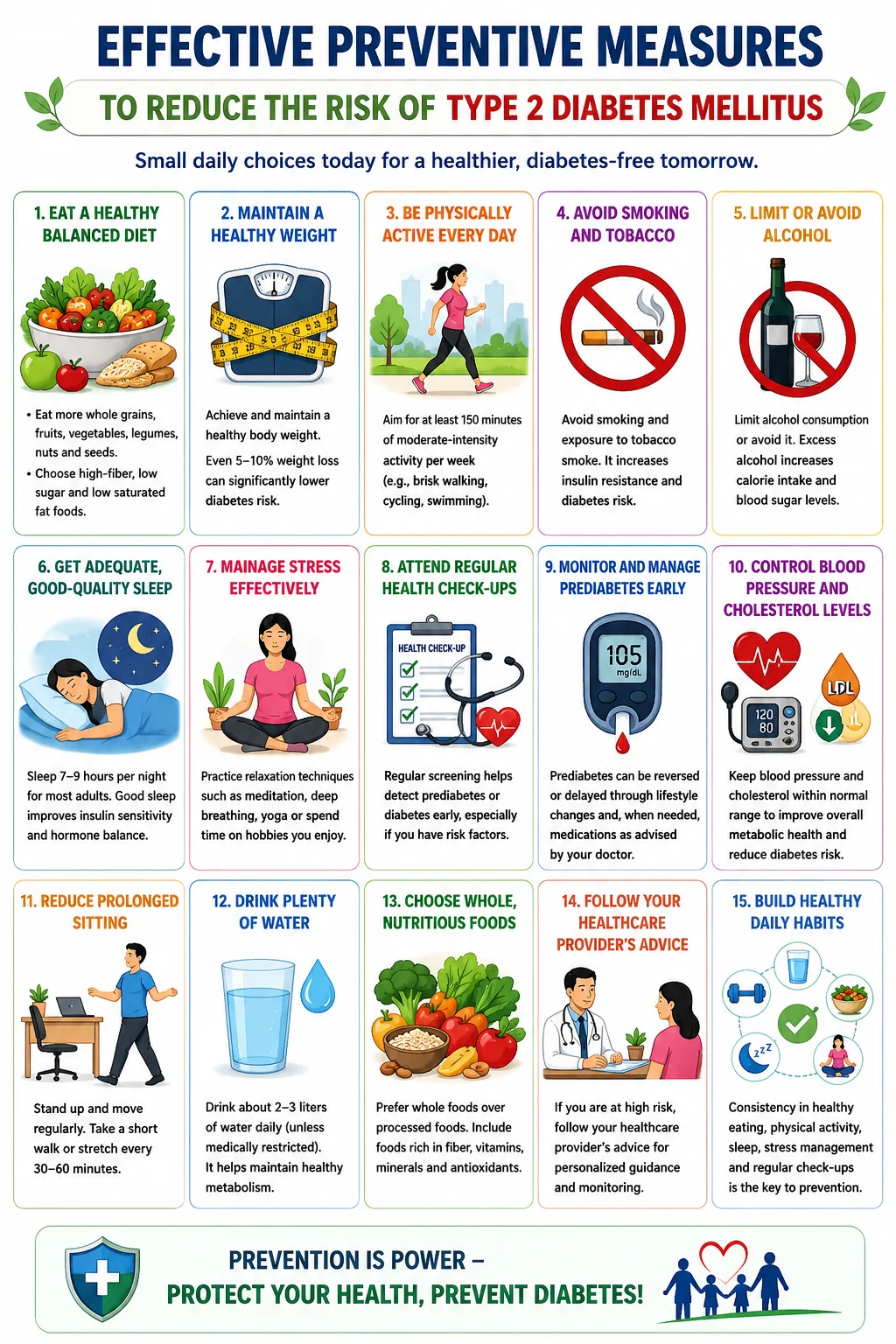
Type 2 diabetes mellitus is one of the most common chronic diseases worldwide, but it is often preventable through healthy lifestyle choices and early intervention. Although factors such as age, family history, and genetics cannot be changed, many of the major risk factors—including overweight and obesity, physical inactivity, unhealthy eating habits, smoking, and excessive alcohol consumption—can be effectively managed. Adopting a balanced diet, maintaining a healthy body weight, engaging in regular physical activity, managing stress, getting adequate sleep, and undergoing routine health screenings can significantly reduce the risk of developing type 2 diabetes. These preventive measures not only help maintain healthy blood glucose levels but also promote overall physical well-being and lower the risk of heart disease, stroke, and other long-term health complications.
The following are the key evidence-based preventive measures to reduce the risk of type 2 diabetes mellitus:
1. Maintain a healthy body weight.
There is no single body weight that everyone should maintain. Instead, healthcare professionals recommend maintaining a healthy Body Mass Index (BMI) and avoiding excess body fat, especially around the waist.
General recommendations
Healthy BMI: 18.5–24.9 kg/m² (WHO classification for adults)
For South Asians (including Indians): The risk of type 2 diabetes begins at a lower BMI. Many experts recommend aiming for a BMI of 18.5–22.9 kg/m², with 23.0 kg/m² or higher considered increased risk and 25.0 kg/m² or higher considered obesity for South Asian populations.
If a person is overweight or obese
Even a 5–10% reduction in body weight can significantly lower the risk of developing type 2 diabetes and improve insulin sensitivity.
Example:
A person weighs 80 kg.
A 5–10% weight loss equals 4–8 kg.
Reducing body weight to 72–76 kg can substantially reduce diabetes risk.
Waist circumference also matters
Excess abdominal fat is a major risk factor for insulin resistance.
For South Asians, aim for:
Men: <90 cm (35.4 inches)
Women: <80 cm (31.5 inches)
Therefore,
Maintain a healthy body weight by keeping your BMI within the recommended range and avoiding excess abdominal fat. If you are overweight, losing just 5–10% of your body weight can significantly reduce your risk of developing type 2 diabetes.
Major study links:
World Health Organization (WHO): Obesity and overweight – https://www.who.int/news-room/fact-sheets/detail/obesity-and-overweight
https://www.who.int/news-room/fact-sheets/detail/obesity-and-overweight
American Diabetes Association. Standards of Care in Diabetes – https://diabetesjournals.org/care
https://diabetesjournals.org/care
Diabetes Prevention Program (DPP) Research Group – https://www.niddk.nih.gov/about-niddk/research-areas/diabetes/diabetes-prevention-program-dpp
https://www.niddk.nih.gov/about-niddk/research-areas/diabetes/diabetes-prevention-program-dpp
WHO Expert Consultation. Appropriate BMI for Asian populations. The Lancet. 2004. https://pubmed.ncbi.nlm.nih.gov/14726171/
https://pubmed.ncbi.nlm.nih.gov/14726171/
2. Engage in regular physical activity (at least 150 minutes of moderate-intensity exercise per week).
According to the American Diabetes Association (ADA), the World Health Organization (WHO), and the American College of Sports Medicine (ACSM), adults should perform the following physical activities to reduce the risk of type 2 diabetes mellitus:
i). Aerobic (cardio) exercise
At least 150 minutes per week of moderate-intensity aerobic activity.
Spread over at least 3 days per week, with no more than 2 consecutive days without exercise.
Alternatively, 75 minutes per week of vigorous-intensity aerobic activity can be performed.
Examples of moderate-intensity activities: Brisk walking (about 5–6 km/hour), Cycling on level ground, Swimming, Dancing, Gardening, Water aerobics
Examples of vigorous-intensity activities: Jogging or running, Fast cycling, Hiking uphill, Playing singles tennis, Fast swimming
ii). Muscle-strengthening (resistance) exercise
2–3 days per week on non-consecutive days.
Examples: Weight lifting, Resistance bands, Bodyweight exercises (push-ups, squats, lunges), Yoga that builds strength
iii). Flexibility and balance exercises
2–3 times per week, especially for older adults.
Examples: Stretching exercises, Yoga, Tai Chi
iv). Reduce prolonged sitting
Avoid sitting continuously for long periods.
Stand up and move every 30–60 minutes, even if only for 2–5 minutes.
Example weekly plan
Monday: 30-minute brisk walk + strength training
Tuesday: 30-minute brisk walk
Wednesday: Stretching or yoga
Thursday: 30-minute cycling + strength training
Friday: 30-minute brisk walk
Saturday: Swimming or dancing
Sunday: Light stretching or an easy walk
Therefore,
Aim for at least 150 minutes of moderate-intensity aerobic exercise each week, perform muscle-strengthening exercises 2–3 times weekly, include flexibility and balance activities, and avoid sitting for long periods.
Major study links:
American Diabetes Association. Standards of Care in Diabetes: https://diabetesjournals.org/care
World Health Organization (WHO). Guidelines on Physical Activity and Sedentary Behaviour: https://www.who.int/publications/i/item/9789240015128
https://www.who.int/publications/i/item/9789240015128
American College of Sports Medicine (ACSM): https://www.acsm.org/education-resources/trending-topics-resources/physical-activity-guidelines
https://acsm.org/education-resources/trending-topics-resources/physical-activity-guidelines/
3. Eat a balanced, high-fiber diet rich in whole grains, fruits, vegetables, legumes, and nuts.
A balanced diet is one that provides the right amounts of carbohydrates, proteins, healthy fats, vitamins, minerals, fiber, and water to meet the body's nutritional needs while maintaining healthy blood glucose levels and body weight.
What does a balanced diet include?
Carbohydrates (45–65% of total daily calories):
Choose whole grains such as brown rice, oats, whole wheat, barley, and millets instead of refined grains.
These provide energy and are rich in fiber, which helps slow glucose absorption.
Proteins (10–35% of total daily calories):
Include lean protein sources such as fish, skinless chicken, eggs, beans, lentils, chickpeas, soy products, and low-fat dairy.
Protein helps maintain muscles and increases satiety.
Healthy fats (20–35% of total daily calories):
Prefer unsaturated fats from nuts, seeds, olive oil, mustard oil, canola oil, avocados, and fatty fish.
Limit saturated fats (butter, ghee, fatty meat) and avoid trans fats.
Fruits and vegetables:
Eat at least 5 servings (about 400 g) per day.
Choose a variety of colorful vegetables and whole fruits.
High-fiber foods:
Aim for 25–38 g of fiber daily.
Include whole grains, vegetables, fruits, legumes, nuts, and seeds.
Water:
Drink enough water throughout the day and limit sugar-sweetened beverages.
Simple example of a balanced plate
Use the Healthy Plate Method:
Half (½) of the plate: Non-starchy vegetables (spinach, cabbage, cauliflower, carrots, cucumber, tomatoes)
One-quarter (¼): Whole grains or other healthy carbohydrates (brown rice, whole wheat roti, oats, millet)
One-quarter (¼): Lean protein (fish, chicken, lentils, beans, tofu, eggs)
Add:
A serving of fruit
A small handful of unsalted nuts
Water or unsweetened beverages
Therefore,
A balanced diet means eating the right proportions of whole grains, lean proteins, healthy fats, fruits, vegetables, legumes, nuts, and adequate water while limiting refined carbohydrates, sugary foods, and unhealthy fats. This helps maintain a healthy weight and reduces the risk of type 2 diabetes.
Major study links:
World Health Organization (WHO): https://www.who.int/news-room/fact-sheets/detail/healthy-diet
https://www.who.int/news-room/fact-sheets/detail/healthy-diet
American Diabetes Association: https://diabetesjournals.org/care
Harvard T.H. Chan School of Public Health – Healthy Eating Plate: https://www.hsph.harvard.edu/nutritionsource/healthy-eating-plate/
https://nutritionsource.hsph.harvard.edu/healthy-eating-plate/
4. Limit refined carbohydrates and added sugars, including sugar-sweetened beverages.
What are refined carbohydrates and added sugars, and why should they be limited?
Refined carbohydrates
Refined carbohydrates are foods that have been processed to remove most of their fiber, vitamins, and minerals. Because they contain little fiber, they are digested and absorbed very quickly, causing a rapid rise in blood glucose.
Examples: White rice, White bread, Refined flour (maida), Cakes and pastries, Biscuits and cookies, Pizza made with refined flour, Instant noodles, Many breakfast cereals with refined grains
Added sugars
Added sugars are sugars that are added to foods and drinks during processing, cooking, or at the table. They are different from the natural sugars found in fruits and milk.
Examples: Table sugar, Brown sugar, Glucose syrup, High-fructose corn syrup, Honey added to beverages or desserts, Sweetened condensed milk, Candy and chocolates
Sugar-sweetened beverages
These are drinks with added sugar.
Examples: Soft drinks (cola, soda), Sweetened fruit drinks, Energy drinks, Sports drinks, Sweetened iced tea, Sweetened coffee drinks, Milkshakes, Packaged sweetened fruit juices
What do they do?
When you eat refined carbohydrates or added sugars:
They are digested quickly, causing a rapid spike in blood glucose >The pancreas must release large amounts of insulin to lower the blood glucose > Frequent blood glucose spikes over months or years can make the body's cells less responsive to insulin (insulin resistance) > Excess sugar that is not used for energy is stored as body fat, especially around the abdomen, increasing the risk of obesity > Over time, insulin resistance and excess body fat increase the risk of developing type 2 diabetes mellitus.
Example
Imagine eating:
White bread with jam and a sugary soft drink → blood glucose rises rapidly.
Whole-grain bread with vegetables and unsweetened milk → blood glucose rises more slowly because the fiber slows glucose absorption.
Therefore,
Refined carbohydrates and added sugars are digested very quickly, causing repeated spikes in blood glucose and insulin. Over time, these spikes promote insulin resistance, weight gain, and increase the risk of type 2 diabetes.
Major study links:
American Diabetes Association. Standards of Care in Diabetes: https://diabetesjournals.org/care
https://diabetesjournals.org/care
World Health Organization (WHO). Healthy diet: https://www.who.int/news-room/fact-sheets/detail/healthy-diet
https://www.who.int/news-room/fact-sheets/detail/healthy-diet
Harvard T.H. Chan School of Public Health. The Nutrition Source – Carbohydrates: https://nutritionsource.hsph.harvard.edu/carbohydrates/
https://nutritionsource.hsph.harvard.edu/carbohydrates/
5. Choose healthy fats (e.g., olive oil, nuts, seeds, and fatty fish) instead of saturated and trans fats.
Not all fats are harmful. Healthy fats (unsaturated fats) help protect the heart and improve the body's response to insulin, whereas saturated and trans fats increase the risk of insulin resistance, obesity, and type 2 diabetes.
i). Healthy fats (Unsaturated fats)
These fats are considered heart-healthy and help improve insulin sensitivity.
Examples: Olive oil, Canola oi (heart-healthy vegetable oil made from canola seeds)l, Mustard oil, Nuts (almonds, walnuts, pistachios), Seeds (flaxseeds, chia seeds, sunflower seeds), Avocados, Fatty fish (salmon, sardines, mackerel)
How do they help?
Improve the body's response to insulin (insulin sensitivity), allowing glucose to enter cells more efficiently.
Reduce bad cholesterol (LDL) and increase good cholesterol (HDL).
Decrease chronic inflammation, which contributes to insulin resistance.
Help maintain healthy blood vessels and heart health.
ii). Saturated fats
These fats should be limited because excessive intake can increase the risk of insulin resistance and heart disease.
Examples: Butter, Ghee (large amounts), Full-fat cheese, Cream, Fatty red meat, Sausages, Coconut oil and palm oil (high in saturated fat)
What do they do?
Increase LDL ("bad") cholesterol.
Promote fat accumulation, especially around the abdomen.
Increase inflammation and reduce insulin sensitivity, making it harder for cells to respond to insulin.
iii). Trans fats
These are the most harmful fats and should be avoided whenever possible.
Examples: Vanaspati (partially hydrogenated vegetable oil), Commercial baked goods (cakes, pastries, cookies), Fried fast foods, Packaged snacks, Some margarines
What do they do?
Increase LDL cholesterol and lower HDL cholesterol.
Increase inflammation.
Worsen insulin resistance.
Greatly increase the risk of type 2 diabetes and cardiovascular disease.
Example
Healthy choice: Grilled fish with vegetables cooked in olive or mustard oil and a handful of almonds.
Less healthy choice: Fried chicken cooked in partially hydrogenated oil with fries and pastries.
Therefore,
Healthy (unsaturated) fats help the body use insulin more effectively and reduce inflammation. Saturated and trans fats can make cells less responsive to insulin, promote weight gain, and increase the risk of type 2 diabetes and heart disease.
Major study links:
American Diabetes Association. Standards of Care in Diabetes: https://diabetesjournals.org/care
World Health Organization (WHO). Healthy diet: https://www.who.int/news-room/fact-sheets/detail/healthy-diet
https://www.who.int/news-room/fact-sheets/detail/healthy-diet
American Heart Association: https://www.heart.org/en/healthy-living/healthy-eating/eat-smart/fats
https://www.heart.org/en/healthy-living/healthy-eating/eat-smart/fats
Harvard T.H. Chan School of Public Health – The Nutrition Source: Fats and Cholesterol: https://nutritionsource.hsph.harvard.edu/what-should-you-eat/fats-and-cholesterol/
6. Avoid smoking and exposure to tobacco smoke.
Smoking and exposure to tobacco smoke increase the risk of type 2 diabetes mellitus in several ways.
i). Improves insulin sensitivity
Nicotine and other chemicals in cigarette smoke make the body's cells less responsive to insulin (insulin resistance).
When a person stops smoking or avoids tobacco smoke, insulin works more effectively, allowing glucose to enter cells more easily.
ii). Reduces chronic inflammation
Tobacco smoke increases the production of inflammatory chemicals and free radicals, leading to oxidative stress.
Chronic inflammation and oxidative stress damage insulin-producing β-cells in the pancreas and worsen insulin resistance.
iii). Protects pancreatic β-cells
Smoking can impair the function of pancreatic β-cells, reducing their ability to produce and release insulin.
Avoiding smoking helps preserve normal insulin secretion.
iv). Helps maintain a healthy body weight
Smokers often develop more abdominal (visceral) fat, which strongly contributes to insulin resistance.
Quitting smoking, together with healthy eating and regular exercise, helps reduce this risk.
v). Improves blood vessel health
Smoking damages blood vessels and reduces blood flow.
Quitting improves circulation and lowers the risk of diabetes-related heart and blood vessel diseases.
Example
A 45-year-old man who smokes one pack of cigarettes daily develops insulin resistance. After quitting smoking, exercising regularly, and eating a healthy diet, his insulin sensitivity improves, reducing his risk of developing type 2 diabetes.
Therefore,
Avoiding smoking and tobacco smoke helps the body respond better to insulin, reduces inflammation and oxidative stress, protects insulin-producing cells in the pancreas, and lowers the risk of developing type 2 diabetes.
Major study links:
U.S. Surgeon General. The Health Consequences of Smoking—50 Years of Progress: https://www.ncbi.nlm.nih.gov/books/NBK179276/
https://www.ncbi.nlm.nih.gov/books/NBK179276/
American Diabetes Association. Standards of Care in Diabetes: https://diabetesjournals.org/care
https://diabetesjournals.org/care
Centers for Disease Control and Prevention (CDC): https://www.cdc.gov/tobacco/about/index.html
https://www.cdc.gov/tobacco/about/index.html
7. Limit or avoid alcohol consumption.
Limiting or avoiding alcohol helps reduce the risk of type 2 diabetes mellitus by improving blood glucose regulation and overall metabolic health.
i). Prevents weight gain
Alcohol is high in calories (about 7 kcal per gram) but provides very few nutrients.
Drinking alcohol regularly can lead to weight gain, especially abdominal (visceral) fat, which increases insulin resistance.
ii). Improves insulin sensitivity
Heavy alcohol consumption makes the body's cells less responsive to insulin, so glucose cannot enter the cells efficiently.
Reducing alcohol intake helps insulin work more effectively.
iii). Protects the pancreas
Long-term heavy alcohol use can damage the pancreas, the organ that produces insulin.
Pancreatic damage reduces insulin production, increasing the risk of diabetes.
iv). Helps maintain healthy blood glucose levels
Many alcoholic beverages, such as cocktails, sweet wines, and flavored alcoholic drinks, contain large amounts of added sugar, causing blood glucose to rise.
Limiting these drinks helps avoid repeated blood glucose spikes.
v). Supports a healthier lifestyle
People who drink heavily are more likely to eat unhealthy foods, be physically inactive, and have poor sleep, all of which increase the risk of type 2 diabetes.
Example
A 42-year-old man drinks several beers every evening. Over time, he gains weight around his waist and develops insulin resistance. After reducing alcohol intake, eating a balanced diet, and exercising regularly, he loses weight and his blood glucose control improves.
Therefore,
Limiting or avoiding alcohol helps prevent type 2 diabetes by reducing excess calorie intake, preventing weight gain, improving insulin sensitivity, protecting the pancreas, and helping maintain healthy blood glucose levels.
Major study links:
American Diabetes Association. Standards of Care in Diabetes: https://diabetesjournals.org/care
World Health Organization (WHO). Alcohol: https://www.who.int/news-room/fact-sheets/detail/alcohol
https://www.who.int/news-room/fact-sheets/detail/alcohol
National Institute on Alcohol Abuse and Alcoholism (NIAAA): https://www.niaaa.nih.gov/health-information/alcohols-effects-health
8. Get adequate, good-quality sleep (about 7–9 hours per night for most adults).
Getting 7–9 hours of good-quality sleep each night helps the body regulate blood glucose and insulin effectively. Both too little sleep and poor-quality sleep increase the risk of type 2 diabetes mellitus.
How does adequate sleep help?
i). Improves insulin sensitivity
During healthy sleep, the body's cells respond better to insulin, allowing glucose to enter cells efficiently.
This helps keep blood glucose levels within the normal range.
ii). Reduces stress hormones
Lack of sleep increases the release of cortisol and other stress hormones.
High cortisol makes the liver release more glucose into the bloodstream and increases insulin resistance.
iii). Maintains healthy appetite hormones
Adequate sleep keeps the hormones ghrelin (hunger hormone) and leptin (fullness hormone) in balance.
Poor sleep increases ghrelin and decreases leptin, causing increased hunger, overeating, and weight gain.
iv). Helps maintain a healthy body weight
Better sleep reduces the likelihood of overeating and supports regular physical activity.
Maintaining a healthy weight lowers the risk of insulin resistance and type 2 diabetes.
v). Reduces chronic inflammation
Poor sleep increases inflammatory chemicals such as TNF-α and IL-6, which contribute to insulin resistance.
Good sleep reduces inflammation and supports normal glucose metabolism.
Example
A 40-year-old office worker sleeps only 5 hours each night. He often feels tired, craves sugary snacks, gains weight, and develops insulin resistance. After improving his sleep to 7–8 hours per night, eating a balanced diet, and exercising regularly, his insulin sensitivity and blood glucose control improve.
Therefore,
Getting 7–9 hours of good-quality sleep helps the body use insulin effectively, lowers stress hormones, balances hunger hormones, reduces inflammation, and helps maintain a healthy weight, all of which reduce the risk of type 2 diabetes.
Major study links:
American Diabetes Association. Standards of Care in Diabetes: https://diabetesjournals.org/care
Centers for Disease Control and Prevention (CDC): https://www.cdc.gov/sleep/about_sleep/how_much_sleep.html
https://www.cdc.gov/sleep/about/
National Institute of Diabetes and Digestive and Kidney Diseases (NIDDK): https://www.niddk.nih.gov/health-information/diabetes/overview/preventing-type-2-diabetes
https://www.niddk.nih.gov/health-information/diabetes/overview/preventing-type-2-diabetes
Knutson KL. Impact of Sleep and Sleep Loss on Glucose Homeostasis and Appetite Regulation. Sleep Medicine Clinics. https://www.ncbi.nlm.nih.gov/pmc/articles/PMC5449130/
https://pmc.ncbi.nlm.nih.gov/articles/PMC5449130/
9. Manage stress through relaxation techniques such as meditation, yoga, deep breathing, or regular physical activity.
Chronic stress increases the release of stress hormones, especially cortisol and adrenaline. These hormones raise blood glucose levels by stimulating the liver to release more glucose and also make the body's cells less responsive to insulin (insulin resistance). Over time, this increases the risk of type 2 diabetes mellitus.
Relaxation techniques such as meditation, yoga, deep breathing, and regular physical activity help lower stress hormone levels, improve insulin sensitivity, reduce inflammation, and support healthy blood glucose control.
Study links:
American Diabetes Association: https://diabetesjournals.org/care
National Institute of Mental Health (NIMH): https://www.nimh.nih.gov/health/topics/coping-with-traumatic-stress-and-related-disorders
National Center for Biotechnology Information (NCBI): https://www.ncbi.nlm.nih.gov/pmc/articles/PMC2990891/
10. Attend regular health check-ups, especially if you have risk factors such as obesity, a family history of diabetes, or prediabetes.
Regular health check-ups help detect prediabetes or type 2 diabetes at an early stage, often before symptoms appear. Early detection allows timely lifestyle changes and, if needed, medication to prevent or delay the development of diabetes and its complications.
People with obesity, a family history of diabetes, prediabetes, high blood pressure, or high cholesterol are at higher risk and should be screened regularly.
Healthcare providers may perform tests such as:
Fasting Plasma Glucose (FPG)
HbA1c
Oral Glucose Tolerance Test (OGTT) (when indicated)
Study links:
American Diabetes Assocition. Standards of Care in Diabetes: https://diabetesjournals.org/care
National Institute of Diabetes and Digestive and Kidney Diseases (NIDDK): https://www.niddk.nih.gov/health-information/diabetes/overview/tests-diagnosis
https://www.niddk.nih.gov/health-information/diabetes/overview/tests-diagnosis
U.S. Preventive Services Task Force (USPSTF): https://www.uspreventiveservicestaskforce.org/uspstf/recommendation/screening-for-prediabetes-and-type-2-diabetes
11. Monitor and manage prediabetes early through lifestyle modification and, when appropriate, medications prescribed by a healthcare provider.
Prediabetes is a condition in which blood glucose levels are higher than normal but not high enough to be diagnosed as diabetes. At this stage, the body's cells have already started becoming resistant to insulin, but the pancreas can still produce enough insulin to partially compensate.
Early lifestyle changes—such as losing excess weight, eating a healthy diet, and exercising regularly—can improve insulin sensitivity and help return blood glucose to the normal range. In people at very high risk, healthcare providers may prescribe medications (such as metformin) to reduce glucose production by the liver and improve insulin action, helping delay or prevent progression to type 2 diabetes.
Study links:
Diabetes Prevention Program (DPP) Research Group: https://www.niddk.nih.gov/about-niddk/research-areas/diabetes/diabetes-prevention-program-dpp
https://www.niddk.nih.gov/about-niddk/research-areas/diabetes/diabetes-prevention-program-dpp
American Diabetes Association. Standards of Care in Diabetes: https://diabetesjournals.org/care
12. Control blood pressure and cholesterol levels to improve overall metabolic health.
High blood pressure and abnormal cholesterol levels often occur alongside insulin resistance, a major cause of type 2 diabetes. Keeping them under control improves overall metabolic health and reduces the strain on the heart, blood vessels, and pancreas.
How does it help?
Healthy blood pressure improves blood flow, allowing glucose and insulin to reach body tissues more effectively.
Healthy cholesterol levels (lower LDL and triglycerides, higher HDL) reduce fat buildup in the liver and muscles, which improves insulin sensitivity.
Together, they lower the risk of type 2 diabetes and reduce the chance of heart disease and stroke.
Major study links:
American Diabetes Association. Standards of Care in Diabetes: https://diabetesjournals.org/care
World Health Organization (WHO): https://www.who.int/news-room/fact-sheets/detail/diabetes
https://www.who.int/news-room/fact-sheets/detail/diabetes
National Institute of Diabetes and Digestive and Kidney Diseases (NIDDK): https://www.niddk.nih.gov/health-information/diabetes/overview/preventing-type-2-diabetes
https://www.niddk.nih.gov/health-information/diabetes/overview/preventing-type-2-diabetes
13. Reduce prolonged sitting by standing up and moving regularly throughout the day.
Sitting for long periods makes the muscles use less glucose and reduces the body's sensitivity to insulin. As a result, blood glucose levels remain higher for longer. Standing up and moving regularly activates the muscles, which take up glucose from the bloodstream for energy, improving insulin sensitivity and helping maintain normal blood glucose levels.
Examples:
Stand up and walk for 2–5 minutes every 30–60 minutes.
Stretch, climb a few stairs, or walk while talking on the phone.
Major study links:
American Diabetes Association. Standards of Care in Diabetes: https://diabetesjournals.org/care
World Health Organization (WHO). Guidelines on Physical Activity and Sedentary Behaviour: https://www.who.int/publications/i/item/9789240015128
https://www.who.int/publications/i/item/9789240015128
14. Follow your healthcare provider's advice if you are at high risk of developing diabetes.
People at high risk of type 2 diabetes (such as those with prediabetes, obesity, a family history of diabetes, or previous gestational diabetes) should follow their healthcare provider's advice because early lifestyle changes, regular monitoring, and, when necessary, medication can delay or even prevent the development of type 2 diabetes and its complications.
Study links:
American Diabetes Association. Standards of Care in Diabetes: https://diabetesjournals.org/care
National Institute of Diabetes and Digestive and Kidney Diseases (NIDDK): https://www.niddk.nih.gov/health-information/diabetes/overview/preventing-type-2-diabetes
https://www.niddk.nih.gov/health-information/diabetes/overview/preventing-type-2-diabetes
These measures have been shown to delay or prevent the onset of type 2 diabetes, particularly in people with prediabetes or other risk factors.