
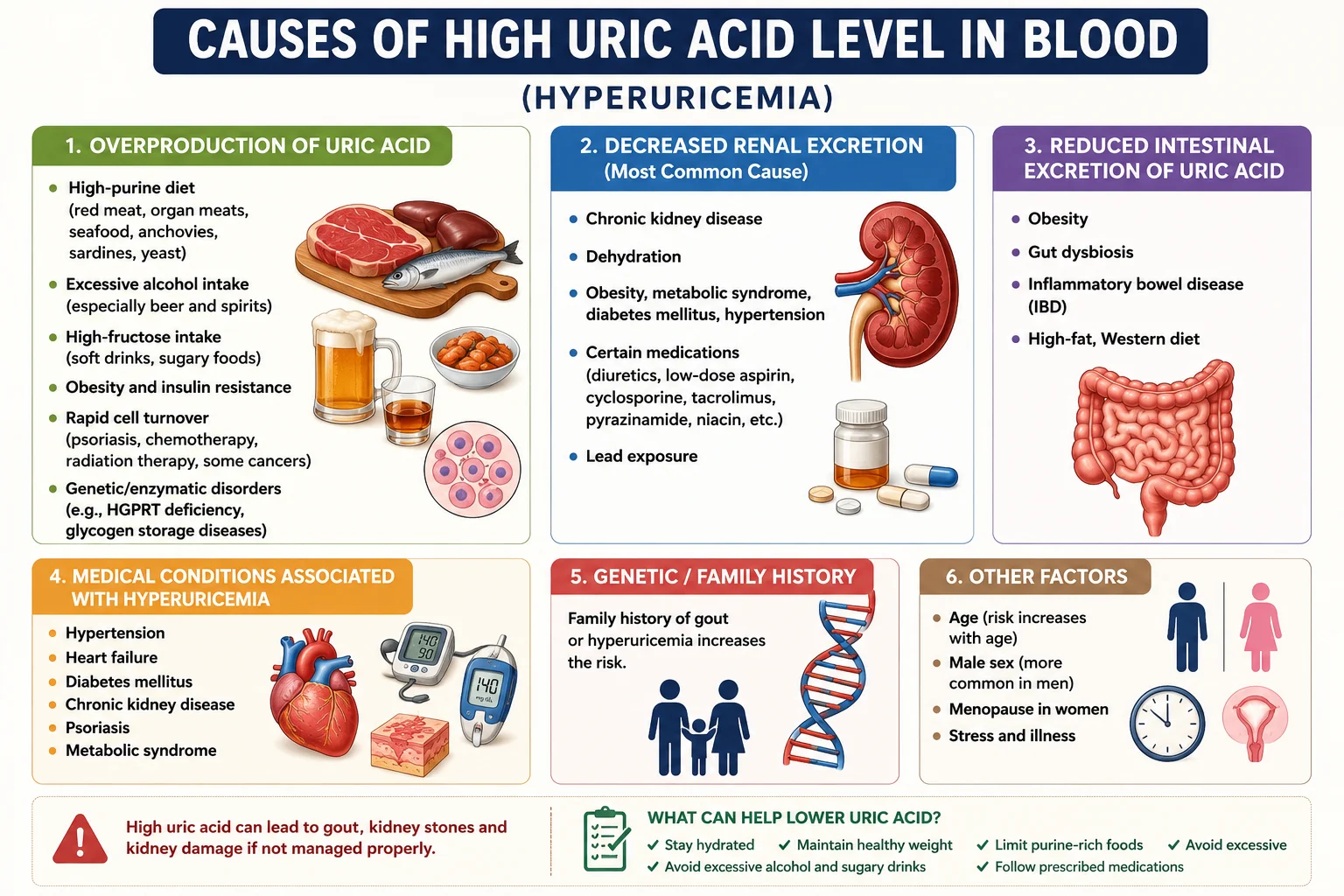
High uric acid is becoming an increasingly common health concern, affecting people of all ages. While uric acid is a natural waste product formed during the breakdown of purines#, excessive levels in the blood can lead to the formation of sharp uric acid crystals that accumulate in the joints and other tissues. This may result in severe pain, swelling, stiffness, and inflammation, most commonly due to gout. If left untreated, persistently high uric acid levels can also contribute to kidney stones, kidney damage, and other long-term health complications. Fortunately, early diagnosis, healthy dietary habits, regular physical activity, adequate hydration, and appropriate medical treatment can effectively control uric acid levels and reduce the risk of complications. Understanding the causes, symptoms, risk factors, prevention, and treatment of high uric acid is essential for maintaining healthy joints, protecting kidney function, and improving overall quality of life.
#Purines are natural chemical compounds found in the body's cells and in many foods. During normal #metabolism, the body breaks down purines to produce uric acid, which is usually removed through the kidneys in urine.
Examples of purine-rich foods: Red meat, organ meats (liver, kidney), seafood (anchovies, sardines, shellfish), and alcoholic beverages (especially beer).
#Metabolism is the process by which the body converts food into energy and other substances needed for growth, repair, and normal functioning.
Causes of High Uric Acid (Hyperuricemia#)
#Hyperuricemia is a medical condition in which there is an abnormally high level of uric acid in the blood. It occurs when the body produces too much uric acid or the kidneys do not remove enough of it.
1. Purine-Rich Diet
Eating large amounts of red meat, organ meats, seafood, and some alcoholic beverages increases uric acid production.
Red meat, organ meats, seafood, and alcoholic beverages (especially beer) are rich in purines. During digestion, the body breaks down these purines into uric acid. Consuming large amounts of these foods increases uric acid production. At the same time, alcohol—particularly beer—can reduce the kidneys' ability to excrete uric acid, causing it to accumulate in the bloodstream.
Research link:
National Institute of Diabetes and Digestive and Kidney Diseases Diet and Gout
https://www.buzzrx.com/blog/10-foods-to-avoid-with-gout
Research article:
Diet and Risk of Gout and Hyperuricemia National Center for Biotechnology Information
https://pubmed.ncbi.nlm.nih.gov/30485934/
2. Reduced Kidney Function
The kidneys normally filter uric acid from the blood and excrete most of it in the urine. When kidney function is reduced or the kidneys are unable to remove enough uric acid, less uric acid is excreted and more remains in the bloodstream. This buildup leads to hyperuricemia, which can increase the risk of #Gout and kidney stones.
Research link:
Hyperuricemia StatPearls NCBI Bookshelf
https://www.ncbi.nlm.nih.gov/books/NBK459218/?utm_source=chatgpt.com
Research article:
Hyperuricemia and Chronic Kidney Disease National Center for Biotechnology Information
https://pmc.ncbi.nlm.nih.gov/articles/PMC5512150/?utm_source=chatgpt.com
3. Obesity and Overweight
People with excess body fat often develop #insulin resistance, a condition in which the body's cells do not respond properly to insulin. Insulin resistance causes the kidneys to reabsorb more uric acid instead of removing it in the urine, so less uric acid is excreted.
In addition, obesity increases the #breakdown of body cells and the production of purines, which are converted into uric acid. As a result, more uric acid is produced while less is eliminated, causing its level in the bloodstream to rise.
#Insulin resistance is a condition in which the body's cells do not respond properly to insulin, the hormone (insulin) that helps glucose (sugar) enter cells for energy. As a result, glucose remains in the bloodstream, causing blood sugar levels to rise.
#breakdown of body cells and the production of purines: In obesity, fat cells become enlarged and unhealthy. Some of these damaged fat cells die naturally. As the body breaks down these dead cells, the DNA and RNA inside them are also broken down, releasing purines. The liver then converts these purines into uric acid. When more fat cells break down, more uric acid is produced, which can increase its level in the bloodstream.
How does it happen:
Every cell contains #DNA and RNA, the genetic material of the cell.
DNA and RNA are made up of building blocks, including the purine bases #adenine and guanine.
When a cell breaks down naturally, its DNA and RNA are also broken down.
This releases the purines (adenine and guanine) that were already part of the DNA and RNA.
The liver converts these purines into uric acid, which is normally excreted by the kidneys.
#DNA (Deoxyribonucleic Acid): The molecule that stores the body's genetic information and provides instructions for growth, development, and cell function.
#RNA (Ribonucleic Acid): The molecule that uses the genetic information from DNA to help make proteins, which are essential for the structure and function of cells.
#Adenine and guanine are natural purine compounds that make up DNA and RNA. When cells break down, these purines are released and converted by the liver into uric acid.
Research link:
Obesity and Hyperuricemia National Center for Biotechnology Information
https://pmc.ncbi.nlm.nih.gov/articles/PMC7125338/
Research article:
Hyperuricemia and Obesity A Systematic Review National Center for Biotechnology Information
https://pmc.ncbi.nlm.nih.gov/articles/PMC9063096/
4. Excessive Alcohol Consumption
Alcohol increases uric acid production and reduces its elimination through the kidneys.
i). Increases uric acid production: When alcohol is metabolized, it increases the breakdown of #ATP (adenosine triphosphate), an energy molecule that contains purines. This breakdown produces more purines, which the liver converts into uric acid.
#ATP (Adenosine Triphosphate) is the main energy-carrying molecule in the body's cells. It stores and releases energy needed for activities such as muscle contraction, nerve signaling, growth, and repair.
ii). Reduces uric acid excretion: Alcohol metabolism also produces lactic acid. High levels of lactic acid compete with uric acid for excretion by the kidneys, so less uric acid is removed in the urine and more remains in the bloodstream. Beer also contains additional purines, which further increase uric acid production.
Research link:
Alcohol Intake and Risk of Gout National Center for Biotechnology Information
https://www.amjmed.com/article/S0002-9343(06)00164-1/fulltext
Research article:
Hyperuricemia StatPearls NCBI Bookshelf
https://www.ncbi.nlm.nih.gov/sites/books/NBK546606/
5. Sugary Foods and Fructose-Rich Drinks
Soft drinks and foods high in fructose stimulate uric acid production.
Foods and drinks high in fructose (such as sugar-sweetened soft drinks, packaged fruit drinks, and many processed foods) increase uric acid because the liver rapidly metabolizes fructose. During this process, ATP (the cell's energy molecule) is broken down, producing purines, which are then converted into uric acid. As a result, frequent consumption of high-fructose foods and beverages can raise uric acid levels in the blood.
Research link:
Fructose Consumption and Hyperuricemia National Center for Biotechnology Information
https://pubmed.ncbi.nlm.nih.gov/33152951/
Research article:
Fructose and Uric Acid National Center for Biotechnology Information
https://pmc.ncbi.nlm.nih.gov/articles/PMC2682989/?utm_source=chatgpt.com
6. Genetic Factors
Inherited variations in genes that regulate uric acid metabolism can increase the risk of hyperuricemia.
Certain #inherited gene variations (genetic mutations or polymorphisms) affect proteins that regulate the production, transport, and excretion of uric acid. For example, changes in genes such as #SLC2A9 and ABCG2 can reduce the kidneys' ability to remove uric acid or increase its reabsorption back into the blood. As a result, uric acid accumulates in the bloodstream, increasing the risk of hyperuricemia and #Gout.
#Inherited gene variations are natural changes in genes passed from parents that can increase the risk of certain diseases, such as high uric acid or gout.
#Gout is a type of inflammatory arthritis caused by the buildup of uric acid crystals in the joints. It leads to sudden, severe pain, swelling, redness, and stiffness, most commonly affecting the big toe, although other joints can also be involved.
#SLC2A9 and ABCG2 are genes that help regulate the movement of uric acid in the body.
SLC2A9: This gene produces a urate transporter protein that controls the movement and reabsorption of uric acid in the kidneys. Changes in this gene can cause the kidneys to retain too much uric acid.
ABCG2: This gene produces a transporter protein that helps remove uric acid from the body through the kidneys and intestines. Variations in this gene can reduce uric acid excretion, leading to higher blood uric acid levels.
Research link:
Genetics of Hyperuricemia and Gout National Center for Biotechnology Information
https://pmc.ncbi.nlm.nih.gov/articles/PMC9333104/
Additional research article:
Hyperuricemia StatPearls NCBI Bookshelf
https://www.ncbi.nlm.nih.gov/sites/books/NBK459218/
7. Certain Medical Conditions
Conditions such as Type 2 Diabetes, high blood pressure, metabolic syndrome, and chronic kidney disease can increase uric acid levels.
Type 2 Diabetes and #metabolic syndrome are often associated with insulin resistance, which causes the kidneys to reabsorb more uric acid instead of excreting it in the urine.
High blood pressure can damage the small blood vessels in the kidneys over time, reducing their ability to remove uric acid efficiently.
Chronic Kidney Disease directly decreases the kidneys' filtering capacity, so less uric acid is excreted and more accumulates in the blood.
#Metabolic syndromeis a group of health conditions that occur together and increase the risk of Type 2 Diabetes, heart disease, and stroke.
These conditions include:
Increased waist circumference (abdominal obesity)
High blood pressure
High blood sugar
High triglyceride levels
Low HDL ("good") cholesterol
Research link:
Hyperuricemia and Metabolic Syndrome National Center for Biotechnology Information
https://pmc.ncbi.nlm.nih.gov/articles/PMC1934956/
Additional research article:
Hyperuricemia and Chronic Kidney Disease National Center for Biotechnology Information
https://clinicaltrials.gov/study/NCT07199205
8. Certain Medications
Diuretics, low-dose aspirin, and some immunosuppressive drugs can reduce uric acid excretion.
Certain medications can increase uric acid levels by reducing the kidneys' ability to remove uric acid:
Diuretics (water pills): Increase urine production but also cause the kidneys to reabsorb more uric acid, so less is excreted in the urine.
Low-dose aspirin: Reduces the kidneys' excretion of uric acid, allowing it to accumulate in the blood.
Some immunosuppressive drugs (such as Cyclosporine and Tacrolimus) impair kidney function or alter uric acid transport, decreasing its elimination.
Research link:
Hyperuricemia StatPearls NCBI Bookshelf
https://www.ncbi.nlm.nih.gov/books/NBK459218/?utm_source=chatgpt.com
Additional research article:
Drug Induced Hyperuricemia National Center for Biotechnology Information
https://www.frontiersin.org/journals/pharmacology/articles/10.3389/fphar.2026.1791120/full
9. Dehydration
Inadequate fluid intake reduces urine production, making it harder for the kidneys to remove uric acid.
When you do not drink enough water, the body becomes dehydrated, and the kidneys produce less urine to conserve water. With less urine being formed, less uric acid is flushed out of the body. As a result, uric acid becomes more concentrated in the blood and is more likely to accumulate, increasing the risk of Hyperuricemia, Gout, and uric acid kidney stones.
Research link:
National Institute of Diabetes and Digestive and Kidney Diseases Uric Acid Stones Eating Diet and Nutrition
https://www.kidney.org/kidney-topics/kidney-stone-diet-plan-and-prevention
Research article:
Hyperuricemia StatPearls NCBI Bookshelf
https://www.ncbi.nlm.nih.gov/books/NBK546606/
10. Rapid Cell Breakdown
Conditions such as cancer treatment, psoriasis, or blood disorders increase the breakdown of cells, producing excess uric acid.
Conditions such as cancer treatment (especially chemotherapy), #Psoriasis, and certain blood disorders cause rapid destruction or turnover of body cells. When many cells break down, their DNA and RNA are also broken down, releasing purines (adenine and guanine). The liver converts these purines into uric acid, leading to increased uric acid levels in the blood.
Research link:
Hyperuricemia StatPearls NCBI Bookshelf
Research article:
Tumor Lysis Syndrome National Center for Biotechnology Information
https://pmc.ncbi.nlm.nih.gov/articles/PMC3437249/
iPsoriasis is a chronic autoimmune skin disease in which skin cells grow and accumulate much faster than normal. This leads to thick, red, inflamed patches covered with silvery-white scales, commonly on the elbows, knees, scalp, and lower back.