
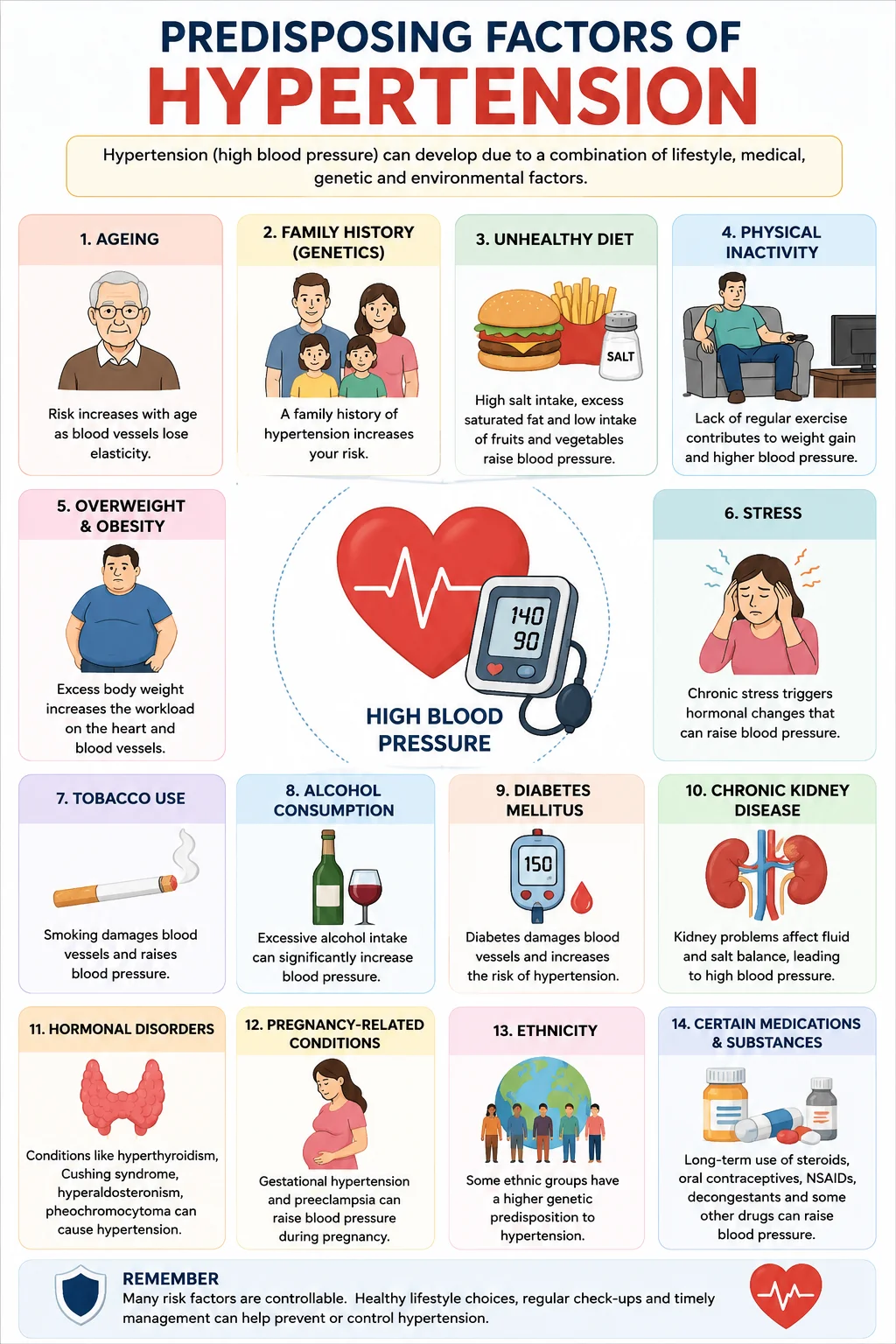
Hypertension develops through the combined influence of genetic, lifestyle, environmental, and medical factors that gradually increase blood pressure over time. While some risk factors, such as advancing age and family history, cannot be changed, many others—including unhealthy diet, obesity, physical inactivity, smoking, excessive alcohol consumption, and chronic stress—are preventable or controllable. Certain medical conditions, medications, and hormonal disorders can also increase the likelihood of developing hypertension. Understanding these predisposing factors is essential for identifying individuals at risk, adopting healthy lifestyle practices, and implementing early preventive measures to reduce the burden of hypertension and its serious complications.
Predisposing Factors of Hypertension
The following factors increase the risk of developing hypertension:
1. Increasing age – As we age, the elastic fibers in the artery walls gradually decrease and are replaced by stiffer collagen fibers. This makes the arteries less flexible, so they cannot expand easily when the heart pumps blood. As a result, resistance to blood flow increases, causing blood pressure to rise.
WHO Hypertension Fact Sheet: https://www.who.int/news-room/fact-sheets/detail/hypertension
https://www.who.int/news-room/fact-sheets/detail/hypertension
2. Family history (genetics) – Having a parent or sibling with hypertension increases the risk. A family history of hypertension means a person may inherit genes that affect blood pressure regulation, kidney function, salt handling, and blood vessel function. These inherited traits make them more likely to develop high blood pressure, especially when combined with unhealthy lifestyle habits.
American Heart Association: https://www.heart.org/en/health-topics/high-blood-pressure/understanding-blood-pressure-readings
https://www.heart.org/en/health-topics/high-blood-pressure/understanding-blood-pressure-readings
3. Overweight and obesity – Excess body fat makes the heart work harder to pump blood throughout the body. It also causes insulin resistance, chronic inflammation, and activates hormones that narrow blood vessels and increase sodium and water retention, all of which raise blood pressure.
WHO Obesity Fact Sheet: https://www.who.int/news-room/fact-sheets/detail/obesity-and-overweight
https://www.who.int/news-room/fact-sheets/detail/obesity-and-overweight
4. Physical inactivity – Lack of regular physical activity can lead to weight gain, reduced heart efficiency, and stiffer blood vessels. It also increases insulin resistance, all of which contribute to higher blood pressure.
WHO Physical Activity Fact Sheet: https://www.who.int/news-room/fact-sheets/detail/physical-activity
https://www.who.int/news-room/fact-sheets/detail/physical-activity
5. High-sodium (salt) diet – Excess sodium makes the kidneys retain more water, which increases blood volume. The extra blood in the blood vessels increases the pressure against the artery walls, raising blood pressure.
WHO Sodium Intake Guideline: https://www.who.int/publications/i/item/9789241504836
https://www.who.int/publications/i/item/9789241504836
6. Low potassium intake – Potassium helps the kidneys remove excess sodium from the body and relaxes the walls of blood vessels. When potassium intake is low, more sodium is retained and blood vessels remain more constricted, causing blood pressure to rise.
\Potassium-rich diet means eating foods that are naturally high in potassium, which helps maintain normal blood pressure and supports heart and muscle function.
Examples include:
Fruits: Bananas, oranges, mangoes, avocados
Vegetables: Spinach, potatoes, sweet potatoes, tomatoes
Legumes: Beans, lentils
Nuts and seeds
Low-fat dairy products: Milk, yogurt
WHO Potassium Intake Guideline: https://www.who.int/publications/i/item/9789241504829
https://www.who.int/publications/i/item/9789241504829
7. Unhealthy diet – Unhealthy diet refers to a diet high in saturated fats, trans fats, salt, added sugars, and processed foods.
Examples:
Saturated fats: Butter, ghee, fatty red meat, full-fat cheese, cream.
Trans fats: Fried foods, commercial baked goods (cakes, pastries, cookies), packaged snacks, stick margarine.
Processed foods: Chips, instant noodles, processed meats (sausages, bacon), canned soups, fast foods, packaged ready-to-eat meals.
How do they increase blood pressure?
These foods promote weight gain, cholesterol buildup (atherosclerosis), inflammation, and stiffening of blood vessels. Many are also high in sodium, which causes water retention. Together, these changes increase blood pressure.
American Heart Association Diet and Lifestyle Recommendations: https://www.heart.org/en/healthy-living/healthy-eating
https://www.heart.org/en/healthy-living/healthy-eating
8. Excessive alcohol consumption – Excessive alcohol consumption activates the sympathetic nervous system, increases stress hormones, and causes the body to retain sodium and water. Over time, it also damages the heart muscle and blood vessels, leading to persistently high blood pressure.
he main stress hormones involved are:
Adrenaline (epinephrine) – Increases heart rate, strengthens heart contractions, and narrows blood vessels, raising blood pressure.
Noradrenaline (norepinephrine) – Causes blood vessels to constrict, increasing blood pressure.
Cortisol – Promotes sodium and water retention by the kidneys and increases the sensitivity of blood vessels to adrenaline and noradrenaline, contributing to higher blood pressure.
WHO Alcohol Fact Sheet: https://www.who.int/news-room/fact-sheets/detail/alcohol
https://www.who.int/news-room/fact-sheets/detail/alcohol
9. Smoking and tobacco use – Nicotine stimulates the sympathetic nervous system, causing blood vessels to narrow and the heart to beat faster. Over time, tobacco chemicals damage the inner lining of blood vessels (endothelium), making them stiffer and promoting plaque buildup, which increases blood pressure.
WHO Tobacco Fact Sheet: https://www.who.int/news-room/fact-sheets/detail/tobacco
https://www.who.int/news-room/fact-sheets/detail/tobacco
10. Chronic stress – Persistent (chronic) stress activates the sympathetic nervous system and increases the release of adrenaline, noradrenaline, and cortisol. These hormones increase heart rate, narrow blood vessels, and promote sodium and water retention, leading to higher blood pressure.
International Society of Hypertension Global Hypertension Practice Guidelines: https://www.ahajournals.org/doi/10.1161/HYPERTENSIONAHA.120.15026
https://www.ahajournals.org/doi/10.1161/HYPERTENSIONAHA.120.15026
11. Diabetes mellitus – High blood glucose damages the inner lining of blood vessels (endothelium), reducing their ability to relax. It also promotes inflammation, atherosclerosis, and kidney damage, which increase blood vessel resistance and blood pressure.
American Diabetes Association Standards of Care: https://diabetesjournals.org/care
https://diabetesjournals.org/care
12. Chronic kidney disease – Impaired kidney function disrupts blood pressure regulation. Healthy kidneys regulate blood pressure by removing excess sodium and water and producing hormones that control blood pressure. When kidney function is impaired, sodium and water accumulate, increasing blood volume. The kidneys also overactivate the renin–angiotensin–aldosterone system (RAAS), causing blood vessels to narrow and blood pressure to rise.
National Kidney Foundation: https://www.kidney.org/kidney-topics/high-blood-pressure-and-chronic-kidney-disease
https://www.kidney.org/high-blood-pressure-and-chronic-kidney-disease
13. Obstructive sleep apnea – In obstructive sleep apnea, repeated pauses in breathing reduce oxygen levels during sleep. This triggers the sympathetic nervous system and increases the release of stress hormones (adrenaline and noradrenaline), which narrow blood vessels and increase heart rate, raising blood pressure.
American Heart Association Scientific Statement: https://www.ahajournals.org/doi/10.1161/HYP.0000000000000108
https://www.ahajournals.org/doi/10.1161/HYP.0000000000000108
14. High cholesterol and atherosclerosis – High cholesterol causes fatty plaques to build up inside the arteries (atherosclerosis). These plaques narrow and stiffen the arteries, making it harder for blood to flow. As a result, the heart must pump with greater force, increasing blood pressure.
American Heart Association Cholesterol Information: https://www.heart.org/en/health-topics/cholesterol
https://www.heart.org/en/health-topics/cholesterol
15. Certain medications – Long-term use of corticosteroids, NSAIDs, oral contraceptives, decongestants, and some antidepressants can increase blood pressure.
Here is how each medication can increase blood pressure, in short:
i). Corticosteroids (e.g., prednisolone, dexamethasone)
Cause the kidneys to retain sodium and water, increasing blood volume. They also make blood vessels more sensitive to vasoconstricting hormones.
ii). NSAIDs (Nonsteroidal Anti-inflammatory Drugs; e.g., ibuprofen, naproxen, diclofenac)
Reduce the production of prostaglandins, which normally help keep kidney blood flow normal and promote sodium excretion. As a result, the body retains sodium and water.
iii). Oral contraceptives (birth control pills containing estrogen)
Estrogen increases the production of angiotensinogen in the liver, activating the renin–angiotensin–aldosterone system (RAAS). This causes blood vessels to narrow and increases sodium and water retention.
iv). #Decongestants (e.g., pseudoephedrine, phenylephrine)
#Decongestants are medications used to relieve a blocked or stuffy nose caused by colds, allergies, or sinus infections. They work by narrowing the blood vessels in the nasal passages, which reduces swelling and congestion.
Decongestants
Stimulate #α-adrenergic receptors, causing blood vessels to constrict (vasoconstriction).
#α-Adrenergic (alpha-adrenergic) receptors are proteins found on the surface of blood vessel muscle cells that respond mainly to the hormone noradrenaline (norepinephrine) and, to a lesser extent, adrenaline (epinephrine). When these receptors are activated, they cause blood vessels to constrict (narrow), which increases blood pressure.
iv). Some antidepressants (especially #SNRIs such as venlafaxine and duloxetine)
#SNRI stands for Serotonin–Norepinephrine Reuptake Inhibitor.
These are antidepressant medications that increase the levels of serotonin and norepinephrine (noradrenaline) in the brain to help treat depression, anxiety, and certain chronic pain conditions.
Some antidepressants
Increase the levels of noradrenaline (norepinephrine), which stimulates the sympathetic nervous system, increasing heart rate and causing blood vessels to constrict.
StatPearls – Secondary Hypertension: https://www.ncbi.nlm.nih.gov/books/NBK544305/
https://www.ncbi.nlm.nih.gov/books/NBK544305/
16. Hormonal disorders – Conditions such as hyperaldosteronism, Cushing syndrome, pheochromocytoma, and thyroid disorders can cause hypertension.
i). Hyperaldosteronism – Excess aldosterone causes the kidneys to retain sodium and water and lose potassium, increasing blood volume and blood pressure.
ii). Cushing syndrome – Excess cortisol (produced by the adrenal cortex) increases the sensitivity of blood vessels to stress hormones and promotes sodium and water retention.
iii). Pheochromocytoma – A tumor of the adrenal gland releases excess adrenaline and noradrenaline, causing blood vessels to constrict and the heart to beat faster.
iv). Thyroid disorders
Hyperthyroidism: Increases heart rate and cardiac output, raising blood pressure.
Hypothyroidism: Causes arteries to become stiffer, increasing resistance to blood flow.
Therefore, Abnormal thyroid hormone levels make the heart or blood vessels work abnormally, leading to high blood pressure.
StatPearls – Secondary Hypertension: https://www.ncbi.nlm.nih.gov/books/NBK544305/
https://www.ncbi.nlm.nih.gov/books/NBK544305/
The main stress hormones are:
Adrenaline (Epinephrine)– Increases heart rate, blood pressure, and energy during stress.
Noradrenaline (Norepinephrine) – Narrows blood vessels and raises blood pressure.
Cortisol – Helps the body cope with long-term stress by increasing blood sugar and promoting sodium and water retention.
17. Ethnicity – Some populations have a higher genetic predisposition to hypertension. Certain ethnic groups inherit genetic variations that affect blood pressure regulation, kidney sodium handling, hormone activity (such as the renin–angiotensin–aldosterone system), and blood vessel function. These inherited differences make them more susceptible to developing hypertension.
WHO Hypertension Fact Sheet: https://www.who.int/news-room/fact-sheets/detail/hypertension
https://www.who.int/news-room/fact-sheets/detail/hypertension
18. Pregnancy-related conditions – Gestational hypertension and preeclampsia increase blood pressure during pregnancy.
During gestational hypertension and preeclampsia, the placenta does not develop or function normally. This causes the release of substances that damage the lining of blood vessels (endothelium), leading to blood vessel narrowing (vasoconstriction), increased sensitivity to hormones that raise blood pressure, and sometimes fluid retention. These changes increase blood pressure during pregnancy.
American College of Obstetricians and Gynecologists (ACOG): https://www.acog.org/womens-health/faqs/preeclampsia-and-high-blood-pressure-during-pregnancy
https://www.acog.org/womens-health/faqs/preeclampsia-and-high-blood-pressure-during-pregnancy
Normally, blood pressure does not rise during pregnancy.
During the first and second trimesters, blood pressure usually decreases slightly because pregnancy hormones (especially progesterone) relax blood vessels, reducing vascular resistance.
In the third trimester, blood pressure gradually returns to the woman's pre-pregnancy level, but it should not become high.
If blood pressure becomes ≥140/90 mmHg after 20 weeks of pregnancy, it is not normal and may indicate gestational hypertension or preeclampsia.
After 20 weeks of pregnancy, the placenta has become fully established. If it does not develop or function normally, it releases substances that damage the mother's blood vessel lining (endothelium). This causes blood vessels to narrow (vasoconstriction), increases their sensitivity to blood pressure–raising hormones, and may lead to fluid retention. As a result, blood pressure rises, causing gestational hypertension or preeclampsia.
Damage to the endothelial lining (the inner lining of blood vessels) reduces its ability to keep blood vessels healthy and relaxed. As a result:
Blood vessels constrict (narrow) instead of relaxing.
Blood pressure increases.
Blood clotting becomes more likely.
Fluid leaks from blood vessels into surrounding tissues, causing swelling (edema).
Blood flow to organs such as the kidneys, liver, brain, and placenta decreases, which can lead to complications such as preeclampsia.
Conclusion:
Hypertension is more likely to develop in people with older age, a family history of high blood pressure, obesity, unhealthy diet, high salt intake, lack of exercise, smoking, excessive alcohol use, chronic stress, diabetes, kidney disease, sleep apnea, and certain medical conditions or medications.