
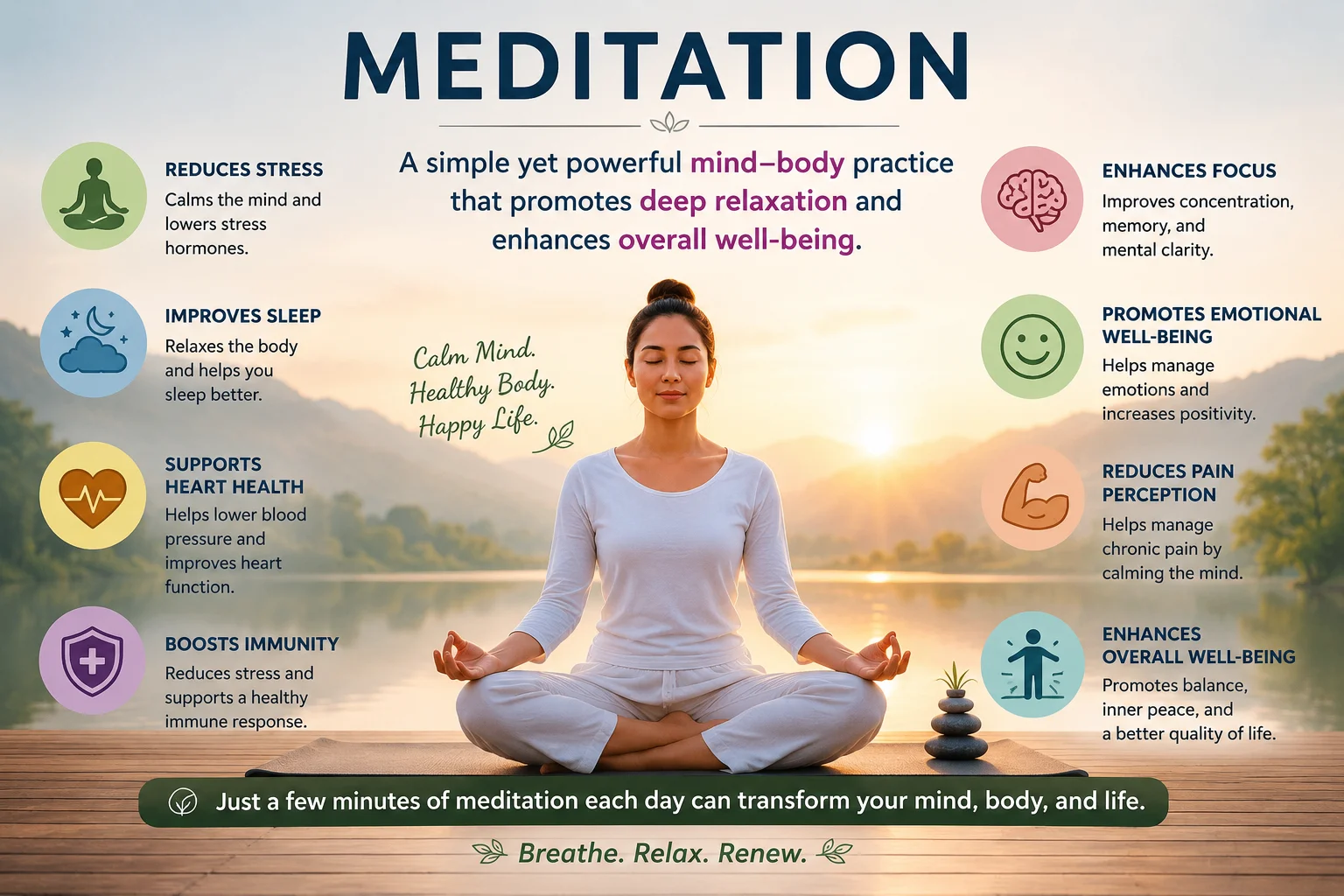
Meditation is a simple yet powerful mind–body practice that promotes deep relaxation and enhances overall well-being. By calming the mind and reducing stress, it helps improve emotional balance, mental clarity, and concentration while supporting healthy body functions. Regular meditation can lower stress hormones, improve sleep quality, reduce anxiety, and promote a sense of inner peace. As part of a healthy lifestyle, meditation contributes to better mental and physical health, helping individuals cope more effectively with daily challenges and improving their overall quality of life.
Meditation: Meditation is a mind–body practice that involves focusing the mind and controlling attention to achieve a state of mental calmness, relaxation, and awareness. It helps reduce stress, improve concentration, and promote overall mental and physical well-being.
Research suggests that regular meditation can benefit both the mind and the body.
1. Benefits of Meditation for the Mind
i). Reduces stress and promotes relaxation.
Meditation helps reduce stress by:
Slowing the body's #stress response and activating the #relaxation response.
#Stress response is the body's natural reaction to a stressful or threatening situation involving the release of stress hormones (such as cortisol and adrenaline) that prepare the body for "fight or flight."
#Relaxation response is the body's natural state of calmness that slows the heart rate, lowers blood pressure, reduces stress hormones, and relaxes the mind and muscles.
Reducing stress hormones, especially #Cortisol.
#Cortisol is a stress hormone produced by the #adrenal glands that helps the body respond to stress, regulate metabolism, blood pressure, and immune function.
#Adrenal glands are small hormone-producing glands located on top of each kidney. They produce hormones such as cortisol, adrenaline, and aldosterone.
Slowing the heart rate and breathing rate and helping lower blood pressure.
Relaxing tense muscles and calming the mind.
Improving emotional control, making people less reactive to stressful situations.
Simple example
Suppose you have had a busy and stressful day at work.
Without meditation: You feel tense, worried, and mentally exhausted.
With 15–20 minutes of meditation: Your breathing becomes slower, your body relaxes, and you feel calmer and more peaceful.
Therefore, Meditation reduces stress by calming the mind and relaxing the body.
ii). Decreases anxiety and symptoms of depression.
How does meditation decrease anxiety and symptoms of depression?
Meditation helps by:
Calming the mind and reducing excessive worrying and negative thoughts.
Lowering stress hormones, especially Cortisol.
Improving emotional regulation, making it easier to cope with stress and difficult emotions.
Increasing #mindfulness, helping people focus on the present rather than dwelling on the past or worrying about the future. #Mindfulness means giving your full attention to what you are doing right now, rather than thinking about the past or worrying about the future. Meditation increases mindfulness.
Simple example
Suppose you are eating an apple.
❌ Instead of thinking, "I made a mistake yesterday," or "What if my meeting tomorrow goes badly?"
✅ You focus on the taste of the apple, its smell, its texture, and each bite you take.
Promoting relaxation and better sleep, which can reduce symptoms of anxiety and depression.
iii). Improves attention, concentration, and focus.
Meditation improves attention, concentration, and focus by:
Training the brain to focus on one object, such as the breath or a sound.
Reducing distractions and mind wandering, making it easier to stay attentive.
Strengthening brain networks involved in attention and self-control. Meditation strengthens brain networks involved in attention and self-control because repeatedly bringing your attention back to a chosen focus (such as your breath) trains the brain, much like exercise trains a muscle. Over time, this practice makes it easier to stay focused and resist distractions.
Simple example
Imagine you are meditating and focusing on your breathing.
You breathe in and out.
Suddenly, you think: "I need to check my phone."
Instead of immediately reaching for your phone, you notice the thought and gently return your attention to your breathing.
Every time you do this, you are practicing:
Attention – bringing your focus back to your breath.
Self-control – choosing not to follow the distracting thought (to check the phone) immediately.
With regular practice, this skill can help in everyday life.
Improving working memory, helping people process and retain information more effectively.
How does meditation improve working memory?
Meditation improves working memory by helping the brain stay focused and hold information in mind for a short time while using it. When the mind is less distracted, it can process and remember information more effectively.
Simple example
Suppose your teacher says:
"Please remember these three numbers: 5, 8, and 2, then add them together."
If your mind is distracted by thoughts such as "What should I eat later?", you may forget the numbers.
After practicing meditation regularly, it becomes easier to keep the numbers in your mind, perform the calculation, and remember the answer because your attention is better focused.
Reducing stress and anxiety, which can otherwise impair concentration.
How does meditation reduce stress and anxiety, improving concentration?
Meditation calms the mind and reduces stress and anxiety. When you are less stressed, your mind is not filled with worrying thoughts, making it easier to focus on the task in front of you.
Simple example
Suppose you are reading a book for an exam.
❌ When you are stressed or anxious:
You keep thinking, "What if I fail the exam?"
You read the same page several times because your mind is distracted.
✅ After practicing meditation:
Your mind becomes calmer.
You focus on the words in the book instead of worrying about the exam.
You understand and remember what you read more easily.
Therefore, Meditation reduces stress and anxiety, leaving fewer distracting thoughts so you can concentrate better on the task you are doing.
iv). Enhances memory and learning ability.
Meditation enhances memory and learning by:
Improving attention and concentration, making it easier to absorb new information.
Simple example
Suppose your teacher is explaining a new lesson.
Without good concentration: Your mind keeps wandering, so you miss important points.
With improved concentration through meditation: You stay focused on the teacher, understand the lesson better, and remember it more easily.
Therefore, Meditation helps you pay attention, making it easier to learn and remember new information.
Increasing working memory, which helps store and process information temporarily.
Reducing stress and anxiety, which can interfere with memory formation and recall.
Improving sleep quality, allowing the brain to better consolidate memories.
Simple example
Suppose you study a lesson in the evening.
After a good night's sleep, your brain stores the information more effectively, making it easier to remember the lesson the next day.
Therefore, Meditation improves sleep, and good sleep helps the brain store new memories more effectively.
Promoting healthy brain function, supporting learning and cognitive performance.
How does meditation promote healthy brain function?
Meditation keeps the brain calm and focused, allowing it to process information more efficiently.
Simple example
Suppose you are solving a math problem.
Without meditation: You get distracted easily and make mistakes.
With regular meditation: You stay focused, think more clearly, and solve the problem more accurately.
Therefore, Meditation helps the brain stay focused and think clearly, making learning and problem-solving easier.
v). Improves emotional regulation and resilience.
How does meditation improve emotional regulation and resilience?
Meditation helps by:
Helps people notice their thoughts and feelings before reacting.
Simple example
Suppose someone says something rude to you.
Without mindfulness: You immediately get angry and argue.
With mindfulness through meditation: You notice, "I'm feeling angry." You pause, take a deep breath, and respond calmly instead of reacting immediately.
Therefore, Meditation helps you notice your thoughts and emotions first, giving you time to choose a calm response instead of reacting impulsively.
Keeps people calmer during stressful situations.
Simple example
Suppose you are stuck in a traffic jam and are getting late for an important meeting.
Without meditation: You become frustrated, angry, and anxious.
With regular meditation: You take a few slow, deep breaths, stay calm, and think, "The traffic is beyond my control. I'll inform them that I'm running late."
Therefore, Meditation helps you stay calmer during stressful situations so you can think clearly and respond wisely instead of panicking.
Improves self-control and helps them deal with problems more effectively.
Suppose a student receives low marks on a test.
Without self-control: They become upset, give up, or stop studying.
With better self-control through meditation: They stay calm, identify their mistakes, make a study plan, and prepare better for the next test.
Therefore, Meditation helps people control their emotions and deal with problems calmly and effectively instead of reacting impulsively.
Reducing stress and anxiety, which supports emotional stability..
Simple example
Suppose you have a job interview tomorrow.
Without meditation: You feel very anxious, worry constantly, and become easily upset.
With regular meditation: You feel calmer, think more clearly, and remain emotionally balanced during the interview.
Therefore, By reducing stress and anxiety, meditation helps you stay emotionally calm and stable in challenging situations.
Builds a positive attitude and helps people recover more easily from difficulties.
Simple example
Suppose you do not get the job you applied for.
Without a positive attitude: You feel discouraged and think, "I'll never succeed."
With regular meditation: You accept the disappointment, think, "I'll learn from this experience and prepare better for the next interview," and keep trying.
Therefore, Meditation helps people stay positive, recover from setbacks more quickly, and move forward with confidence.
vi). Promotes self-awareness and mindfulness.
How does meditation promote self-awareness and mindfulness?
Meditation helps by:
Focusing on the present moment.
Simple example
Suppose you are drinking a cup of tea.
Instead of thinking about yesterday's mistakes or tomorrow's work,
You focus on the warmth of the cup, the aroma of the tea, and the taste of each sip.
This is focusing on the present moment.
Making people more aware of their thoughts and feelings.
Simple example
Suppose your colleague criticizes your work.
Without self-awareness: You immediately become angry and argue.
With meditation: You notice, "I'm feeling angry and upset." Because you recognize your feelings, you pause, take a deep breath, and respond calmly.
Therefore, Meditation helps people recognize their thoughts and emotions as they arise, making it easier to respond thoughtfully instead of reacting impulsively
Helping them stay calm instead of reacting quickly.
Simple example
Suppose someone cuts in front of you while standing in a queue.
Without meditation: You immediately shout or argue.
With regular meditation: You pause, take a deep breath, stay calm, and politely ask the person to return to the end of the queue.
Therefore, Meditation helps people pause, stay calm, and respond thoughtfully instead of reacting immediately.
Improving self-understanding and emotional balance.
Simple example
Suppose you notice that you often become angry during meetings.
With meditation: You become aware that stress is triggering your anger. You take a few deep breaths, remain calm, and express your opinion politely instead of reacting angrily.
Therefore, Meditation helps you understand your emotions better and maintain emotional balance in difficult situations.
vi). Improves sleep quality and reduces insomnia.
How does meditation improve sleep quality and reduce insomnia?
Meditation helps by:
Calming the mind and reducing racing thoughts at bedtime.
Simple example
Suppose you go to bed and keep thinking:
"I have so much work tomorrow."
"What if I forget something?"
These racing thoughts make it difficult to fall asleep.
After practicing meditation:
You focus on your slow breathing.
Your mind becomes calmer.
The worrying thoughts gradually fade, making it easier to fall asleep.
Therefore, Meditation calms the mind, reduces racing thoughts at bedtime, and helps you fall asleep more easily.
Reducing stress and anxiety, making it easier to fall asleep.
Simple example
Suppose you have an important exam the next day.
Without meditation: You feel stressed and anxious, keep worrying about the exam, and struggle to fall asleep.
With regular meditation: You relax, your worries decrease, and you fall asleep more easily.
Therefore, Meditation reduces stress and anxiety, helping you relax and fall asleep more easily.
Relaxing the body by slowing breathing and heart rate.
Simple example
Suppose you come home after a stressful day at work.
Before meditation: Your breathing is fast, and your heart is beating quickly.
After 10 minutes of slow breathing meditation: Your breathing becomes slower, your heart rate gradually slows, and your body feels relaxed.
Therefore, Meditation slows your breathing and heart rate, helping your body relax and prepare for restful sleep.
Helping people stay asleep longer and improving overall sleep quality.
Simple example
Suppose you usually wake up 3–4 times during the night.
Without meditation: You wake up often and feel tired in the morning.
With regular meditation: You sleep for longer periods without waking up as often and wake up feeling more refreshed.
Therefore, Meditation helps people stay asleep longer, resulting in better-quality and more refreshing sleep.
vii). Enhances overall psychological well-being and quality of life.
How does meditation enhance overall psychological well-being and quality of life?
Meditation helps by:
Reducing stress, anxiety, and negative emotions.
Simple example
Suppose you have a presentation at work tomorrow.
Without meditation: You feel stressed, anxious, and keep thinking, "What if I make a mistake?"
With regular meditation: You feel calmer, more confident, and think, "I'll do my best."
Therefore, Meditation reduces stress, anxiety, and negative emotions, helping you stay calm and positive.
Improving mood and emotional balance.
Simple example
Suppose you have a disagreement with a friend.
Without meditation: You remain upset and irritated for the rest of the day.
With regular meditation: You calm down more quickly, understand your emotions, and continue your day with a more positive mood.
Therefore, Meditation helps improve mood and maintain emotional balance, even after upsetting situations.
Increasing feelings of calmness, happiness, and inner peace.
Simple example
Suppose you finish a 15-minute meditation session after a busy day.
You feel calm instead of stressed.
You feel more cheerful instead of irritated.
Your mind feels peaceful instead of filled with worries.
Therefore, Meditation increases feelings of calmness, happiness, and inner peace, helping you feel relaxed and emotionally refreshed.
Helping people cope better with daily challenges and improve relationships.
Simple example
Suppose a family member speaks to you impatiently.
Without meditation: You become angry and argue.
With regular meditation: You stay calm, listen patiently, and respond politely, avoiding unnecessary conflict.
Therefore, Meditation helps people handle daily challenges calmly and communicate more positively, leading to better relationships.
Supporting better sleep and overall mental health.
Simple example
Suppose you meditate for 15–20 minutes every evening.
You fall asleep more easily and sleep more soundly.
The next morning, you wake up feeling refreshed, calmer, and better able to handle the day's activities.
Therefore, Meditation supports better sleep, which contributes to improved mental health, mood, and overall well-being.
Benefits of Meditation for the Body
i). May lower blood pressure in some people.
How does meditation help lower blood pressure?
Meditation may lower blood pressure by:
Reducing stress hormones, especially cortisol and adrenaline.
Activating the body's relaxation response, which relaxes blood vessels. Relaxed and widened blood vessels reduce resistance to blood flow, so the heart pumps more easily and blood pressure falls.
Slowing the heart rate and breathing rate. The heart beats more slowly, reducing its workload. Breathing becomes slower and deeper, improving oxygen delivery and promoting relaxation.
Reducing tension in the nervous system, allowing blood to flow more easily. Meditation calms the nervous system, causing the heart and breathing to slow, which helps the body relax and reduces stress.
Simple example
Suppose you have a stressful day at work.
Without meditation: You remain tense, your heart beats faster, and your blood pressure may rise.
With regular meditation: You practice slow breathing for 15–20 minutes. Your body relaxes, your heart rate slows, your blood vessels relax, and your blood pressure may gradually decrease.
Therefore, Meditation relaxes the body and reduces stress, helping lower blood pressure, especially in some people with high blood pressure.
ii). Reduces stress hormone (cortisol) levels.
How does meditation reduce stress hormone (cortisol) levels?
Meditation helps by:
Activating the body's relaxation response.
Reducing the activity of the stress response #(fight-or-flight response).
#Fight-or-flight response is the body's automatic reaction to a real or perceived danger or stressful situation. It prepares you either to fight the threat or run away from it.
When this response is activated:
Your heart beats faster.
Your breathing becomes quicker.
Your muscles become tense.
Stress hormones such as adrenaline and cortisol are released to help you react quickly.
Simple example
Imagine you are walking and suddenly see a dog running toward you and barking.
Your body immediately reacts:
Your heart starts beating faster.
You breathe more quickly.
Your muscles become tense.
You quickly decide whether to run away (flight) or protect yourself (fight).
This automatic reaction is called the fight-or-flight response.
So, The fight-or-flight response is the body's natural emergency response that prepares you to face or escape a dangerous or stressful situation.
Decreasing the release of cortisol from the adrenal glands.
Helping the mind stay calm, so the body produces less cortisol.
Simple example
Suppose you are worried about an important exam.
Without meditation: You keep worrying, your body stays stressed, and your cortisol level remains high.
With regular meditation: You focus on slow breathing for 15–20 minutes, your mind becomes calmer, your body relaxes, and your cortisol level gradually decreases.
Therefore, Meditation calms the body and mind, reducing stress and lowering cortisol levels.
iii). Helps reduce chronic pain perception.
How does meditation help reduce chronic pain perception?
Meditation helps by:
Changing how the brain processes pain, making pain feel less intense.
Reducing stress and anxiety, which can worsen pain. Stress and anxiety make the brain more sensitive to pain, so reducing them can make pain feel less severe.
Helping people focus less on pain and more on the present moment.
Improving emotional control, making it easier to cope with persistent pain.
Simple example
Suppose a person has chronic back pain.
Without meditation: They keep thinking, "This pain is unbearable," which makes the pain feel worse.
With regular meditation: They stay calm, focus on their breathing, and notice the pain without becoming overwhelmed by it. As a result, the pain feels more manageable, even though it may not disappear completely.
Therefore, Meditation helps people stay calm and changes how the brain processes pain, making chronic pain feel less severe and easier to cope with.
iv). Improves heart health by reducing stress-related cardiovascular effects.
How does meditation improve heart health?
Meditation helps by:
Reducing stress hormones, such as cortisol and adrenaline.
Lowering blood pressure by relaxing blood vessels.
Slowing the heart rate, reducing the heart's workload.
Reducing stress on the heart and blood vessels, supporting overall cardiovascular health.
Simple example
Suppose you are stuck in heavy traffic.
Without meditation: You become stressed, your heart beats faster, and your blood pressure may rise temporarily.
With regular meditation: You take slow, deep breaths, remain calm, your heart beats more slowly, and your blood pressure is less likely to increase as much.
Therefore, Meditation helps keep the heart calmer during stressful situations, reducing strain on the heart and supporting long-term heart health.
v). Supports a healthy immune response.
How does meditation support a healthy immune response?
Meditation helps by:
Reducing chronic stress, which can weaken the immune system. Long-term stress raises cortisol levels > which suppresses immune cells and then >reduces the body's ability to fight infections.
Lowering stress hormones (especially cortisol), allowing immune cells to function more effectively. Meditation lowers stress hormone, which strengthens the immune system.
Improving sleep quality, which is important for normal immune function. Good sleep gives the immune system time to produce immune cells and protective proteins, helping the body fight infections and recover effectively.
Improves overall physical well-being by encouraging relaxation and healthy lifestyle habits.
Simple example
Suppose two people have a busy and stressful week.
Without meditation: One person stays highly stressed, sleeps poorly, and may become more susceptible to common infections.
With regular meditation: The other person feels calmer, sleeps better, and their immune system is better able to respond to germs.
Therefore, Meditation helps reduce stress and improve sleep, which supports the body's natural ability to fight infections and stay healthy.
Main research link