
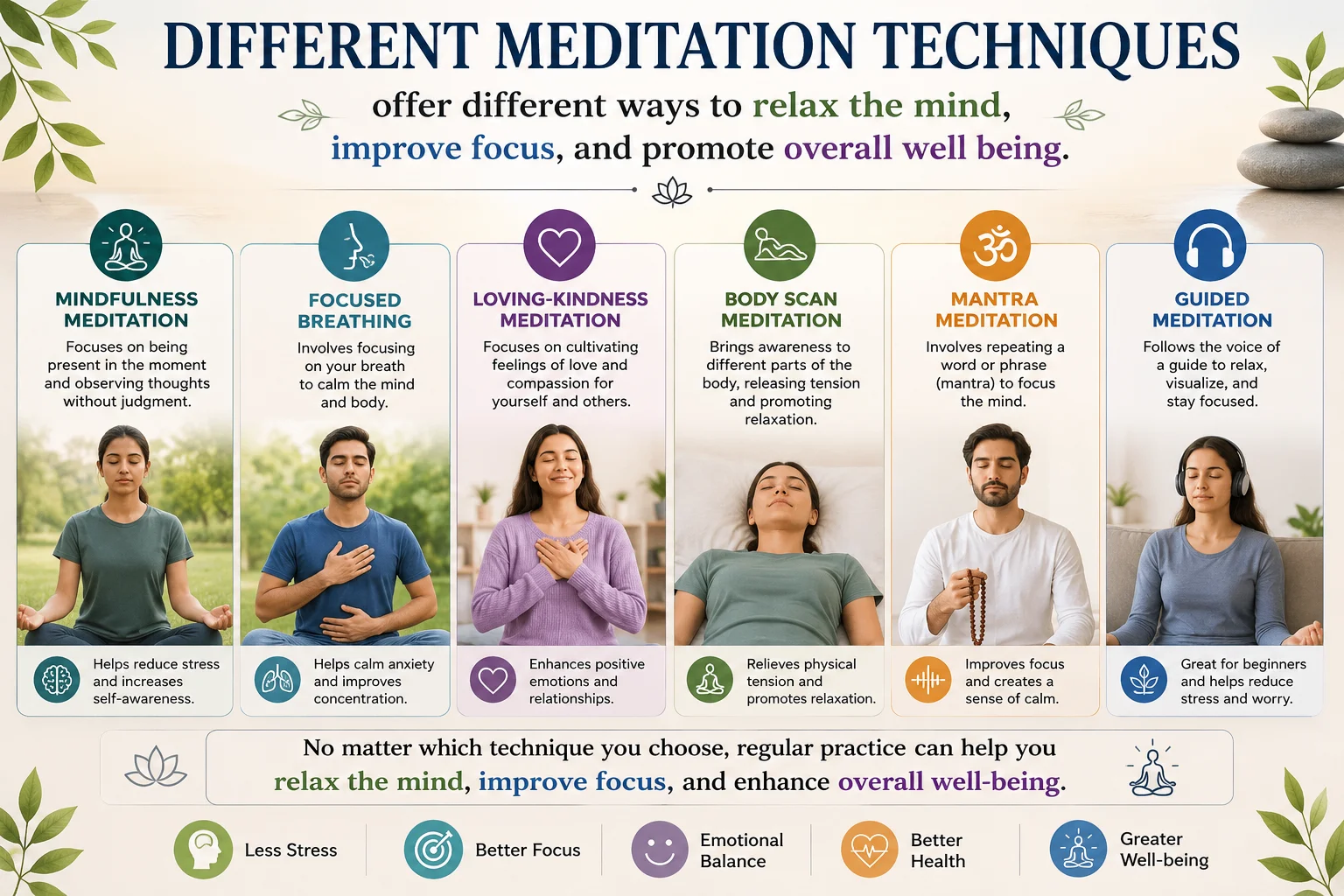
Meditation is not a one size fits all practice. Different meditation techniques offer different ways to relax the mind, improve focus, and promote overall well being. Choosing a technique that matches your personal needs, preferences, and lifestyle makes meditation more comfortable, enjoyable, and easier to practice regularly. Some people prefer quiet sitting, while others find breathing exercises, gentle movement, or guided sessions more helpful. There is no single technique that is best for everyone. The best meditation technique is the one that you can practice consistently with comfort and confidence. With regular practice, meditation can become a valuable habit that supports both mental and physical health and improves overall quality of life.
The following meditation techniques are widely recognized in clinical practice and research:
1. Mindfulness meditation – Focus on the present moment without judging your thoughts.
Example:
Sit comfortably and close your eyes > Focus on your natural breathing > Notice the air going in and out of your nose.
>If a thought comes, such as "I have a lot of work to do," simply notice it without judging it or following it (Do not analyze it, worry about it, or make a plan at that moment.), Let the thought pass, like a cloud moving across the sky.> Then gently bring your attention back to your breathing.
So, Focus on your breathing. When your mind wanders, calmly bring your attention back to your breath.
2. Breathing meditation – Focus attention on slow, deep breathing.
Simple example
Suppose you are meditating and focusing on your breathing.
A thought may come:
"I have an exam tomorrow."
❌ Instead of doing this: (Don't do this)
"What if I fail?"
"I should study Chapter 5 first."
"Maybe I don't have enough time."
✅ But you do this instead:
Notice the thought: "I'm thinking about my exam."
But do not continue the above mental conversation.
Gently bring your attention back to your breathing: In... Out... In... Out...
Therefore, Notice the thought, don't continue thinking about it, and gently return your focus to your breathing.
3. Guided meditation – Follow spoken instructions from a teacher or audio recording.
Guided meditation is a type of meditation in which a teacher or an audio recording gives step-by-step instructions, telling you what to do and where to focus your attention.
Simple example
You play a 10-minute guided meditation on your phone.
The instructor says:
"Sit comfortably and close your eyes > Take a slow, deep breath. Breathe in... and breathe out > Relax your shoulders. Notice your breathing > If your mind wanders, gently bring your attention back to your breath."
You simply listen to the instructions and follow them.
Therefore, In guided meditation, someone guides you step by step, and you simply listen and follow their instructions.
4. Body scan meditation – Focus on different parts of the body to release tension.
In body scan meditation, you gently check each part of your body one by one to notice how it feels. You are not trying to diagnose a problem—just becoming aware of any sensations.
For example:
a). Focus on your feet.
Ask yourself: "Do my feet feel relaxed, tight, warm, cold, or uncomfortable?"
Move to your legs.
Notice whether they feel tense or relaxed.
Continue with your stomach, chest, shoulders, arms, neck, and face.
If you notice tension, don't struggle to remove it. Simply take a slow, deep breath and allow that area to relax before moving to the next body part.
Such as:
"My shoulders feel tight."
Take a slow breath in.
As you breathe out, let your shoulders drop and relax.
Then move your attention to your arms.
Therefore, You notice each body part one by one, observe any tension or discomfort without judging it, then gently relax that area before moving on.
5. Mantra meditation – Repeat a word, phrase, or sound (e.g., "Om") to improve concentration.
Mantra meditation is a meditation technique in which you repeat a word, short phrase, or sound over and over to keep your mind focused and reduce distractions.
Simple example
Sit comfortably and close your eyes.
Choose a simple word or sound, such as:
"Om"
"Peace"
"Calm"
Then repeat it slowly:
"Om... Om... Om..."
or
"Peace... Peace... Peace..."
If your mind wanders to thoughts like "What should I cook today?", gently stop repeating the thought and return to your mantra:
"Om... Om... Om..."
or
"Peace... Peace... Peace..."
Continue for 5–10 minutes.
Therefore, Mantra meditation means repeating the same word or sound over and over to keep your mind focused and calm.
6. Loving-kindness (Metta) meditation – Cultivate feelings of kindness and compassion toward yourself and others.
Metta is a Pali word that means loving-kindness, unconditional friendliness, or goodwill toward all living beings.
Loving-kindness (Metta) meditation is a meditation technique in which you silently repeat kind and caring wishes for yourself and for other people. The goal is to develop kindness, compassion, and goodwill.
Simple example
Sit comfortably and close your eyes.
>First, think about yourself and silently say:
"May I be healthy. May I be happy. May I be safe. May I live in peace."
>Next, think about someone you love, such as a family member or friend, and say:
"May you be healthy. May you be happy. May you be safe. May you live in peace."
>Then, think about all people and say:
"May everyone be healthy. May everyone be happy. May everyone be safe. May everyone live in peace."
Therefore, loving-kindness (Metta) meditation means silently wishing health, happiness, safety, and peace for yourself and others.
7. Walking meditation – Walk slowly while paying attention to each step and your surroundings.
Walking meditation is a meditation technique in which you walk slowly and pay full attention to each step, your breathing, and your surroundings instead of letting your mind wander.
Simple example
Go to a quiet place, such as a garden or a room.
Walk slowly.
As you walk:
Notice your right foot lifting, moving, and touching the ground.
Then notice your left foot lifting, moving, and touching the ground.
Breathe naturally.
Pay attention to the feeling of your feet touching the ground, the sound of birds, or the gentle breeze.
(Making it more simple:-
As you take a step, think:
"My right foot is touching the ground."
"I can hear birds chirping."
"I can feel a gentle breeze on my face.")
Then continue walking slowly while keeping your attention on these sensations
If your mind starts thinking, "I need to finish my work," simply notice the thought and gently bring your attention back to your walking.
Therefore, walking meditation means walking slowly while focusing on each step, your breathing, and your surroundings with full awareness.
8. Yoga meditation – Combine gentle yoga postures, breathing, and mindfulness.
Yoga meditation is a meditation technique that combines gentle yoga movements (postures), slow breathing, and mindful attention to relax the body and calm the mind.
Simple example
Stand or sit comfortably.
>Raise your arms slowly while breathing in.
>Lower your arms slowly while breathing out.
>As you move, pay full attention to your breathing and how your body feels. Such as While raising your arms, you might notice:
"I feel a gentle stretch in my shoulders."
"My breathing is slow and steady."
"My body feels relaxed."
>If your mind wanders, gently bring your attention back to your breathing and movements.
Another simple example is sitting in a comfortable yoga pose, taking slow deep breaths, and focusing only on your breathing for a few minutes.
Therefore, yoga meditation means performing gentle yoga movements while breathing slowly and keeping your mind focused on your body and breath.
9. #Transcendental Meditation – Silently repeat a personalized mantra to achieve deep relaxation.
#Transcendental means going beyond ordinary thinking or the normal active state of the mind to experience a deeper state of calmness and awareness.
Transcendental Meditation (TM) is a meditation technique in which you sit comfortably with your eyes closed and silently repeat a specific personal mantra (a word or sound given by a trained TM instructor). The repetition helps the mind become calm and relaxed.
Simple example
Suppose your instructor has given you a personal mantra.
>Sit comfortably and close your eyes.
>Breathe naturally.
>Silently repeat your mantra in your mind.
>If your mind wanders, gently return to repeating the mantra.
>Continue for about 20 minutes.
For example, in a simplified illustration (not an actual TM instruction), you might silently think:
"Shiram... Shiram... Shiram..."
>If you start thinking about work or other worries, gently return to your mantra.
Note
In the official TM technique, the mantra is personalized and taught by a certified instructor, so publicly used words like "Om" or "Peace" are examples of mantra meditation, not necessarily Transcendental Meditation.
In Transcendental Meditation (TM), you do not choose your own mantra. A certified TM instructor gives you a unique mantra and teaches you how to use it.
The main difference is that in mantra meditation you choose the mantra yourself, whereas in Transcendental Meditation the mantra is personally assigned by a certified instructor.
The official Transcendental Meditation organization states that receiving a personalized mantra from a certified instructor helps people learn the technique correctly and practice it consistently. However, independent scientific reviews have not conclusively shown that a personalized mantra is superior to a self-selected mantra (as in Mantra meditation). Some studies suggest benefits of TM, but overall evidence is mixed, and many forms of meditation produce similar improvements in stress, anxiety, and well-being.
A certified TM instructor assigns a mantra based on the TM teaching method. According to the TM organization, factors such as age are used in the assignment process. The exact method is part of the TM teaching tradition and is not publicly disclosed.
For example:
Person A may receive one mantra.
Person B may receive a different mantra.
Each person is instructed to use only their own assigned mantra during TM practice.
Research links:
Cochrane Review on meditation for health outcomes (systematic reviews evaluating the quality of evidence for meditation interventions)
Therefore, Transcendental Meditation is a specific form of mantra meditation in which a person silently repeats a personalized mantra to achieve a state of deep mental and physical relaxation.
10. #Zen meditation (Zazen) – Sit quietly and focus on the breath or simply observe thoughts without reacting.
#Zen is a word derived from the Japanese pronunciation of the Chinese word "Chan," which comes from the Sanskrit word "Dhyāna," meaning meditation.
Zen meditation (Zazen) is a meditation technique in which you >sit quietly, >breathe naturally, and >watch your thoughts like a person watching clouds pass across the sky > You do not try to stop the thoughts or think more about them.
Simple example
Suppose you are sitting quietly and focusing on your breathing.
Breathe in slowly.
Breathe out slowly.
After a minute, a thought comes:
"I have to pay my electricity bill today."
❌ Don't do this:
"Where is the bill?"
"I'll pay it this evening."
"What if I forget?"
This means you have followed the thought.
✅ Instead, do this:
Notice the thought: "I'm thinking about my electricity bill."
Do not continue thinking about it.
Let the thought pass.
Gently bring your attention back to your breathing.
A few minutes later, another thought comes:
"What should I cook for dinner?"
Again, simply notice it:
"That's another thought."
Then return your attention to your breathing.
Therefore,
In Zen meditation, thoughts are allowed to come and go naturally. You notice them but do not become involved in them. Instead, you gently return your attention to your breathing. This practice helps the mind become calmer and more focused over time.
These techniques are recognized by major health organizations and have been studied for their effects on stress reduction, mental health, and overall well-being.
Main research/reference link:
Practicing just one type of meditation consistently is enough to gain benefits. Regular daily practice is more important than practicing multiple techniques.
For most beginners, mindfulness meditation or breathing meditation is the easiest place to start because they require no special equipment or training.
Regular practice is more important than long sessions. Most experts recommend practicing every day, even if only for 10–20 minutes.
Meditation technique | Recommended time per session | Practice frequency |
|---|---|---|
Mindfulness meditation | 10–20 minutes | Every day |
Breathing meditation | 5–20 minutes | Every day |
Guided meditation | 10–30 minutes | Every day or several times per week |
Body scan meditation | 10–20 minutes | Every day or as needed |
Mantra meditation | 10–20 minutes | Every day |
Loving-kindness (Metta) meditation | 10–20 minutes | Every day |
Walking meditation | 10–30 minutes | Every day |
Yoga meditation | 15–30 minutes | Every day or 3–5 days per week |
Transcendental Meditation | 20 minutes, twice daily | Every day |
Zen (Zazen) meditation | 15–30 minutes | Every day |
For beginners
Start with 5–10 minutes per day.
Gradually increase to 15–20 minutes as you become comfortable.
Choose a quiet place and try to meditate at the same time each day to build a habit.
Therefore, Most meditation techniques are practiced for about 10–20 minutes daily. Transcendental Meditation is traditionally practiced for 20 minutes twice a day. Consistency is more important than duration.
Research/reference links:
American Heart Association Meditation and Cardiovascular Risk Reduction