
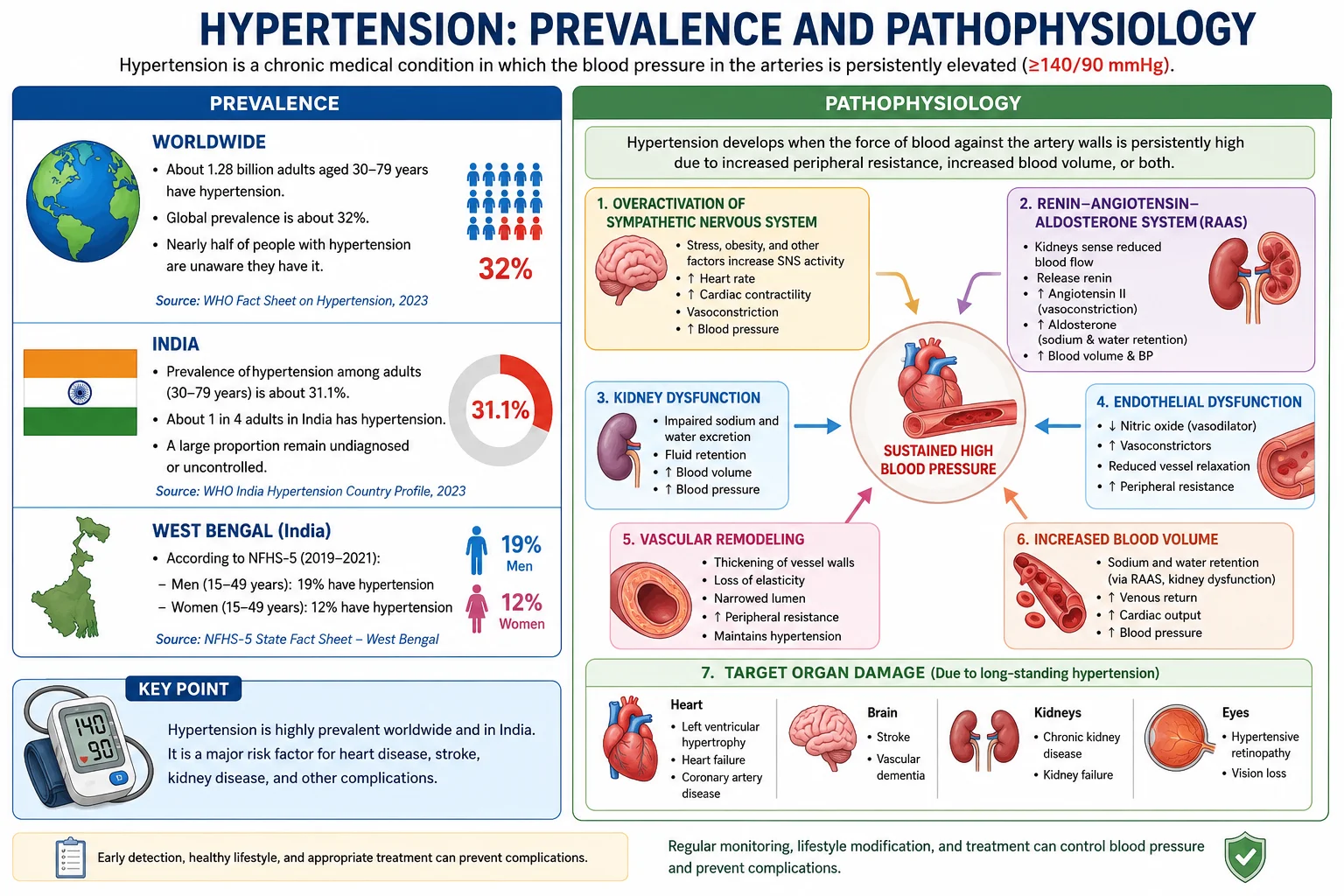
Hypertension, commonly known as high blood pressure, is one of the most widespread chronic health conditions worldwide and a leading cause of preventable illness and death. It occurs when the force of blood against the walls of the arteries remains consistently higher than normal, placing extra strain on the heart and blood vessels. Often called the "silent killer," hypertension may not cause noticeable symptoms for many years while gradually damaging vital organs such as the heart, brain, kidneys, and eyes. If left untreated, it can lead to serious complications, including heart attack, stroke, heart failure, kidney disease, and vision loss. Fortunately, hypertension can be prevented, detected early through regular blood pressure checks, and effectively managed with healthy lifestyle changes and appropriate medications. Understanding its causes, risk factors, symptoms, diagnosis, treatment, and prevention is essential for maintaining healthy blood pressure and protecting long-term health.
Hypertension:
Hypertension is a chronic medical condition in which the blood pressure in the arteries remains consistently higher than normal. Over time, this increased pressure puts extra strain on the heart and blood vessels, increasing the risk of heart disease, stroke, kidney disease, and other complications.
According to current guidelines, hypertension is generally diagnosed when blood pressure is consistently ≥140/90 mmHg on repeated measurements in a clinical setting (or according to guideline-specific thresholds and measurement methods).
Prevalence of Hypertension
West Bengal
According to the National Family Health Survey (NFHS-5, 2019–2021):
Women (15–49 years): 12% have hypertension.
Men (15–49 years): 19% have hypertension.
India
The World Health Organization (WHO) estimates that 31.1% of adults aged 30–79 years in India have hypertension (age-standardized prevalence).
https://data.who.int/countries/356
WHO also notes that about one in four adults in India has hypertension, and only a small proportion have their blood pressure adequately controlled.
Worldwide
According to the World Health Organization (WHO):
Approximately 1.28 billion adults aged 30–79 years worldwide have hypertension.
About 32% of adults aged 30–79 years globally are living with hypertension.
Nearly half of people with hypertension are unaware they have the condition.
https://data.who.int/indicators/i/7DA4E68/608DE39?utm_source=chatgpt.com
Major references
https://www.who.int/news-room/fact-sheets/detail/hypertension?utm_source=chatgpt.com
WHO India Hypertension Country Profile
https://www.who.int/publications/m/item/hypertension-ind-2023-country-profile?utm_source=chatgpt.com
Pathophysiology of Hypertension
Hypertension develops when the force of blood flowing through the arteries remains persistently high because of increased resistance in the blood vessels and/or increased blood volume. Several body systems work together to cause and maintain high blood pressure.
1. Narrowing of blood vessels (increased peripheral resistance)
The small arteries (arterioles) become narrower and less elastic due to prolonged contraction and thickening of their walls. This increases resistance to blood flow, so the heart must pump with greater force, raising blood pressure.
2. Overactivation of the sympathetic nervous system
Stress, obesity, and genetic factors can increase the activity of the #sympathetic nervous system, causing:
Faster heart rate.
Stronger heart contractions.
Narrowing of blood vessels.
These changes increase blood pressure.
#Sympathetic nervous system (SNS) is a part of the autonomic nervous system that prepares the body for #"fight-or-flight" situations such as stress, fear, or danger.
#"Fight-or-flight" is the body's emergency response that prepares you to react quickly to danger by increasing heart rate, breathing, and blood pressure.
3. Activation of the Renin–Angiotensin–Aldosterone System (RAAS)
When the kidneys sense reduced blood flow, they release renin, which leads to the formation of angiotensin II.
Angiotensin II narrows blood vessels (vasoconstriction).
It also stimulates the release of #aldosterone, which causes the kidneys to retain sodium and water (reabsorbed from kidney tubules in the blood stream) that increases blood volume and so the narrowed blood vessels together with increased blood volume raise blood pressure.
#Aldosterone is a steroid hormone produced by the adrenal cortex (outer part of the adrenal glands). It acts on the kidneys to increase sodium (salt) reabsorption, increase water retention (water follows sodium), increase potassium excretion.These effects increase blood volume and raise blood pressure.
Reason of reduced blood flow to the kidneys:
The kidneys may sense reduced blood flow even when a person's blood pressure is normal or high because the blood reaching the kidneys is actually reduced or the kidneys mistakenly perceive it as reduced.
This can happen because:
Narrowing of the kidney arteries (renal artery stenosis) reduces blood flow to the kidneys.
Damage to the small blood vessels in the kidneys decreases blood supply.
In essential (primary) hypertension, the kidneys may have an abnormal ability to regulate sodium and blood flow, causing them to incorrectly activate the renin–angiotensin–aldosterone system (RAAS) even when blood pressure is already elevated.
4. Kidney dysfunction
The kidneys normally regulate blood pressure by removing excess sodium and water. If they cannot do this effectively, more fluid remains in the bloodstream, increasing blood volume and blood pressure.
5. Endothelial dysfunction
The endothelium (inner lining of blood vessels) normally produces nitric oxide (NO), which relaxes blood vessels. In hypertension, less nitric oxide is produced and more vasoconstricting substances are released, causing blood vessels to remain narrowed.
6. Vascular remodeling
Over time, persistently high blood pressure causes the walls of blood vessels to thicken and stiffen, making them less able to expand, so blood volume gives more pressure to the wall of the blood vessels and blood pressure rises. This further increases resistance and maintains hypertension.
7. Target organ damage
Why does long-standing hypertension damage different organs?
Long-term high blood pressure continuously puts excess pressure on blood vessel walls, causing them to become thickened, narrowed, stiff, and damaged. This reduces blood flow and oxygen delivery to vital organs, leading to target organ damage.
1. Heart
Left ventricular hypertrophy (LVH): The heart must pump against high pressure, so the left ventricle becomes thicker to generate more force.
Heart failure: Over time, the thickened heart muscle becomes stiff and eventually weak, making it unable to pump blood effectively.
Coronary artery disease: High blood pressure damages the coronary arteries, promoting atherosclerosis (plaque buildup) and reducing blood flow to the heart.
https://www.ncbi.nlm.nih.gov/books/NBK539800/?utm_source=chatgpt.com
2. Brain
Stroke: Damaged and narrowed brain arteries may become blocked by a clot or rupture, interrupting blood supply to the brain.
Vascular dementia: Long-term damage to the brain's small blood vessels reduces blood flow, leading to gradual loss of memory and thinking ability.
https://pubmed.ncbi.nlm.nih.gov/17016413/
3. Kidneys
Chronic kidney disease (CKD): High blood pressure damages the tiny filtering blood vessels (glomeruli) in the kidneys, reducing their ability to filter waste and excess fluid from the blood.
4. Eyes
Hypertensive retinopathy: High blood pressure damages the small blood vessels of the retina, causing narrowing, leakage, bleeding, and reduced blood supply, which can impair vision or even lead to vision loss.
https://pubmed.ncbi.nlm.nih.gov/17016413/
For the pathophysiology of hypertension, the following are authoritative and widely used references:
i). StatPearls – Essential Hypertension (NCBI Bookshelf)
This review explains the mechanisms of hypertension, including the roles of the sympathetic nervous system, renin–angiotensin–aldosterone system (RAAS), salt and water retention, increased peripheral vascular resistance, and target organ damage.
Essential Hypertension StatPearls NCBI Bookshelf
https://www.ncbi.nlm.nih.gov/books/NBK539859/?utm_source=chatgpt.com
ii). StatPearls – Elevated Blood Pressure (NCBI Bookshelf)
This resource discusses the pathogenesis of hypertension, including vascular inflammation, endothelial dysfunction, sympathetic overactivity, and kidney-mediated mechanisms.
Elevated Blood Pressure StatPearls NCBI Bookshelf
https://www.ncbi.nlm.nih.gov/sites/books/NBK538313/?utm_source=chatgpt.com
iii). World Health Organization (WHO) – Hypertension Fact Sheet
Provides an overview of hypertension, its causes, risk factors, complications, prevention, and global burden.
WHO Hypertension Fact Sheet
https://www.who.int/news-room/fact-sheets/detail/hypertension?utm_source=chatgpt.com