
For many decades, Type 2 diabetes mellitus was considered a disease that primarily affected middle-aged and older adults. The condition usually developed after years of unhealthy lifestyle habits, excess body weight, reduced physical activity, and the natural decline in insulin sensitivity that occurs with aging. Because these risk factors accumulate over time, the disease was rarely seen in children, adolescents, or young adults. As a result, Type 2 diabetes was commonly known as adult-onset diabetes. Understanding its traditional age pattern helps highlight how dramatically the disease is changing today, with an increasing number of younger people now being diagnosed worldwide.
Prevalence of Type 2 Diabetes mellitus
The following are the most reliable and widely cited estimates for Type 2 diabetes mellitus (most diabetes cases are Type 2).
Region | Prevalence | Research link |
|---|---|---|
West Bengal | 11.3% of adults (≥20 years) have diabetes according to the ICMR-INDIAB state estimates. | ICMR-INDIAB National Study (The Lancet Diabetes & Endocrinology) |
India | 11.4% of adults (approximately 101 million people) have diabetes. | ICMR-INDIAB National Study (The Lancet Diabetes & Endocrinology) |
Worldwide | Approximately 10.5% of adults aged 20–79 years (about 589 million people) are living with diabetes globally. Around 90–95% of these cases are Type 2 diabetes mellitus. |
Main research references
India and West Bengal
https://pubmed.ncbi.nlm.nih.gov/37301218/
https://diabetesatlas.org/?utm_source=chatgpt.com
These are the most authoritative and commonly cited sources for reporting diabetes prevalence in West Bengal, India, and globally.
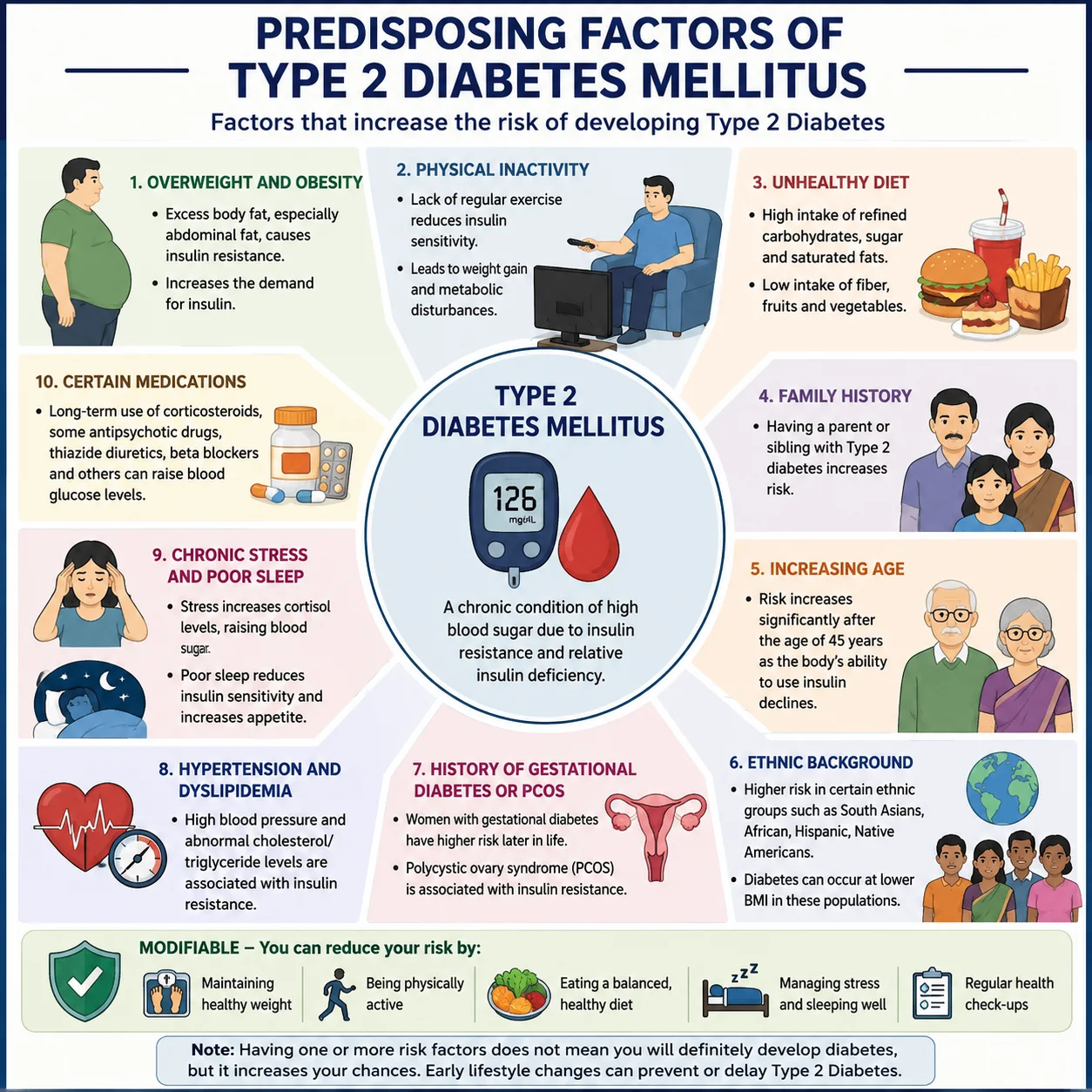
The major predisposing (risk) factors for Type 2 diabetes mellitus include:
1. Overweight and obesity, especially excess abdominal (belly) fat.
How does this happen?
Excess belly fat releases fatty acids and inflammatory chemicals (such as #TNF-α and IL-6) into the bloodstream> these substances interfere with the action of insulin>the pancreas initially produces more insulin to compensate>over time, the pancreas cannot keep up with the increased demand>blood glucose levels rise, leading to Type 2 diabetes mellitus.
#TNF-α (Tumor Necrosis Factor-alpha): An inflammatory protein (cytokine) released by immune cells that promotes inflammation and can reduce the body's response to insulin.
#IL-6 (Interleukin-6): An inflammatory protein (cytokine) produced by immune cells and other tissues that helps regulate inflammation. When present at high levels for a long time, it can contribute to insulin resistance.
Simple example
Imagine insulin is a key and your body's cells are locked doors.
In a healthy person, the key (insulin) easily opens the doors, allowing glucose to enter the cells.
In a person with excess belly fat, the locks become stiff and difficult to open (insulin resistance). Even though insulin is present, the doors do not open properly, so glucose stays in the blood instead of entering the cells.
Research link:
American Diabetes Association Understanding Type 2 Diabetes Risk Factors
https://www.heart.org/en/health-topics/diabetes/understand-your-risk-for-diabetes
https://nutritionsource.hsph.harvard.edu/obesity/
Why is belly fat more harmful than fat in other parts of the body?
Belly fat (especially the fat deep inside the abdomen around the organs, called visceral fat) is more harmful because it is more metabolically active than fat under the skin (subcutaneous fat).
It contributes to Type 2 diabetes in several ways:
It releases more free fatty acids into the bloodstream, which interfere with insulin action.
It produces more inflammatory chemicals (such as TNF-α and IL-6) that increase insulin resistance.
Because it surrounds organs like the liver, these substances reach the liver directly through the portal vein, causing the liver to produce more glucose even when it is not needed.
Fat under the skin (for example, in the hips, thighs, or arms) releases fewer of these harmful substances and is generally less strongly linked to insulin resistance.
Simple example
Imagine there are two fat stores:
Fat around your belly is like a factory that releases harmful chemicals all day, making it harder for insulin to work.
Fat around your hips or thighs is more like a storage warehouse, keeping fat stored with much less release of harmful substances.
Therefore, belly fat is much more likely to increase blood sugar and lead to Type 2 diabetes.
Research links:
Harvard T H Chan School of Public Health Belly Fat and Health Risks.
2. Physical inactivity or a sedentary lifestyle.
How does this happen?
Active muscles use glucose from blood stream for energy, helping lower blood glucose levels.
When you are inactive, muscles use much less glucose, so more glucose remains in the blood stream.
Over time, the muscles become less responsive to insulin (insulin resistance).
The pancreas has to produce more insulin to keep blood glucose normal.
Eventually, the pancreas cannot produce enough insulin, causing blood glucose levels to rise and increasing the risk of Type 2 diabetes mellitus.
Simple example
Suppose two people eat the same meal.
Person A goes for a 30-minute brisk walk.
Person B sits on the sofa watching television for several hours.
Person A's muscles use more glucose for energy, helping keep blood glucose lower. Person B's muscles use much less glucose, so more glucose remains in the blood. If this pattern continues for years, Person B has a higher risk of developing Type 2 diabetes mellitus.
Research links:
https://diabetes.org/health-wellness/fitness?utm_source=chatgpt.com
https://www.who.int/news-room/fact-sheets/detail/physical-activity?utm_source=chatgpt.com
3. Unhealthy diet, particularly one high in refined carbohydrates, sugary drinks, and processed foods.
How does this happen?
Refined carbohydrates (e.g., white bread, white rice, cakes, pastries) are digested quickly, causing a rapid rise in blood glucose.
Sugary drinks (e.g., soft drinks, sweetened fruit juices, energy drinks) contain large amounts of sugar that are absorbed rapidly, causing frequent blood glucose spikes.
Processed foods are often high in refined starch, added sugars, unhealthy fats, and calories, promoting weight gain and increasing belly fat.
Over time:
The pancreas must produce more insulin to control the repeated blood glucose spikes.
The body's cells gradually become less responsive to insulin (insulin resistance).
The pancreas can no longer produce enough insulin to overcome this resistance.
Blood glucose levels remain high, leading to Type 2 diabetes mellitus.
Simple example
Suppose two people eat differently every day.
Person A usually eats whole grains, vegetables, fruits, and legumes.
Person B frequently drinks sugary soft drinks and eats cakes, chips, burgers, and other processed foods.
Over several years, Person B is more likely to gain excess belly fat, develop insulin resistance, and eventually develop Type 2 diabetes mellitus.
Research links:
https://diabetes.org/food-nutrition?utm_source=chatgpt.com
https://www.who.int/news-room/fact-sheets/detail/healthy-diet?utm_source=chatgpt.com
4. Family history of Type 2 diabetes.
How does this happen?
Some people inherit genes that make their body's cells less sensitive to insulin (insulin resistance).
Others inherit genes that make the pancreatic beta cells less able to produce enough insulin.
If these genetic factors are combined with obesity, physical inactivity, or an unhealthy diet, the risk of developing Type 2 diabetes mellitus becomes much higher.
Simple example
Suppose two friends have the same lifestyle.
Person A has no family history of diabetes.
Person B has both parents with Type 2 diabetes.
Although both eat similar foods and exercise equally, Person B has a higher chance of developing Type 2 diabetes because they inherited genes that increase susceptibility to the disease.
Research links
American Diabetes Association Risk Factors for Type 2 Diabetes
https://www.heart.org/en/health-topics/diabetes/understand-your-risk-for-diabetes
Centers for Disease Control and Prevention Type 2 Diabetes Risk Factors
5. Increasing age, especially after 45 years (although it is now becoming more common in younger people).
Increasing age, especially after 45 years, increases the risk of Type 2 diabetes mellitus because the body's ability to use insulin and produce enough insulin gradually declines with age. In addition, many people become less physically active, gain weight, and accumulate more abdominal fat as they get older, which further increases the risk.
How does this happen?
The body's cells gradually become less sensitive to insulin (insulin resistance).
The pancreatic beta cells become less efficient at producing enough insulin.
Muscle mass often decreases with age, so the body uses less glucose from blood stream. So more glucose remains in the blood stream.
Many people become less physically active and gain excess belly fat, which further worsens insulin resistance.
These changes make it harder to keep blood glucose within the normal range, increasing the risk of Type 2 diabetes mellitus.
Simple example
Suppose two people eat the same healthy diet.
A 25-year-old usually uses insulin efficiently to keep blood glucose normal.
A 60-year-old may have reduced insulin sensitivity and lower insulin production. As a result, the same meal can lead to higher blood glucose levels, especially if they are inactive or overweight.
Research links
American Diabetes Association Risk Factors for Type 2 Diabetes
National Institute of Diabetes and Digestive and Kidney Diseases Risk Factors for Type 2 Diabetes
6. Prediabetes (higher-than-normal blood glucose levels).
Prediabetes is a condition in which blood glucose levels are higher than normal but not high enough to be diagnosed as Type 2 diabetes mellitus. It is a warning stage that indicates the body is beginning to have difficulty controlling blood glucose.
Who has prediabetes?
A person is considered to have prediabetes if any of the following are present:
Fasting blood glucose: 100–125 mg/dL (5.6–6.9 mmol/L)
HbA1c: 5.7%–6.4%
2-hour blood glucose after a 75-g oral glucose tolerance test: 140–199 mg/dL (7.8–11.0 mmol/L)
These values are recommended by the American Diabetes Association.
Why does prediabetes increase the risk of Type 2 diabetes?
Prediabetes develops because:
The body's cells have become less sensitive to insulin (insulin resistance).
The pancreas is producing extra insulin to keep blood glucose under control.
Over time, the pancreas cannot keep up with the increased demand for insulin.
Blood glucose levels continue to rise and eventually reach the diabetes range, leading to Type 2 diabetes mellitus.
Simple example
Suppose Mrs. A has a fasting blood glucose of 110 mg/dL.
This is higher than normal, so she has prediabetes.
Her pancreas is still producing enough insulin to prevent diabetes, but it has to work much harder.
If she does not improve her diet, exercise regularly, or lose excess weight, her pancreas may gradually become unable to keep up, and she may develop Type 2 diabetes mellitus.
Research links
American Diabetes Association Prediabetes Diagnosis and Prevention
https://diabetes.org/about-diabetes/prediabetes?utm_source=chatgpt.com
National Institute of Diabetes and Digestive and Kidney Diseases Prediabetes and Insulin Resistance
Centers for Disease Control and Prevention Prediabetes Information
https://www.cdc.gov/diabetes/diabetes-testing/index.html
7. High blood pressure (hypertension).
High blood pressure (hypertension) is a risk factor for Type 2 diabetes mellitus because it is often associated with insulin resistance, obesity, and chronic inflammation. These conditions reduce the body's ability to use insulin effectively, making it more likely that blood glucose levels will rise over time.
How does this happen?
People with high blood pressure often have insulin resistance, meaning their cells do not respond well to insulin.
High blood pressure is commonly linked with excess abdominal fat and physical inactivity, which further worsen insulin resistance.
Insulin resistance forces the pancreas to produce more insulin.
Over time, the pancreas cannot keep up with the increased demand, causing blood glucose levels to rise and leading to Type 2 diabetes mellitus.
Simple example
Suppose Mr. A has high blood pressure, is overweight, and rarely exercises.
His body's cells gradually become less responsive to insulin.
His pancreas has to work harder to produce more insulin.
After several years, his pancreas cannot produce enough insulin, and he develops Type 2 diabetes mellitus.
Research links
American Diabetes Association Risk Factors for Type 2 Diabetes
National Institute of Diabetes and Digestive and Kidney Diseases Risk Factors for Type 2 Diabetes
American Heart Association High Blood Pressure and Diabetes
https://pmc.ncbi.nlm.nih.gov/articles/PMC6201457/
8. Abnormal blood lipid levels, such as high triglycerides or low HDL ("good") cholesterol.
How does this happen?
High triglycerides cause excess fat to accumulate in the liver and muscles.
This fat interferes with the action of insulin, making the body's cells less responsive to insulin (insulin resistance).
Low HDL cholesterol is associated with poor fat metabolism and is another marker of insulin resistance.
Over time, the pancreas has to produce more insulin to keep blood glucose normal.
Eventually, the pancreas cannot keep up, causing blood glucose levels to rise and leading to Type 2 diabetes mellitus.
Simple example
Suppose Mr. A has:
High triglycerides
Low HDL cholesterol
Excess belly fat
Fat gradually builds up in his liver and muscles, making it difficult for insulin to work properly. His pancreas has to produce more insulin, and after several years, he develops Type 2 diabetes mellitus.
Research links
American Diabetes Association Risk Factors for Type 2 Diabetes
National Institute of Diabetes and Digestive and Kidney Diseases Insulin Resistance and Prediabetes
American Heart Association Cholesterol Triglycerides and Heart Health
https://newsroom.heart.org/news/accaha-issue-updated-guideline-for-managing-lipids-cholesterol
My question: How does liver fat interfere with insulin?
The liver does not produce insulin. Insulin is produced by the beta cells of the pancreas. The liver's role is different—it responds to insulin.
In Normal situation
After you eat:
The pancreas releases insulin.
Insulin tells the liver, "Stop making glucose. There is already enough glucose in the blood."
The liver obeys and slows down glucose production.
When excess fat accumulates in the liver
Fat inside liver cells makes the liver less responsive to insulin (this is called hepatic insulin resistance).
As a result:
Insulin still sends the signal: "Stop making glucose."
But the fatty liver doesn't respond properly.
The liver continues to produce and release glucose into the bloodstream, even when blood glucose is already high.
This causes blood glucose levels to rise further.
Simple example
Imagine the pancreas is a teacher and the liver is a student.
The teacher says, "Stop writing."
A healthy student hears the instruction and stops.
But a distracted student (a fatty liver) doesn't listen and keeps writing.
Similarly, a fatty liver doesn't respond properly to insulin's instruction and keeps releasing glucose into the blood.
Research links
diabetes-org.translate.goog/about-diabetes/type-2?_x_tr_sl=en&_x_tr_tl=bn&_x_tr_hl=bn&_x_tr_pto=sc
My question: How does the high HDL help not to increase the risk of developing Type 2 Diabetes mellitus?
How does this happen?
HDL cholesterol helps remove excess cholesterol and fats from tissues and carries them back to the liver for removal (called reverse cholesterol transport).
When HDL is low, fat is removed from tissues less efficiently.
As a result, more fat accumulates in the liver and muscles.
This excess fat makes these tissues less responsive to insulin (insulin resistance).
Insulin resistance increases the risk of developing Type 2 diabetes mellitus.
Simple example
Imagine HDL is a garbage truck.
A healthy number of garbage trucks remove excess fat from the body's tissues.
If there are too few garbage trucks (low HDL), more fat is left behind in the liver and muscles.
This extra fat makes it harder for insulin to work properly, increasing blood glucose levels over time.
Note: Low HDL itself is not the direct cause of diabetes. It is a marker of unhealthy fat metabolism and insulin resistance, which increase the risk of Type 2 diabetes.
Research links
American Heart Association HDL Good Cholesterol
https://www.heart.org/en/health-topics/cholesterol/hdl-good-ldl-bad-cholesterol-and-triglycerides
American Diabetes Association Risk Factors for Type 2 Diabetes
https://www.heart.org/en/health-topics/diabetes/understand-your-risk-for-diabetes
9. History of gestational diabetes or giving birth to a baby weighing more than 4 kg (≈9 lb).
A history of gestational diabetes mellitus (GDM) or giving birth to a baby weighing more than 4 kg (≈9 lb) increases the risk of developing Type 2 diabetes mellitus later in life because it suggests that the mother's body already had difficulty producing enough insulin to overcome insulin resistance during pregnancy.
How does this happen?
During pregnancy, hormones produced by the placenta naturally make the mother's body less sensitive to insulin (insulin resistance).
Most women compensate by producing more insulin.
In women with gestational diabetes, the pancreas cannot produce enough insulin to overcome this insulin resistance, causing blood glucose levels to rise.
Although blood glucose often returns to normal after delivery, the underlying tendency toward insulin resistance and reduced pancreatic beta-cell function usually remains.
Over the following years, this increases the risk of developing Type 2 diabetes mellitus.
My question: Why does giving birth to a baby weighing more than 4 kg increase the risk?
High maternal blood glucose during pregnancy crosses the placenta.
The baby responds by producing more insulin.
Insulin acts as a growth hormone in the fetus, leading to excessive growth (macrosomia, birth weight >4 kg).
Therefore, delivering a large baby often indicates that the mother had high blood glucose during pregnancy, even if gestational diabetes was not formally diagnosed.
These mothers have a higher likelihood of developing Type 2 diabetes mellitus later in life.
Simple example
Suppose Mrs. A develops gestational diabetes during pregnancy.
Her pancreas cannot produce enough insulin to control blood glucose.
After delivery, her blood glucose returns to normal.
However, the underlying insulin resistance remains.
Five to ten years later, she develops Type 2 diabetes mellitus.
Research links
American Diabetes Association Gestational Diabetes
https://diabetes.org/living-with-diabetes/pregnancy/gestational-diabetes
Centers for Disease Control and Prevention Gestational Diabetes
https://www.cdc.gov/diabetes/about/gestational-diabetes.html?utm_source=chatgpt.com
My another question: Why does the mother's blood glucose level remain high during pregnancy?
Answer: The placenta produces hormones such as:
Human placental lactogen (hPL)
Progesterone
Estrogen
Cortisol
Placental growth hormone
These hormones reduce the effectiveness of insulin so that more glucose stays in the mother's bloodstream.
This is actually beneficial for the baby, because glucose can cross the placenta and provide energy for fetal growth.
Normally, the pancreas compensates by producing 2–3 times more insulin.
If the pancreas cannot produce enough extra insulin, blood glucose rises, resulting in gestational diabetes mellitus (GDM).
Simple example
Think of insulin as a key that helps glucose enter the mother's cells.
Before pregnancy: The key works well, so glucose enters the cells easily.
During pregnancy: Pregnancy hormones make the lock harder to open (insulin resistance).
The pancreas must make more keys (insulin).
If it cannot make enough keys, glucose stays in the blood, causing gestational diabetes.
Research links
American Diabetes Association Gestational Diabetes
https://diabetes.org/living-with-diabetes/pregnancy/gestational-diabetes
10. Polycystic ovary syndrome (PCOS) in women.
How does this happen?
Women with PCOS often have insulin resistance, even if they are not overweight.
Reason: Researchers believe that in many women with PCOS the muscle, liver, and fat cells have an inherited defect in insulin signaling (Insulin signaling is the process by which insulin sends a message to the body's cells to take up glucose from the blood and use it for energy or store it for later use.) Insulin is present, but these cells do not respond normally to it.
Because insulin is less effective, the pancreas produces more insulin (hyperinsulinemia).
High insulin levels can promote weight gain, especially around the abdomen, which further worsens insulin resistance.
Over time, the pancreatic beta cells become unable to keep up with the increased insulin demand.
Blood glucose levels rise, leading to Type 2 diabetes mellitus.
Simple example
Suppose Mrs. A has PCOS.
Her body's cells do not respond well to insulin.
Her pancreas works harder and produces extra insulin.
After several years, her pancreas cannot produce enough insulin to overcome the resistance.
As a result, her blood glucose remains high, and she develops Type 2 diabetes mellitus.
Research links
Centers for Disease Control and Prevention Diabetes and Polycystic Ovary Syndrome
https://www.monash.edu/medicine/mchri/pcos/guideline?utm_source=chatgpt.com
National Institute of Child Health and Human Development Polycystic Ovary Syndrome
American Diabetes Association Risk Factors for Type 2 Diabetes
https://www.niddk.nih.gov/health-information/diabetes/overview/risk-factors-type-2-diabetes
11. Smoking.
Smoking increases the risk of Type 2 diabetes mellitus because the chemicals in cigarette smoke make the body's cells less responsive to insulin (insulin resistance), increase inflammation and oxidative stress, and impair the function of pancreatic beta cells that produce insulin.
How does this happen?
Nicotine and other harmful chemicals reduce the body's sensitivity to insulin, making it harder for glucose to enter the cells.
Smoking increases chronic inflammation and #oxidative stress, which further interfere with insulin action.
It can damage pancreatic beta cells, reducing their ability to produce enough insulin over time.
Smoking also promotes abdominal (belly) fat accumulation, which further worsens insulin resistance.
Over time, these changes cause blood glucose levels to rise, increasing the risk of Type 2 diabetes mellitus.
Simple example
Suppose Mr. A smokes one pack of cigarettes every day.
The nicotine and other chemicals make his muscle and liver cells less responsive to insulin.
His pancreas has to produce more insulin to keep blood glucose normal.
After several years, the pancreas cannot keep up with the increased demand.
His blood glucose remains high, and he develops Type 2 diabetes mellitus.
Research links
https://www.cdc.gov/tobacco/campaign/tips/diseases/diabetes.html?utm_source=chatgpt.com
https://diabetes.org/health-wellness/smoking-and-diabetes?utm_source=chatgpt.com
World Health Organization Tobacco and Diabetes
#Oxidative stress is a condition in which harmful #free radicals become more numerous than the body's #antioxidants can remove, causing damage to the body's cells.
#Antioxidants are protective substances that neutralize harmful free radicals and help prevent damage to the body's cells.
#Free radicals are highly unstable molecules that can damage the body's cells, proteins, and DNA. They are produced naturally during normal metabolism, but they also increase due to smoking, air pollution, radiation, infections, and unhealthy die
#Chronic inflammation: Smoking increases chronic inflammation means that smoking keeps the body's immune system mildly activated for a long time, causing continuous low-level inflammation that can gradually damage tissues and organs.
12. Excessive alcohol consumption.
How does this happen?
Excess alcohol promotes weight gain, especially around the abdomen, which increases insulin resistance.
It causes fat to accumulate in the liver (fatty liver), making the liver less responsive to insulin. As a result, the liver continues to release glucose into the bloodstream even when it is not needed.
Heavy alcohol use can damage the pancreatic beta cells, reducing their ability to produce insulin.
Alcohol also increases inflammation and oxidative stress, which further reduce insulin sensitivity.
Simple example
Suppose Mr. A drinks large amounts of alcohol every day.
He gradually develops belly fat and fatty liver.
His liver and muscles become less responsive to insulin.
His pancreas has to produce more insulin, but over time it cannot keep up.
His blood glucose levels remain high, and he develops Type 2 diabetes mellitus.
Research links
National Institute on Alcohol Abuse and Alcoholism Alcohol and Health
American Diabetes Association Alcohol and Diabetes
https://www.who.int/news-room/fact-sheets/detail/alcohol?utm_source=chatgpt.com
13. Chronic stress and poor sleep quality.
How does chronic stress cause Type 2 diabetes?
During long-term stress, the body releases more cortisol and adrenaline.
These hormones tell the liver to release more glucose into the bloodstream so the body has extra energy for a "fight-or-flight" situation.
If stress continues for a long time, blood glucose remains higher than normal.
At the same time, body cells become less responsive to insulin (insulin resistance).
Over time, this can lead to Type 2 diabetes mellitus.
How does poor sleep quality cause Type 2 diabetes?
Too little or poor-quality sleep increases cortisol levels and reduces insulin sensitivity.
It also increases hunger hormones, making people more likely to overeat and gain weight.
Weight gain, especially around the abdomen, further increases insulin resistance.
As a result, blood glucose becomes harder to control.
Simple example
Suppose Mrs. A sleeps only 5 hours each night and experiences work-related stress every day.
Her body releases more cortisol, causing the liver to release extra glucose.
Her cells become less responsive to insulin.
She also feels hungrier, gains belly fat, and becomes less active.
After several years, she develops Type 2 diabetes mellitus.
Research links
Centers for Disease Control and Prevention Sleep and Diabetes
https://www.cdc.gov/diabetes/php/toolkits/new-beginnings-sleep-health.html
American Diabetes Association Stress and Diabetes
https://diabetes.org/health-wellness/mental-health
14. Certain ethnic backgrounds, including South Asians, who have a higher risk at lower body mass index (BMI).
Certain ethnic groups, especially South Asians (including Indians, Bangladeshis, Pakistanis, and Sri Lankans), have a higher risk of developing Type 2 diabetes mellitus even at a lower BMI because they are genetically more likely to develop insulin resistance and accumulate excess fat around internal organs (visceral fat), even if they do not appear overweight.
How does this happen?
South Asians tend to store more fat around the liver, pancreas, and abdominal organs rather than under the skin.
This visceral fat releases substances that make the body's cells less responsive to insulin (insulin resistance).
South Asians also tend to have less muscle mass than many other populations at the same BMI. Since muscles use glucose, having less muscle means less glucose is removed from the blood.
In addition, inherited genetic factors make their pancreatic beta cells less able to compensate for insulin resistance.
As a result, they can develop Type 2 diabetes mellitus at a lower BMI than many other ethnic groups.
Simple example
Suppose Mr. A (European) and Mr. B (South Asian) both have a BMI of 23 kg/m², which is considered normal.
Mr. A stores less fat around his internal organs.
Mr. B stores more visceral fat around his liver and pancreas, even though he looks slim.
This visceral fat causes insulin resistance, so Mr. B has a higher risk of developing Type 2 diabetes mellitus despite having the same BMI.
Research links
World Health Organization Appropriate Body Mass Index for Asian Populations
https://pubmed.ncbi.nlm.nih.gov/14726171/
https://idf.org/about-diabetes/diabetes-facts-figures/?utm_source=chatgpt.com
15. Certain medications, such as long-term corticosteroids and some antipsychotic drugs.
Certain medications, especially long-term corticosteroids (such as prednisolone and dexamethasone) and some antipsychotic drugs (such as olanzapine and clozapine), can increase the risk of Type 2 diabetes mellitus because they raise blood glucose levels, increase insulin resistance, and may reduce the body's ability to produce or use insulin effectively.
i). How do corticosteroids cause Type 2 diabetes?
Corticosteroids make the liver produce more glucose.
They reduce the ability of muscle and fat cells to respond to insulin (insulin resistance).
They can also increase appetite, leading to weight gain, especially around the abdomen.
Over time, the pancreas may not be able to produce enough insulin to overcome the increased insulin resistance.
Simple example
Suppose Mr. A takes prednisolone for several months to treat an autoimmune disease.
His liver starts releasing more glucose into the blood.
His muscles become less responsive to insulin.
He gains belly fat.
After several months, his blood glucose remains high, and he develops Type 2 diabetes mellitus.
ii). How do some antipsychotic drugs cause Type 2 diabetes?
Some antipsychotics (especially olanzapine and clozapine) increase appetite, causing people to eat more.
They often lead to weight gain, particularly abdominal fat.
They also reduce insulin sensitivity, making it harder for glucose to enter the cells.
In some people, they may also impair the function of pancreatic beta cells, reducing insulin secretion.
Simple example
Suppose Mrs. B starts taking olanzapine.
She becomes hungrier and gains weight.
Her body's cells become less responsive to insulin.
Her pancreas has to produce more insulin.
Over time, her blood glucose rises, and she develops Type 2 diabetes mellitus.
Research links
National Institute of Diabetes and Digestive and Kidney Diseases Diabetes Caused by Medicines
https://www.niddk.nih.gov/health-information/diabetes/overview/symptoms-causes
American Diabetes Association Medications That Affect Blood Glucose
https://diabetes.org/about-diabetes/high-blood-sugar
National Health Service Corticosteroids Side Effects
https://www.nhs.uk/medicines/steroids/
Main research references
American Diabetes Association Risk Factors for Type 2 Diabetes
https://www.who.int/news-room/fact-sheets/detail/diabetes?utm_source=chatgpt.com
International Diabetes Federation Diabetes Atlas
https://diabetesatlas.org/?utm_source=chatgpt.com
These are the major, evidence-based risk factors recognized by international diabetes guidelines.