
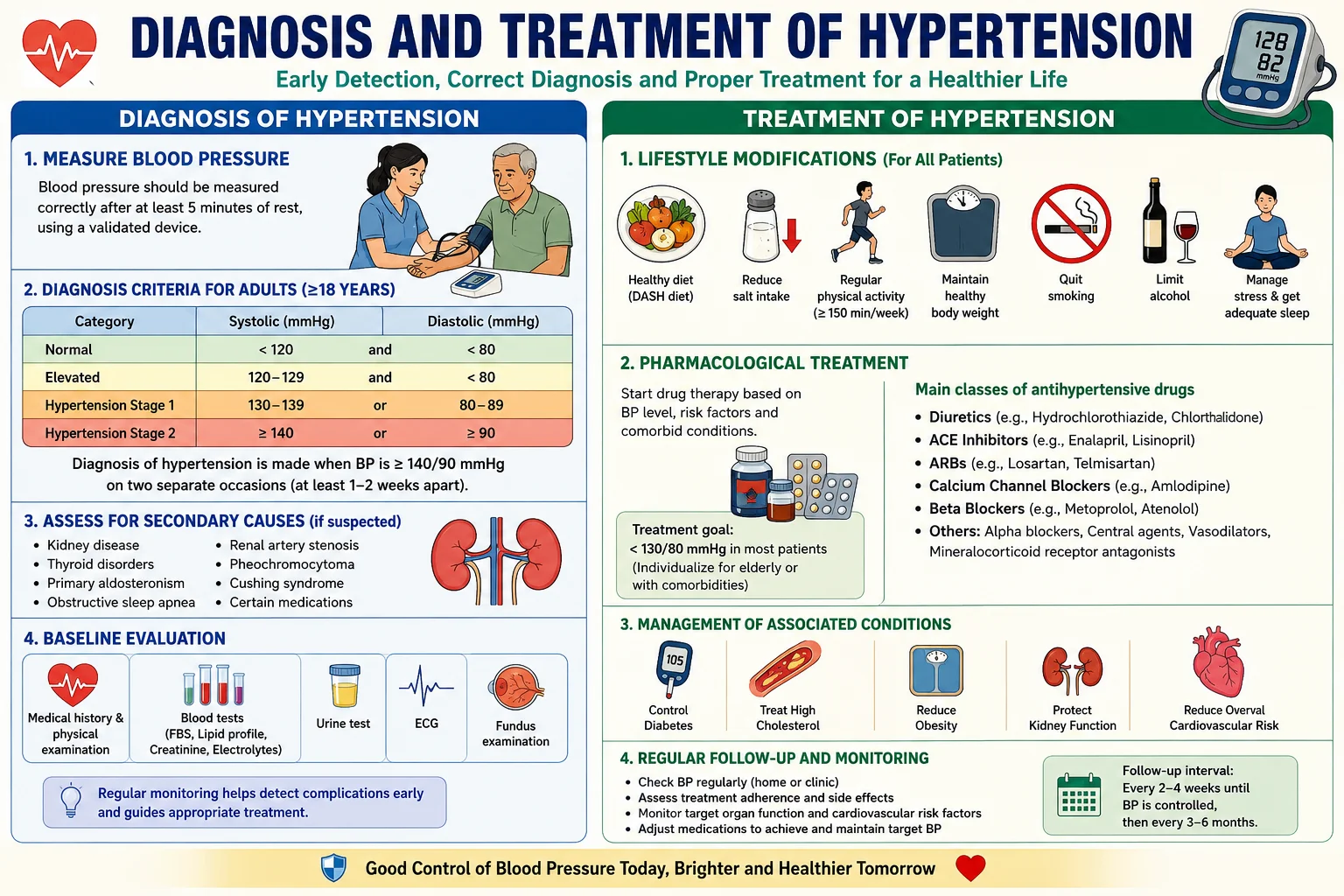
Hypertension is a common but manageable condition that, if left untreated, can silently damage the heart, brain, kidneys, eyes, and blood vessels. Fortunately, effective treatment and long-term management can significantly reduce the risk of these serious complications. Successful blood pressure control involves a combination of healthy lifestyle modifications, regular blood pressure monitoring, prescribed medications when needed, and consistent follow-up with healthcare providers. Early diagnosis, adherence to treatment, and maintaining healthy daily habits not only help keep blood pressure within the target range but also improve overall health, enhance quality of life, and lower the risk of heart attack, stroke, kidney disease, and premature death.How to Diagnose Hypertension
Hypertension is diagnosed primarily by measuring blood pressure with a validated blood pressure monitor. Because blood pressure can vary throughout the day, the diagnosis is not usually based on a single reading. Instead, repeated measurements taken on different occasions are used to confirm persistent elevation.
Tests and methods used to diagnose hypertension
1. Office (clinic) blood pressure measurement
Blood pressure is measured using a validated automatic or manual sphygmomanometer. It is the blood pressure reading taken by a healthcare professional during a visit to a clinic or hospital.
Hypertension is generally diagnosed if the average office blood pressure is ≥140/90 mmHg on two or more separate visits (unless blood pressure is severely elevated or there is evidence of hypertensive emergency).
At the first assessment, blood pressure should be measured in both arms.
If there is a difference between the two arms, the arm with the higher blood pressure should be used for future measurements.
During routine follow-up visits, blood pressure is usually measured in one arm (the arm that previously showed the higher reading).
Higher blood pressure reading in one arm may better reflect your true blood pressure, while the lower-reading arm may be affected by normal anatomical differences or narrowing of an artery. Using the higher-reading arm helps avoid underestimating blood pressure and reduces the chance of missing or undertreating hypertension. High blood pressure can contribute to artery narrowing over time, but if an artery supplying one arm is already narrowed (for example, by atherosclerosis in the subclavian artery), the blood pressure measured beyond that narrowing can actually be lower in that arm, because less blood pressure reaches the cuff.
For example:
Right arm: 150/90 mmHg
Left arm (with a narrowed artery): 130/80 mmHg
The person's true systemic blood pressure is closer to 150/90 mmHg, but the narrowed artery causes the cuff on the left arm to record a falsely lower pressure.
https://www.heart.org/en/health-topics/high-blood-pressure/understanding-blood-pressure-readings
2. Home Blood Pressure Monitoring (HBPM)
The patient measures blood pressure at home over several days using a validated monitor.
Average home blood pressure ≥135/85 mmHg suggests hypertension.
Home Blood Pressure Monitoring (HBPM) uses a validated automatic digital upper-arm blood pressure monitor (electronic sphygmomanometer). It consists of:
Inflatable upper-arm cuff
Digital monitor/display unit
Automatic air pump (built into the device)
Note: Upper-arm monitors are recommended over wrist or finger monitors because they are generally more accurate.
https://my.clevelandclinic.org/health/articles/24566-wrist-blood-pressure-monitor
3. 24-hour Ambulatory Blood Pressure Monitoring (ABPM)
It is a diagnostic test that tracks your blood pressure continuously over 24 hours as you go about your normal daily activities. You wear a small portable monitor on a belt or strap with a cuff attached to your arm, which takes readings every 15 to 30 minutes during the day and less frequently at night. It provides a highly accurate picture of your true blood pressure, eliminating #"white-coat hypertension" and #masked hypertension.
#White-coat hypertension
White-coat hypertension is when a person's blood pressure is high in the doctor's clinic but normal at home or during ambulatory monitoring. It is usually caused by anxiety or stress during the medical visit.
#Masked hypertension
Masked hypertension is the opposite condition. A person's blood pressure is normal in the doctor's clinic but high at home or during daily activities.
Hypertension is suggested by:
24-hour average: ≥130/80 mmHg
Daytime average: ≥135/85 mmHg
Night-time average: ≥120/70 mmHg
4. Additional tests after diagnosis
These tests help identify organ damage and possible causes of hypertension:
i). Urine analysis
Urine analysis does not diagnose hypertension. Instead, urine analysis is performed after or alongside the diagnosis to:
Detect kidney damage caused by long-standing hypertension (e.g., protein/albumin in the urine).
Identify kidney disease, which may be the underlying cause of secondary hypertension.
ii). Blood glucose or HbA1c
These tests are done because diabetes commonly coexists with hypertension and high blood glucose damages blood vessels, increasing the risk of hypertension and cardiovascular disease. Identifying diabetes helps guide treatment and reduce complications.
iii). Kidney function tests (serum creatinine, #eGFR)
#eGFR stands for estimated Glomerular Filtration Rate.
These tests help to:
Detect kidney disease, which can be a cause of secondary hypertension.
Identify kidney damage caused by long-standing hypertension.
Guide the choice and dosing of blood pressure medications. If kidney function is reduced (low eGFR or high creatinine), some medicines may need a lower dose, while others may need to be avoided or used with caution because they can worsen kidney function or accumulate in the body.
iv). Electrolytes (sodium, potassium)
Low potassium (hypokalemia) may suggest primary #hyperaldosteronism, a hormonal disorder that can cause secondary hypertension.
#Hyperaldosteronism (also called primary aldosteronism) is a condition in which the adrenal glands produce too much aldosterone, a hormone that regulates sodium, potassium, and blood pressure.
How does it cause hypertension?
Excess aldosterone causes the kidneys to retain sodium and water.
This increases blood volume, raising blood pressure.
At the same time, it causes the kidneys to excrete more potassium, leading to low blood potassium (hypokalemia).
Sodium and potassium levels are also checked before and during treatment because some blood pressure medicines (such as diuretics, #ACE inhibitors, and #ARBs) can change these electrolyte levels.
#ACE inhibitors
ACE inhibitors (Angiotensin-Converting Enzyme inhibitors) are medicines that block the formation of angiotensin II, a hormone that narrows blood vessels. As a result, blood vessels relax and widen, lowering blood pressure.
Examples: Enalapril, Lisinopril, Ramipril.
#ARBs
ARBs (Angiotensin II Receptor Blockers) are medicines that block the action of angiotensin II by preventing it from binding to its receptors on blood vessels. This also relaxes and widens blood vessels, lowering blood pressure.
Examples: Losartan, Valsartan, Telmisartan.
v). Lipid profile
Lipid profile does not diagnose hypertension directly. It measures cholesterol and triglyceride levels to assess cardiovascular risk.
People with hypertension often also have high cholesterol, which promotes atherosclerosis (narrowing and hardening of arteries) and increases the risk of heart attack and stroke. The results help doctors determine the need for cholesterol-lowering treatment and overall cardiovascular risk reduction.
vi). Electrocardiogram (ECG), and sometimes echocardiography
Electrocardiogram (ECG) and echocardiography do not diagnose hypertension directly. Instead, they help detect heart damage caused by long-standing hypertension.
ECG records the heart's electrical activity and can detect left ventricular hypertrophy (thickening of the heart muscle), heart rhythm abnormalities, or previous heart attack.
Echocardiography (heart ultrasound) provides a detailed image of the heart and can detect left ventricular hypertrophy, reduced pumping function, and other structural heart changes caused by hypertension.
Major guidelines
World Health Organization (WHO): Hypertension
https://www.who.int/news-room/fact-sheets/detail/hypertension
https://www.who.int/news-room/fact-sheets/detail/hypertension
2024 European Society of Cardiology (ESC) Guidelines for the Management of Elevated Blood Pressure and Hypertension
https://www.escardio.org/Guidelines/Clinical-Practice-Guidelines/Arterial-Hypertension2017 ACC/AHA Guideline for High Blood Pressure in Adults
https://www.ahajournals.org/doi/10.1161/HYP.0000000000000065
https://www.ahajournals.org/doi/10.1161/HYP.0000000000000065
Treatment of Hypertension
The treatment of hypertension aims to lower blood pressure to the target range, reduce the risk of heart attack, stroke, heart failure, kidney disease, and other complications, and improve overall health. Treatment usually combines healthy lifestyle modifications, regular blood pressure monitoring, and antihypertensive medications when lifestyle measures alone are not enough. Long-term follow-up and adherence to treatment are essential for effective blood pressure control.
Main components of hypertension treatment
1. Lifestyle modifications
Lifestyle modifications are healthy daily habits that help lower blood pressure naturally and reduce the risk of heart disease and stroke.
They include:
i). Maintain a healthy body weight.
ii). Follow a heart-healthy diet (such as the DASH diet).
iii). Reduce salt (sodium) intake.
iv). Increase potassium-rich foods (unless contraindicated because of kidney disease).
v). Exercise regularly (at least 150 minutes of moderate-intensity aerobic activity per week).
vi). Limit alcohol consumption or avoid it.
vii). Avoid smoking and all tobacco products.
viii). Manage stress through relaxation techniques, meditation, yoga, or deep breathing.
ix). Get adequate sleep (about 7–9 hours per night for most adults).
x). Limit prolonged sitting and stay physically active throughout the day.
These lifestyle measures are recommended for all people with hypertension, whether or not they require medication, because they improve blood pressure control and overall cardiovascular health.
https://www.who.int/news-room/fact-sheets/detail/hypertension
2. Antihypertensive medications
Antihypertensive medications are medicines used to lower high blood pressure (hypertension). They work by relaxing blood vessels, reducing the amount of fluid in the body, slowing the heart rate, or blocking hormones that raise blood pressure.
Main classes of antihypertensive medications
Diuretics (water pills) – Help the kidneys remove excess sodium and water.
Examples: Hydrochlorothiazide, Chlorthalidone, Indapamide.
ACE inhibitors (Angiotensin-Converting Enzyme inhibitors) – Reduce the formation of angiotensin II, relaxing blood vessels.
Examples: Enalapril, Lisinopril, Ramipril.
ARBs (Angiotensin II Receptor Blockers) – Block the action of angiotensin II on blood vessels.
Examples: Losartan, Valsartan, Telmisartan.
Calcium channel blockers (CCBs) – Relax the muscles of blood vessel walls.
Examples: Amlodipine, Nifedipine, Diltiazem.
Beta-blockers – Slow the heart rate and reduce the force of heart contractions.
Examples: Atenolol, Metoprolol, Bisoprolol.
Other medications (used in selected patients)
Alpha-blockers (e.g., Prazosin)
Central alpha-2 agonists (e.g., Clonidine, Methyldopa)
Direct vasodilators (e.g., Hydralazine, Minoxidil)
Mineralocorticoid receptor antagonists (e.g., Spironolactone, Eplerenone)
3. Regular blood pressure monitoring
https://www.heart.org/en/health-topics/high-blood-pressure/understanding-blood-pressure-readings
4. Treatment of underlying conditions (if secondary hypertension is present)
Secondary hypertension
Secondary hypertension is high blood pressure caused by an identifiable underlying disease or condition. Unlike primary (essential) hypertension, which has no single identifiable cause, secondary hypertension can often improve or resolve if the underlying condition is treated.
Conditions that should be treated
i). Kidney diseases (e.g., chronic kidney disease, glomerulonephritis)
ii). Primary hyperaldosteronism (excess aldosterone production)
iii). Renal artery stenosis (narrowing of the artery supplying the kidney)
iv). Pheochromocytoma (adrenal gland tumor producing excess adrenaline and noradrenaline)
v). Cushing syndrome (excess cortisol production)
vi). Thyroid disorders (hyperthyroidism or hypothyroidism)
vii). Obstructive sleep apnea
viii). Coarctation of the aorta (congenital narrowing of the aorta)
ix). Medication-induced hypertension (e.g., corticosteroids, NSAIDs, oral contraceptives, decongestants)
Difference between primary hypertension and secondary hypertension
Primary hypertension: High blood pressure without a single identifiable cause; it develops gradually and requires lifelong management.
Secondary hypertension: High blood pressure caused by another disease or medication; treating the underlying cause can often improve or resolve the hypertension.
5. Management of other cardiovascular risk factors (e.g., diabetes, high cholesterol, obesity)
Management of other cardiovascular risk factors (e.g., diabetes, high cholesterol, obesity): Diabetes, high cholesterol, and obesity damage blood vessels, increase arterial stiffness, and make the heart work harder, worsening hypertension and increasing the risk of heart attack, stroke, and kidney disease. Proper treatment of these conditions helps protect blood vessels, improve blood pressure control, and reduce cardiovascular complications.
https://www.who.int/news-room/fact-sheets/detail/hypertension
6. Regular follow-up and medication adjustment
Regular follow-up and medication adjustment: Regular follow-up helps ensure that blood pressure remains within the target range and allows early detection of side effects or complications. After starting or changing antihypertensive medication, follow-up is usually recommended every 2–4 weeks until blood pressure is controlled. Once blood pressure is stable and well controlled, follow-up is generally recommended every 3–6 months, or more frequently if other medical conditions are present.
Medication adjustment may include increasing or decreasing the dose, adding another antihypertensive medicine, switching to a different drug if side effects occur, or reducing medication when blood pressure is consistently well controlled, depending on the patient's blood pressure readings, kidney function, and overall health.
7. Patient education and adherence to treatment
Patient education and adherence to treatment: Patients should be educated about the nature of hypertension, the importance of taking medications exactly as prescribed, regularly monitoring blood pressure, following a healthy lifestyle (DASH diet, reduced salt intake, regular exercise, maintaining a healthy weight, avoiding smoking, limiting alcohol, managing stress, and getting adequate sleep, recognizing possible medication side effects, attending regular follow-up appointments, and never stopping or changing medications without consulting a healthcare provider. Good adherence to these recommendations helps achieve long-term blood pressure control and reduces the risk of heart attack, stroke, kidney disease, and other complications.