
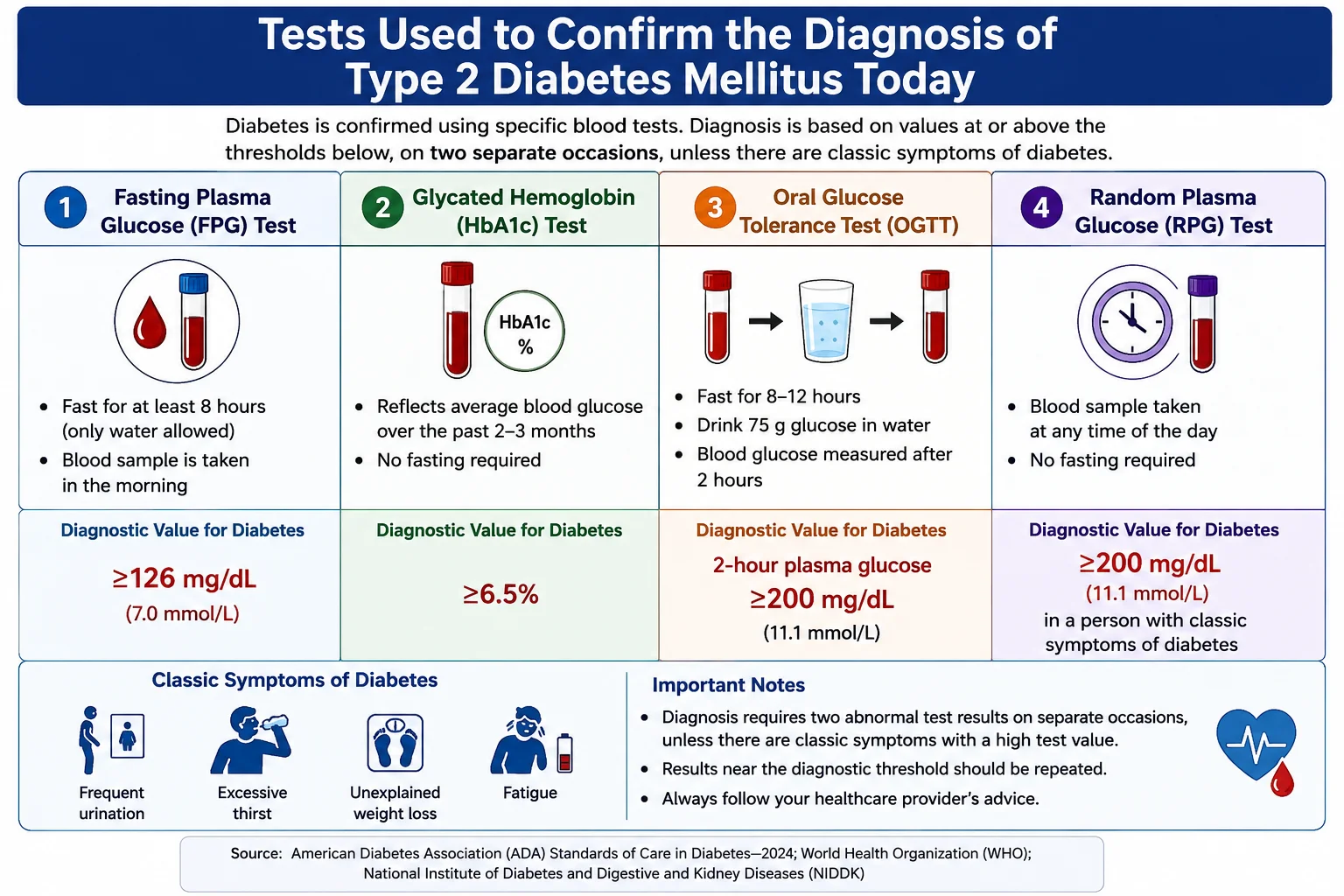
Diagnosing type 2 diabetes mellitus requires blood tests that measure how well the body regulates glucose. While symptoms such as increased thirst, frequent urination, fatigue, and unexplained weight loss may raise suspicion, a diagnosis cannot be confirmed based on symptoms alone. Healthcare professionals use specific laboratory tests, including the fasting plasma glucose (FPG) test, glycated hemoglobin (HbA1c) test, oral glucose tolerance test (OGTT), and, in certain situations, the random plasma glucose test, to accurately diagnose diabetes. Early confirmation through these tests allows timely treatment, better blood glucose control, and helps prevent serious long-term complications affecting the heart, kidneys, eyes, nerves, and blood vessels.
The four main tests used to diagnose type 2 diabetes mellitus are:
1. Fasting Plasma Glucose (FPG) Test
Measures blood glucose after fasting for at least 8 hours.
Diabetes: ≥126 mg/dL (7.0 mmol/L) on two separate occasions (unless there are unequivocal symptoms).
The Fasting Plasma Glucose (FPG) test is repeated on two separate occasions to make sure the high blood glucose result is real and persistent, not a temporary increase.
Why is the test repeated?
A person's blood glucose can temporarily rise because of:
Acute illness (such as fever or infection)
Severe physical or emotional stress
Certain medications (e.g., corticosteroids)
Recent surgery or injury
Laboratory or sample collection errors
Repeating the test on another day confirms that the high blood glucose is due to diabetes rather than one of these temporary factors.
Why is a repeat test not always needed?
If a person has classic symptoms of diabetes (such as frequent urination, excessive thirst, unexplained weight loss) or a hyperglycemic crisis, and has a clearly elevated blood glucose level, the diagnosis is considered sufficiently certain, so a repeat test is usually not necessary.
Example
Person A: Has no symptoms but a fasting blood glucose of 130 mg/dL. The doctor repeats the test on another day. If the second result is also ≥126 mg/dL, diabetes is confirmed.
Person B: Has frequent urination, excessive thirst, unexplained weight loss, and a random blood glucose of 250 mg/dL. Because the person has classic symptoms plus a markedly elevated blood glucose, diabetes can usually be diagnosed without waiting for a repeat test.
Study links:
American Diabetes Association. Standards of Care in Diabetes: https://diabetesjournals.org/care
https://diabetesjournals.org/care
National Institute of Diabetes and Digestive and Kidney Diseases (NIDDK): https://www.niddk.nih.gov/health-information/diabetes/overview/tests-diagnosis
https://www.niddk.nih.gov/health-information/diabetes/overview/tests-diagnosis
My question: What will be the interval between 2 occasions of FPG tests?
Answer: There is no fixed time interval that must separate the two tests. The key requirement is that they are performed on two different days, after the temporary causes of high blood glucose have resolved.
In practice:
Usually within a few days to 1–2 weeks if the person is otherwise well.
Sooner if the doctor strongly suspects diabetes.
Later if the first high result may have been caused by an acute illness, surgery, severe stress, or medications. The repeat test is done after these factors have resolved.
Example
Monday: Fasting Plasma Glucose = 132 mg/dL
Thursday (3 days later): Fasting Plasma Glucose = 128 mg/dL
Since both results are ≥126 mg/dL on different days, the diagnosis of diabetes is confirmed.
Why "different days" instead of the same day?
Repeating the test on a different day helps ensure that the elevated blood glucose is persistent, which is the hallmark of diabetes, rather than a temporary fluctuation caused by illness, stress, medications, or laboratory error.
According to the American Diabetes Association (ADA), in the absence of unequivocal hyperglycemia or classic symptoms, diagnosis requires two abnormal test results, either:
the same test repeated on a different day (e.g., two FPG tests ≥126 mg/dL), or
two different diagnostic tests that are both abnormal (e.g., FPG ≥126 mg/dL and HbA1c ≥6.5%).
Study links:
American Diabetes Association. Standards of Care in Diabetes: https://diabetesjournals.org/care
National Institute of Diabetes and Digestive and Kidney Diseases (NIDDK): https://www.niddk.nih.gov/health-information/diabetes/overview/tests-diagnosis
2. Glycated Hemoglobin (HbA1c) Test
Measures the average blood glucose over the previous 2–3 months. Diabetes: HbA1c ≥6.5%.
HbA1c (Hemoglobin A1c) is a blood test that measures the average blood glucose level over the previous 2–3 months.
Why is it called HbA1c?
Hb = Hemoglobin, the oxygen-carrying protein inside red blood cells.
A1c = A specific form of hemoglobin that has glucose attached to it (also called glycated hemoglobin).
When blood glucose is high, more glucose sticks to hemoglobin. Since red blood cells live for about 120 days (4 months), the HbA1c level reflects the average blood glucose over the past 2–3 months.
Therefore,
HbA1c is a blood test that shows how well a person's blood glucose has been controlled over the last 2–3 months, rather than at a single point in time.
HbA1c values
HbA1c (%) | Interpretation |
|---|---|
Below 5.7% | Normal |
5.7–6.4% | Prediabetes |
6.5% or higher | Diabetes (confirmed by repeat testing or another diagnostic test if appropriate) |
Example
A person's blood glucose may be normal on the morning of a test because they have been fasting. However, if their blood glucose has been high for the past three months, their HbA1c will still be elevated, helping the doctor diagnose diabetes.
Study links:
American Diabetes Association. Standards of Care in Diabetes: https://diabetesjournals.org/care
National Institute of Diabetes and Digestive and Kidney Diseases (NIDDK): https://www.niddk.nih.gov/health-information/diagnostic-tests/a1c-test
https://www.niddk.nih.gov/health-information/diagnostic-tests/a1c-test
Centers for Disease Control and Prevention (CDC): https://www.cdc.gov/diabetes/diabetes-testing/prediabetes-a1c-test.html
https://www.cdc.gov/diabetes/diabetes-testing/prediabetes-a1c-test.html
3. Oral Glucose Tolerance Test (OGTT)
Blood glucose is measured after fasting, then again 2 hours after drinking a 75 g glucose solution.
Diabetes: 2-hour plasma glucose ≥200 mg/dL (11.1 mmol/L).
My question: What is the difference between OGTT and Postprandial blood sugar (PPBS) test?
Answer: The Oral Glucose Tolerance Test (OGTT) and the Postprandial Blood Sugar (PPBS) test are not the same, although both measure blood glucose 2 hours after glucose intake.
Oral Glucose Tolerance Test (OGTT) | Postprandial Blood Sugar (PPBS) |
|---|---|
Performed after an 8–12 hour fast | Usually performed 2 hours after a regular meal |
The person drinks a standard 75 g glucose solution | The person eats their usual meal |
#Blood glucose is measured before and 2 hours after the glucose drink | Blood glucose is measured 2 hours after starting the meal |
Used mainly to diagnose diabetes and prediabetes | Used mainly to monitor blood glucose control in people with diabetes |
Why are they different?
The OGTT uses a fixed amount of glucose (75 g), so everyone receives the same glucose load. This standardization makes it reliable for diagnosing diabetes.
The PPBS depends on what and how much a person eats, so the glucose load varies from person to person. Because of this variability, PPBS is not recommended as a standard diagnostic test for diabetes by major guidelines.
Example
OGTT: After fasting overnight, a person drinks 75 g of glucose dissolved in water. Blood glucose is checked 2 hours later. A value ≥200 mg/dL (11.1 mmol/L) indicates diabetes.
PPBS: A person eats breakfast (for example, rice, vegetables, and eggs), and blood glucose is measured 2 hours after the meal. The result helps assess blood glucose control but does not by itself diagnose diabetes.
Study links:
National Institute of Diabetes and Digestive and Kidney Diseases (NIDDK): https://www.niddk.nih.gov/health-information/diabetes/overview/tests-diagnosis
https://www.niddk.nih.gov/health-information/diabetes/overview/tests-diagnosis
American Diabetes Association. Standards of Care in Diabetes: https://diabetesjournals.org/care
My question: In OGTT why is the Blood glucose measured before and 2 hours after the glucose drink?
Answer: Blood glucose is measured before drinking the glucose solution to determine the person's fasting (baseline) blood glucose level. This provides a starting point against which the body's response to the glucose drink can be assessed.
Why is the fasting sample taken first?
a). Establishes the baseline blood glucose level
It shows the blood glucose level before any glucose is consumed.
b). Confirms that the person has fasted properly
Eating before the test would raise blood glucose and make the OGTT result unreliable.
c). Helps interpret the 2-hour result
Comparing the fasting level with the 2-hour level shows how effectively the body handles a glucose load.
In healthy individuals, insulin is released after drinking glucose, allowing blood glucose to return toward normal within 2 hours.
In people with diabetes, blood glucose remains abnormally high because insulin secretion is inadequate, insulin resistance is present, or both.
Example
A person arrives after fasting overnight.
Before the glucose drink: Fasting blood glucose = 95 mg/dL (baseline)
Drinks 75 g of glucose dissolved in water.
2 hours later: Blood glucose = 210 mg/dL
The fasting sample tells the doctor where the blood glucose started, and the 2-hour sample shows how well the body processed the glucose. Because the 2-hour value is ≥200 mg/dL, the result is consistent with diabetes.
Study links:
National Institute of Diabetes and Digestive and Kidney Diseases (NIDDK): https://www.niddk.nih.gov/health-information/diabetes/overview/tests-diagnosis
World Health Organization (WHO). Definition and diagnosis of diabetes mellitus and intermediate hyperglycaemia: https://iris.who.int/handle/10665/43588
https://iris.who.int/items/e6e9ee5a-cacf-4278-97be-c6a967f6520a
My another question: In PPBS, why is 2 hours counted at the starting of eating the meal? why not from the end of eating the meal?
Answer: The phrase "2 hours after starting the meal" often confuses people.
Here's the reason:
When a person starts eating, digestion begins immediately. As food enters the stomach and small intestine, carbohydrates begin to be broken down into glucose, which is absorbed into the bloodstream. Blood glucose starts rising within minutes of the first bite, not after the meal is finished.
Therefore, the 2-hour countdown begins from the first bite of the meal, not from the last bite.
Why not count from the end of the meal?
The time taken to finish a meal varies from person to person:
One person may finish in 10 minutes.
Another may take 30–40 minutes.
If the test were timed from the end of the meal, the results would not be standardized because some people would have had glucose entering their bloodstream much earlier than others.
By measuring 2 hours after the first bite, everyone is tested in a consistent way.
Example
Suppose Mr. Roy starts eating lunch at 1:00 PM and finishes at 1:20 PM.
Meal starts: 1:00 PM
Meal finishes: 1:20 PM
PPBS sample: 3:00 PM (2 hours after the first bite)
The blood sample is not taken at 3:20 PM because digestion and glucose absorption began as soon as he started eating.
Therefore,
The PPBS test is done 2 hours after the first bite of the meal because digestion and glucose absorption begin immediately after eating starts. This provides a standardized and accurate assessment of how the body handles the rise in blood glucose after a meal.
Study link:
American Diabetes Association. Standards of Care in Diabetes: https://diabetesjournals.org/care
https://diabetesjournals.org/care
4. Random Plasma Glucose (RPG) Test
Blood glucose is measured at any time of the day, regardless of when the person last ate.
Diabetes: ≥200 mg/dL (11.1 mmol/L) plus classic symptoms of diabetes (such as frequent urination, excessive thirst, unexplained weight loss, or hyperglycemic crisis).
Diagnostic criteria at a glance
Test | Diabetes Diagnostic Value |
|---|---|
Fasting Plasma Glucose (FPG) | ≥126 mg/dL (7.0 mmol/L) |
HbA1c | ≥6.5% |
2-hour OGTT | ≥200 mg/dL (11.1 mmol/L) |
Random Plasma Glucose (RPG) | ≥200 mg/dL (11.1 mmol/L) with classic symptoms |
Study links:
American Diabetes Association. Standards of Care in Diabetes: https://diabetesjournals.org/care
National Institute of Diabetes and Digestive and Kidney Diseases (NIDDK): https://www.niddk.nih.gov/health-information/diabetes/overview/tests-diagnosis
https://www.niddk.nih.gov/health-information/diabetes/overview/tests-diagnosis
World Health Organization (WHO): https://www.who.int/news-room/fact-sheets/detail/diabetes
https://www.who.int/news-room/fact-sheets/detail/diabetes
My last question: The 2-hour Oral Glucose Tolerance Test (OGTT) and the Random Plasma Glucose (RPG) both use ≥200 mg/dL (11.1 mmol/L) as the diagnostic threshold, but they are not considered equivalent tests- why?
Answer: They use the same glucose cutoff because research has shown that blood glucose levels at or above 200 mg/dL are strongly associated with diabetic complications, particularly diabetic retinopathy (damage to the retina).
Why is the diagnostic value the same?
Large population studies found that the risk of diabetic retinopathy increases markedly when:
the 2-hour plasma glucose during an OGTT reaches ≥200 mg/dL (11.1 mmol/L), and
a random plasma glucose is around ≥200 mg/dL (11.1 mmol/L) in a person with classic symptoms of diabetes.
For this reason, international organizations such as the American Diabetes Association (ADA) and the World Health Organization (WHO) adopted the same threshold.
Why is the RPG test only diagnostic when symptoms are present?
A random blood glucose can temporarily rise after:
a large meal,
severe stress,
an acute illness,
or certain medications.
Therefore, an RPG ≥200 mg/dL alone is not enough to diagnose diabetes in someone who has no symptoms.
However, if a person has classic symptoms (frequent urination, excessive thirst, unexplained weight loss) plus an RPG ≥200 mg/dL, the combination is highly suggestive of diabetes, so the diagnosis can usually be made without waiting for another test.
Example
OGTT: A fasting person drinks 75 g of glucose. Two hours later, the blood glucose is 205 mg/dL. This meets the diagnostic criterion for diabetes.
RPG: A person comes to the clinic with frequent urination, excessive thirst, and weight loss. Their random blood glucose is 220 mg/dL. Because they have classic symptoms plus RPG ≥200 mg/dL, diabetes can be diagnosed.
Therefore,
The 2-hour OGTT and RPG use the same cutoff (≥200 mg/dL) because this glucose level has been shown to indicate a high likelihood of diabetes and a significantly increased risk of diabetic complications. However, the RPG requires the presence of classic symptoms because it is not performed under standardized conditions.
Study links:
American Diabetes Association. Standards of Care in Diabetes: https://diabetesjournals.org/care
https://diabetesjournals.org/care
World Health Organization (WHO). Definition and diagnosis of diabetes mellitus and intermediate hyperglycaemia: https://iris.who.int/handle/10665/43588
https://iris.who.int/items/e6e9ee5a-cacf-4278-97be-c6a967f6520a
National Institute of Diabetes and Digestive and Kidney Diseases (NIDDK): https://www.niddk.nih.gov/health-information/diabetes/overview/tests-diagnosis
https://www.niddk.nih.gov/health-information/diabetes/overview/tests-diagnosis