
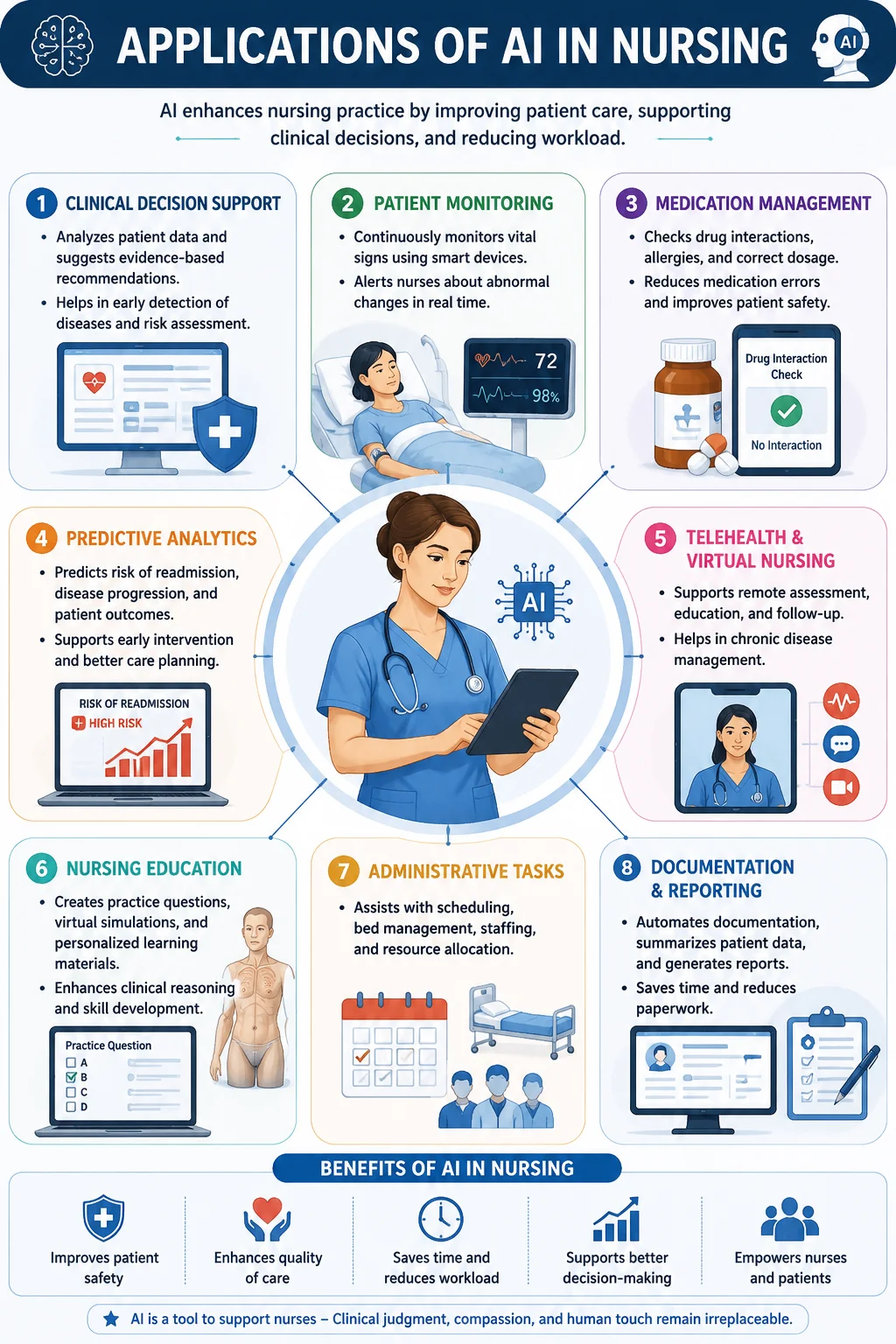
Artificial Intelligence (AI) in nursing refers to the use of computer systems that can analyze health data, support clinical decision-making, automate routine tasks, and improve patient care. AI is designed to assist nurses, not replace them, by reducing workload and helping them make informed decisions.
https://pmc.ncbi.nlm.nih.gov/articles/PMC6716553/?utm_source=chatgpt.com
Applications of AI in Nursing
1. Clinical decision support:
AI helps nurses identify patients at risk by continuously analyzing large amounts of patient data from electronic health records (EHRs), vital signs, laboratory reports, nursing assessments, and medical history. It compares the patient's condition with patterns learned from thousands of previous cases and alerts nurses when it detects a high risk of deterioration. This enables earlier assessment and intervention, improving patient safety.
i). Sepsis Risk Detection
How AI helps:
AI monitors changes in temperature, heart rate, respiratory rate, blood pressure, oxygen saturation, white blood cell count, and other laboratory results. If the combination of these changes suggests developing sepsis, it sends an early warning to the healthcare team.
Example:
A 68-year-old patient admitted with pneumonia develops:
Temperature: 39°C
Heart rate: 118 beats/min
Respiratory rate: 28 breaths/min
Blood pressure: 88/56 mmHg
White blood cell count: 18,000/µL
AI detects the pattern as high risk for sepsis and immediately alerts the nurse. The nurse promptly informs the physician, collects blood cultures, starts the sepsis protocol, administers intravenous fluids and antibiotics as prescribed, and closely monitors the patient's condition. Early intervention reduces the risk of septic shock.
ii). Fall Risk Prediction
How AI helps:
AI evaluates factors such as age, previous falls, medications (e.g., sedatives), dizziness, impaired mobility, confusion, visual impairment, and muscle weakness to estimate the patient's risk of falling.
Example:
An 80-year-old patient:
Has a history of two falls
Is receiving sleeping medication
Walks with a walker
Becomes confused at night
AI classifies the patient as high risk for falls. The nurse responds by:
Placing the patient in a room near the nursing station.
Activating the bed alarm.
Ensuring the call bell is within reach.
Assisting with toileting and ambulation.
Educating the patient and family about fall prevention.
These measures reduce the likelihood of injury.
iii). Pressure Injury (Pressure Ulcer) Risk Prediction
How AI helps:
AI analyzes mobility, nutritional status, skin condition, moisture, incontinence, age, body weight, and chronic diseases (e.g., diabetes) to identify patients likely to develop pressure injuries.
Example:
A 72-year-old patient:
Is bedridden after a stroke.
Has diabetes.
Is malnourished.
Has urinary incontinence.
AI identifies a high risk for pressure injury. The nurse:
Repositions the patient every two hours.
Uses a pressure-relieving mattress.
Keeps the skin clean and dry.
Provides nutritional support.
Inspects the skin daily.
These preventive measures help avoid pressure ulcers.
iv). Clinical Deterioration Detection
How AI helps:
AI continuously monitors vital signs and laboratory trends to recognize subtle signs that a patient's condition is worsening before obvious symptoms appear.
Example:
A patient recovering after surgery initially appears stable. Over several hours:
Oxygen saturation falls from 98% to 92%.
Respiratory rate increases from 18 to 26 breaths/min.
Heart rate rises from 82 to 110 beats/min.
Although each change alone seems minor, AI recognises the overall pattern as possible early respiratory deterioration and alerts the nurse. The nurse immediately assesses the patient, notifies the physician, provides oxygen as ordered, and initiates further investigations. Early treatment may prevent admission to the intensive care unit.
Summary
By analyzing patient data in real time, AI acts as an early warning system. It does not replace the nurse's clinical judgment but provides timely alerts that help nurses recognize risks earlier, prioritize care, and implement preventive interventions before serious complications develop.
Study references
https://jamanetwork.com/journals/jamanetworkopen/fullarticle/2753526#google_vignette
https://www.ahrq.gov/cpi/about/index.html?utm_source=chatgpt.com
2. Patient monitoring:
AI continuously collects and analyzes data from bedside monitors, wearable devices, and other medical equipment. It monitors vital signs such as heart rate, blood pressure, respiratory rate, body temperature, oxygen saturation (SpO₂), and sometimes electrocardiogram (ECG) readings. Instead of only checking whether a value is above or below a normal limit, AI also identifies trends and patterns that may indicate a patient's condition is worsening.
When AI detects an abnormality or predicts that a patient is likely to deteriorate, it immediately alerts the nurse or physician. This enables healthcare providers to assess the patient and intervene early before a serious complication develops.
i). Example:
Detecting Respiratory Deterioration
A 65-year-old patient is admitted with pneumonia. An AI-enabled bedside monitor continuously records the patient's vital signs.
Initially:
Heart rate: 82 beats/min
Respiratory rate: 18 breaths/min
Oxygen saturation (SpO₂): 98%
Over the next two hours, AI detects the following changes:
Heart rate increases to 108 beats/min
Respiratory rate increases to 28 breaths/min
Oxygen saturation falls to 91%
Although these changes occur gradually, AI recognizes the pattern as early respiratory deterioration and immediately alerts the nurse.
Nursing actions:
Assess airway, breathing, and circulation.
Check the patient's respiratory status.
Administer oxygen as prescribed.
Inform the physician promptly.
Prepare for additional investigations or treatment if required.
Because the deterioration is identified early, treatment can begin before the patient develops severe respiratory failure.
ii). Example: Detecting Cardiac Abnormality
A patient recovering after cardiac surgery is connected to a cardiac monitor.
AI continuously analyzes:
Heart rhythm (ECG)
Heart rate
Blood pressure
The AI detects an irregular rhythm consistent with atrial fibrillation and immediately alerts the healthcare team, even before the patient notices symptoms.
Nursing actions:
Assess the patient's condition.
Confirm the abnormal rhythm.
Notify the physician.
Administer prescribed medications.
Continue close cardiac monitoring.
Early recognition reduces the risk of complications such as stroke or heart failure.
iii). Example:
Detecting Patient Deterioration in the General Ward
A patient admitted with dengue fever has normal vital signs during the morning.
Later, AI detects:
Blood pressure decreasing steadily.
Heart rate increasing.
Temperature remaining high.
Although none of the values has yet reached a critical threshold, AI predicts a high risk of shock and alerts the nurse.
Nursing actions:
Assess the patient immediately.
Monitor urine output.
Inform the physician.
Begin appropriate fluid management as ordered.
Increase the frequency of vital sign monitoring.
Early intervention helps prevent severe complications.
Platelet count should be monitored, but it is not the earliest indicator of clinical deterioration in dengue. A falling platelet count alone does not necessarily mean the patient is getting worse. Nurses should assess the overall clinical picture, especially warning signs and evidence of plasma leakage or bleeding.
Summarization:
AI in patient monitoring functions as an early warning system. It continuously analyzes vital signs, detects subtle changes and abnormal patterns, and promptly alerts healthcare providers. This allows nurses to intervene earlier, improve patient safety, and reduce the risk of serious complications. AI supports—but does not replace—the nurse's clinical judgment.
Study References
World Health Organization. Ethics and Governance of Artificial Intelligence for Health (2021). https://www.who.int/publications/i/item/9789240029200
Escobar GJ, et al. Automated identification of adults at risk for in-hospital clinical deterioration. New England Journal of Medicine Catalyst. 2020.
Subbe CP, et al. Validation of early warning scoring systems for detecting clinical deterioration. QJM. 2001;94(10):521–526.
3. Electronic Health Records (EHRs):
Electronic Health Records (EHRs) are digital versions of patients' medical records. AI integrated into EHR systems can quickly review large amounts of patient information, organise it into a concise summary, assist with nursing documentation, and identify missing or incomplete information. This reduces documentation time, improves accuracy, and helps nurses make informed clinical decisions.
i). Assists with Documentation
How it works:
After the nurse enters assessment findings or speaks into a voice-recognition system, AI automatically converts the information into a structured nursing note in the EHR.
Example:
A nurse assesses a postoperative patient and records:
Temperature: 37.2°C
Blood pressure: 120/80 mmHg
Pulse: 80 beats/min
Surgical wound clean and dry
Pain score: 3/10
AI automatically generates the nursing documentation:
"Patient is conscious and oriented. Vital signs are stable. Surgical wound is clean and dry with no signs of infection. Pain score is 3/10. Patient tolerates oral fluids well. Continue routine postoperative monitoring."
The nurse reviews the note, makes any necessary corrections, and signs it electronically.
Benefit: Saves time and reduces repetitive typing while maintaining standardised documentation.
ii). Summarises Patient Records
How it works:
Instead of reading hundreds of pages of medical records, AI creates a concise summary of the patient's important clinical information.
Example:
A nurse receives a patient transferred from another hospital.
The complete EHR contains:
Previous admissions
Laboratory reports
Medication history
Allergy information
Surgical history
Progress notes
AI summarises the record as:
Patient Summary
68-year-old male with type 2 diabetes and hypertension
Allergic to penicillin
Admitted with pneumonia
Receiving intravenous ceftriaxone
Oxygen therapy at 2 L/min
Blood glucose elevated during admission
High risk of falls
The nurse can understand the patient's condition within a minute instead of reading the entire record.
Benefit: Improves efficiency during shift handover and patient admission.
iii). Identifies Missing Information
How it works:
AI checks whether essential patient information has been documented and alerts the nurse if anything is missing.
Example:
During admission documentation, the nurse enters:
Vital signs ✔
Medical history ✔
Current medications ✔
However, the nurse forgets to document:
Drug allergies
Pain assessment
Fall risk assessment
AI immediately displays an alert:
"Admission record incomplete. Please document allergy status, pain score, and fall risk assessment before completing admission."
The nurse completes the missing information before finalising the record.
Benefit: Reduces documentation errors and improves patient safety.
Another Example: Medication Safety
A physician prescribes an antibiotic.
AI reviews the EHR and detects that the patient has a documented allergy to that medication.
The system immediately displays an alert:
"Warning: Patient has a documented penicillin allergy. Verify medication before administration."
The nurse informs the physician, and the medication is changed, preventing a potentially serious allergic reaction.
Summarisation:
AI in Electronic Health Records acts as an intelligent assistant by:
Automatically preparing nursing documentation.
Providing quick summaries of patient records.
Identifying missing or incomplete documentation.
Alerting healthcare providers to important safety issues such as allergies or missing assessments.
AI supports nurses by improving efficiency, accuracy, and patient safety, but the nurse remains responsible for reviewing the information, applying clinical judgment, and ensuring the documentation is correct before it becomes part of the permanent medical record.
Study References
World Health Organization. Ethics and Governance of Artificial Intelligence for Health (2021).
Health Level Seven International. Electronic Health Record standards and interoperability.
Agency for Healthcare Research and Quality. Health Information Technology and Patient Safety.
4. Medication safety:
AI integrated into Electronic Health Records (EHRs) and computerised prescribing systems continuously reviews the patient's medications, allergies, age, body weight, kidney and liver function, and laboratory results. Before a medication is prescribed or administered, AI automatically checks for:
Drug–drug interactions
Drug allergies
Incorrect dosage
Duplicate medications
Contraindications based on the patient's condition
If AI detects a potential problem, it immediately alerts the healthcare provider so that the medication can be reviewed before administration.
i). Detecting Drug Interactions
How it works:
AI compares the newly prescribed medication with all the medicines the patient is already taking.
Example
A 70-year-old patient is taking:
Warfarin for atrial fibrillation.
The physician prescribes:
Trimethoprim-sulfamethoxazole for a urinary tract infection.
AI detects a drug interaction because this antibiotic can increase the effect of warfarin, increasing the risk of bleeding.
AI Alert:
"Warning: Significant interaction detected. Trimethoprim-sulfamethoxazole may increase warfarin levels and bleeding risk."
Nursing action:
Inform the physician or pharmacist.
Monitor for signs of bleeding.
Monitor the INR as prescribed.
(INR stands for International Normalized Ratio.
It is a blood test that measures how long it takes blood to clot. INR is mainly used to monitor patients who are taking the anticoagulant (blood thinner) Warfarin.
Why is INR monitored?
Warfarin prevents harmful blood clots, but:
If the dose is too low, the blood clots too easily, increasing the risk of stroke, deep vein thrombosis (DVT), or pulmonary embolism (PE).
If the dose is too high, the blood takes too long to clot, increasing the risk of serious bleeding.)
Administer the revised medication if the prescription is changed.
ii). Detecting Drug Allergies
How it works:
AI checks the patient's documented allergy history before medication administration.
Example
A patient's EHR shows:
Allergy: Penicillin (causes rash and difficulty breathing)
The physician prescribes:
Ampicillin
AI immediately recognises that ampicillin belongs to the penicillin group.
AI Alert:
"Allergy Alert: Patient has a documented penicillin allergy. Verify medication before administration."
Nursing action:
Do not administer the medication.
Inform the physician immediately.
Verify the allergy history.
Administer an alternative antibiotic after receiving a new prescription.
This prevents a potentially life-threatening allergic reaction.
iii). Detecting Dosage Errors
How it works:
AI calculates the appropriate dose using the patient's:
Age
Body weight
Kidney function
Liver function
Recommended dosage guidelines
Example
A child weighs 15 kg.
The recommended dose of an antibiotic is:
10 mg/kg
The correct dose should be:
15 kg × 10 mg = 150 mg
By mistake, 500 mg is prescribed.
AI immediately identifies that the prescribed dose is much higher than recommended.
AI Alert:
"Dose exceeds recommended pediatric limit. Please verify the prescription."
Nursing action:
Hold the medication.
Contact the physician.
Administer the corrected dose after the prescription is revised.
iv). Detecting Duplicate Medications
How it works:
AI checks whether two medicines with the same therapeutic effect have been prescribed unnecessarily.
Example
A patient is already receiving:
Ibuprofen
A new prescription is entered for:
Diclofenac
AI identifies that both are nonsteroidal anti-inflammatory drugs (NSAIDs) and warns that taking both together may increase the risk of gastrointestinal bleeding and kidney injury.
AI Alert:
"Duplicate NSAID therapy detected. Review medication order."
Nursing action:
Inform the physician.
Clarify which medication should be continued.
Monitor for adverse effects if indicated.
Summarisation:
AI acts as a medication safety checker. Before a medicine is administered, it automatically reviews:
Drug interactions
Allergy history
Correct dosage
Duplicate medications
Patient-specific factors (such as age, weight, kidney function, and liver function)
By providing timely alerts, AI helps nurses and physicians prevent medication errors and improve patient safety. However, the nurse must always verify the alert and use clinical judgment before administering any medication.
Study References
World Health Organisation. Medication Without Harm: Global Patient Safety Challenge.
Institute for Safe Medication Practices. Guidelines for Safe Medication Use.
Agency for Healthcare Research and Quality. Clinical Decision Support and Medication Safety.
5. Telehealth and virtual nursing:
Telehealth is the delivery of healthcare services remotely using the internet, smartphones, computers, or video calls. Virtual nursing allows nurses to assess, educate, and monitor patients without requiring them to visit the hospital.
AI enhances telehealth by analysing patient data collected from wearable devices, home monitoring equipment, and patient-reported symptoms. It identifies abnormal findings, prioritises high-risk patients, reminds patients to take medications, and alerts nurses when follow-up is needed.
This helps nurses provide timely care while reducing unnecessary hospital visits.
i). Remote Patient Assessment
How it works:
Patients measure their vital signs at home using devices such as:
Digital blood pressure monitor
Glucometer
Pulse oximeter
Digital thermometer
Smartwatch
The data are automatically sent to the hospital through a telehealth platform. AI analyses the information and alerts the nurse if any values are abnormal.
Example
A 60-year-old patient with hypertension measures blood pressure at home every morning.
For three consecutive days, the readings are:
165/100 mmHg
170/102 mmHg
168/98 mmHg
AI recognises persistently high blood pressure and sends an alert to the nurse.
Nursing actions:
Contact the patient by telephone or video call.
Assess symptoms such as headache, dizziness, or blurred vision.
Review medication adherence.
Advise lifestyle modifications.
Inform the physician if medication adjustment is needed.
ii). Patient Education
How it works:
AI identifies educational needs based on the patient's diagnosis and sends personalised reminders and educational materials.
Example
A patient newly diagnosed with type 2 diabetes is discharged from the hospital.
AI sends reminders about:
Blood glucose monitoring
Taking medicines on time
Healthy diet
Daily exercise
Foot care
The patient also receives educational videos and quizzes through a mobile application.
Nursing actions:
Review the patient's understanding during the follow-up call.
Clarify doubts.
Reinforce self-care practices.
iii). Follow-up After Hospital Discharge
How it works:
AI schedules follow-up appointments and monitors recovery after discharge.
Example
A patient undergoes abdominal surgery and returns home.
Each day, the patient answers questions on a mobile app:
Do you have a fever?
Is the wound red or swollen?
Are you having severe pain?
The patient uploads a photograph of the surgical wound.
AI analyses the responses and identifies increasing redness around the wound.
An alert is sent to the nurse.
Nursing actions:
Contact the patient immediately.
Assess for possible wound infection.
Arrange an earlier hospital visit if needed.
Inform the surgeon.
Early intervention helps prevent serious complications.
iv). Chronic Disease Management
How it works:
AI continuously monitors patients with chronic diseases such as diabetes, hypertension, heart failure, asthma, and chronic kidney disease.
Example
A 55-year-old patient with type 2 diabetes uses a Continuous Glucose Monitor (CGM) at home.
During one week, AI detects repeated fasting blood glucose readings above the target range.
AI sends alerts to both the patient and the diabetes nurse.
Nursing actions:
Contact the patient through a telehealth consultation.
Review medication adherence.
Discuss diet and physical activity.
Recommend consultation with the physician for treatment adjustment if necessary.
This helps improve blood glucose control and reduces the risk of complications.
Summarisation:
AI in telehealth and virtual nursing enables nurses to:
Monitor patients remotely.
Detect health problems early.
Provide personalised education.
Conduct timely follow-up after hospital discharge.
Improve long-term management of chronic diseases.
AI supports nurses by making remote care more efficient and proactive, but clinical judgment, patient communication, and decision-making remain the responsibility of the nurse.
Study References
World Health Organisation. Global Strategy on Digital Health 2020–2025.
American Nurses Association. Telehealth Nursing Practice Guidelines.
American Telemedicine Association. Telehealth Practice Standards.
6. Nursing education:
AI supports nursing education by creating practice questions, virtual patient simulations, and personalised learning materials based on each student's strengths and weaknesses. It provides immediate feedback, explains mistakes, and recommends topics that need further study. This helps students improve their clinical knowledge, critical thinking, and decision-making skills.
i). Creates Practice Questions
How it works:
AI analyses the student's learning progress and automatically generates quizzes of different difficulty levels.
Example
A nursing student is studying Type 2 Diabetes Mellitus.
AI generates the following question:
Question: Which laboratory test is most commonly used to assess long-term blood glucose control?
A. Random Blood Sugar (RBS)
B. HbA1c
C. Urine glucose test
D. Serum insulin level
The student selects A.
AI immediately responds:
Incorrect.
The correct answer is B. HbA1c, because it reflects the average blood glucose level over the previous 2–3 months.
AI then generates additional questions on diabetes management until the student demonstrates understanding.
Benefit: Students receive immediate feedback and targeted practice.
ii). Virtual Patient Simulation
How it works:
AI creates realistic virtual patients with different diseases. Students assess the patient, make nursing decisions, and receive feedback without risking patient safety.
Example
A virtual patient arrives in the emergency department.
Patient Details
Age: 58 years
Complaint: Chest pain for 30 minutes
Blood pressure: 90/60 mmHg
Pulse: 112 beats/min
Oxygen saturation: 92%
The student is asked:
What is your first nursing action?
The student chooses:
✔ Assess airway, breathing, and circulation (ABC).
AI responds:
Correct. ABC assessment is the priority. The next appropriate action is to administer oxygen as prescribed, obtain an ECG, monitor vital signs, and notify the physician immediately.
If the student makes an unsafe decision, AI explains why it is inappropriate and provides the correct rationale.
Benefit: Students develop clinical reasoning and confidence in a safe learning environment.
iii). Personalised Learning Materials
How it works:
AI tracks each student's performance and identifies weak areas. It then recommends customised study materials, videos, and quizzes.
Example
A nursing student performs well in pharmacology but scores poorly in cardiac nursing.
AI recommends:
A short video on heart failure.
Reading material on ECG interpretation.
Ten additional practice questions on cardiac nursing.
A virtual simulation involving a patient with myocardial infarction.
After completing these activities, the student's performance improves.
Benefit: Students focus on topics they need most instead of studying all topics equally.
iv). Assisting Nursing Faculty
How it works:
AI helps nursing educators prepare teaching materials and assessments.
Example
A faculty member wants to teach Hypertension.
AI can generate:
A lesson outline.
PowerPoint presentation content.
Case studies.
Multiple-choice questions.
Objective Structured Clinical Examination (OSCE) scenarios.
Answer keys and explanations.
The educator reviews and edits the content before using it in class.
Benefit: Saves preparation time while allowing faculty to focus on teaching and mentoring.
Summarisation:
AI in nursing education acts as a smart learning assistant. It:
Creates practice questions with instant feedback.
Simulates realistic patient care scenarios.
Provides personalised learning resources based on student performance.
Assists educators in preparing teaching and assessment materials.
AI enhances learning but does not replace nursing educators or clinical practice. Students must still develop hands-on skills, communication, empathy, and professional judgment through supervised clinical experience.
https://pubmed.ncbi.nlm.nih.gov/38921860/
Russell S, Norvig P. Artificial Intelligence: A Modern Approach. 4th ed. Pearson; 2021.
7. Predictive analytics:
Predictive analytics is the use of AI and statistical models to analyse large amounts of patient data and predict what may happen in the future. AI studies information from thousands or even millions of patient records and identifies patterns associated with complications, readmissions, disease progression, or poor outcomes.
The data analysed may include:
Age
Medical history
Vital signs
Laboratory results
Medications
Previous hospital admissions
Nursing assessments
Lifestyle factors
Comorbidities (e.g., diabetes, hypertension)
Based on these data, AI estimates the patient's risk and alerts healthcare providers so that preventive actions can be taken early.
i). Predicting Hospital Readmission
Example
A 72-year-old patient with heart failure is ready for discharge.
AI analyses:
Two hospital admissions within the last six months.
Poor medication adherence.
Diabetes and hypertension.
Reduced mobility.
Living alone.
Persistent shortness of breath.
After comparing these findings with thousands of similar cases, AI predicts a high risk of readmission within 30 days.
Nursing actions
Provide detailed discharge education.
Ensure the patient understands medications.
Arrange early follow-up appointments.
Educate family members or caregivers.
Organise telehealth follow-up if available.
Reinforce dietary and fluid restrictions.
These interventions may reduce the chance of readmission.
ii). Predicting Disease Progression
Example
A patient with chronic kidney disease (CKD) has laboratory results monitored regularly.
AI notices:
Gradually decreasing eGFR.
(eGFR stands for Estimated Glomerular Filtration Rate.
It is a blood test calculation that estimates how well the kidneys are filtering waste products from the blood. The eGFR is calculated using the patient's serum creatinine level, age, and sex (and in some equations, body size). It is reported in mL/min/1.73 m².)
Rising serum creatinine levels.
Poorly controlled blood pressure.
Long-standing diabetes.
Using previous data from many CKD patients, AI predicts that the patient's kidney disease is likely to progress more rapidly.
Nursing actions
Monitor blood pressure closely.
Reinforce medication adherence.
Educate the patient about dietary restrictions.
Encourage regular follow-up visits.
Inform the physician about worsening trends.
Early interventions may slow disease progression.
iii). Predicting Patient Outcomes
Example
A patient is admitted to the Intensive Care Unit (ICU) with severe sepsis.
AI analyses:
Age
Blood pressure
Oxygen saturation
Lactate level (Normally, cells produce only a small amount of lactate. However, when oxygen delivery to tissues is reduced—such as in sepsis, shock, severe infection, or cardiac arrest—lactate levels rise.
Therefore, blood lactate level is an important indicator of tissue hypoxia (lack of oxygen) and poor tissue perfusion.)
Kidney function
White blood cell count
Existing chronic diseases
The system predicts a high risk of clinical deterioration and ICU complications.
Nursing actions
Increase monitoring frequency.
Prepare for rapid interventions.
Monitor urine output and vital signs closely.
Notify the physician immediately if the condition worsens.
Prioritise the patient for intensive nursing care.
Early recognition can improve survival and outcomes.
iv). Predicting Risk of Type 2 Diabetes
Example
During a community health screening, AI analyses:
BMI: 31 kg/m²
Family history of diabetes
Sedentary lifestyle
Prediabetes (HbA1c 6.2%)
Hypertension
AI predicts a high likelihood of developing Type 2 Diabetes Mellitus in the coming years.
Nursing actions
Educate about weight management.
Encourage regular exercise.
Promote healthy eating habits.
Arrange periodic blood glucose monitoring.
Reinforce lifestyle modification strategies.
Preventive measures may delay or even prevent diabetes.
Summarisation:
Predictive analytics functions like an early warning system. It does not state with certainty what will happen; instead, it estimates the probability of future events based on patterns found in large datasets.
By identifying patients at high risk, predictive analytics helps nurses:
Initiate preventive measures earlier.
Prioritise patient care.
Improve discharge planning.
Reduce complications and readmissions.
Enhance overall patient outcomes.
AI provides predictions, but nurses and healthcare professionals still use clinical judgment to interpret the results and decide the appropriate interventions.
https://www.bmj.com/content/369/bmj.m958?utm_source=chatgpt.com
https://pubmed.ncbi.nlm.nih.gov/41493890/
https://pubmed.ncbi.nlm.nih.gov/38854327/
https://pubmed.ncbi.nlm.nih.gov/39282081/
8. Administrative tasks:
AI assists nurse managers and hospital administrators by analysing hospital data and helping them make better decisions about staff scheduling, bed management, staffing levels, and resource allocation. It reduces manual work, improves efficiency, and ensures that patients receive timely care.
i). Staff Scheduling
How it works
AI analyses:
Number of patients admitted.
Patient acuity (severity of illness).
Number of nurses available.
Nurses' qualifications and specialities.
Shift timings and leave schedules.
It automatically prepares a duty roster while ensuring adequate nurse-to-patient ratios.
Example
A medical ward usually has 20 patients.
One morning, 10 additional patients are admitted from the emergency department.
AI predicts that the ward will require three additional nurses for the evening shift.
Nursing Manager's Action
Approve the AI-generated schedule.
Call additional nurses or reassign nurses from another ward.
Ensure adequate staffing for safe patient care.
Benefit: Prevents nurse overload and improves patient safety.
ii). Bed Management
How it works
AI continuously monitors:
Occupied beds.
Beds ready after cleaning.
Expected patient discharges.
Emergency admissions.
It recommends the best available bed for each patient.
Example
A patient with pneumonia arrives in the emergency department and requires admission.
AI identifies:
One bed in the medical ward will become available within 30 minutes after discharge and cleaning.
Another patient can be transferred to a step-down unit.
The system recommends the most appropriate bed.
Nursing Action
Prepare the bed for the new admission.
Coordinate with housekeeping.
Inform the admission office.
Transfer the patient safely.
Benefit: Reduces waiting time and improves patient flow.
iii). Staffing According to Patient Acuity
How it works
AI evaluates not only the number of patients but also how sick they are.
Example
Two wards each have 20 patients.
Ward A
Most patients are recovering and independent.
Ward B
Several patients require oxygen therapy.
Two patients are receiving intravenous medications every hour.
One patient is critically ill.
Although both wards have the same number of patients, AI recommends more nurses for Ward B because the patients require more intensive care.
Nursing Manager's Action
Assign experienced nurses to Ward B.
Adjust staffing based on patient acuity.
Benefit: Ensures safe and appropriate nursing care.
iv). Resource Allocation
How it works
AI predicts the need for hospital supplies and equipment by analysing previous usage patterns and current patient numbers.
Example
AI predicts that, during the coming week, there will be an increase in dengue cases.
It estimates that the hospital will need more:
Intravenous fluids.
Platelet collection bags (blood bank planning).
Cannulas.
Intravenous infusion sets.
Mosquito nets in designated wards.
Nursing Manager's Action
Ensure adequate stock of supplies.
Coordinate with the pharmacy, blood bank, and central store.
Prevent shortages during increased patient admissions.
Benefit: Improves preparedness and avoids delays in patient care.
Summarisation:
AI supports hospital administration by helping with:
Scheduling nurses according to patient needs.
Managing hospital beds efficiently.
Planning staffing based on patient acuity.
Allocating resources such as medicines, equipment, and supplies.
AI improves efficiency and supports better decision-making, but the final decisions remain the responsibility of the nurse manager and hospital administration, who consider clinical judgment, staff experience, emergencies, and local policies.
https://www.ncbi.nlm.nih.gov/books/NBK613207/?utm_source=chatgpt.com
file:///Users/ritapaul/Downloads/fdgth-7-1552372.pdf
Russell S, Norvig P. Artificial Intelligence: A Modern Approach. 4th ed. Pearson; 2021.